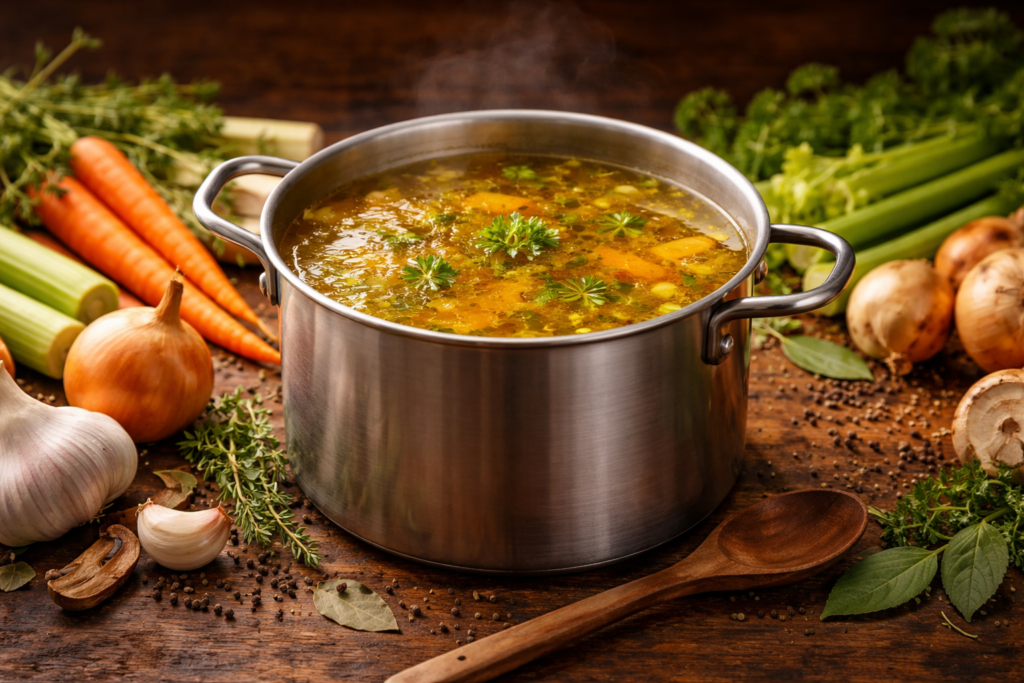
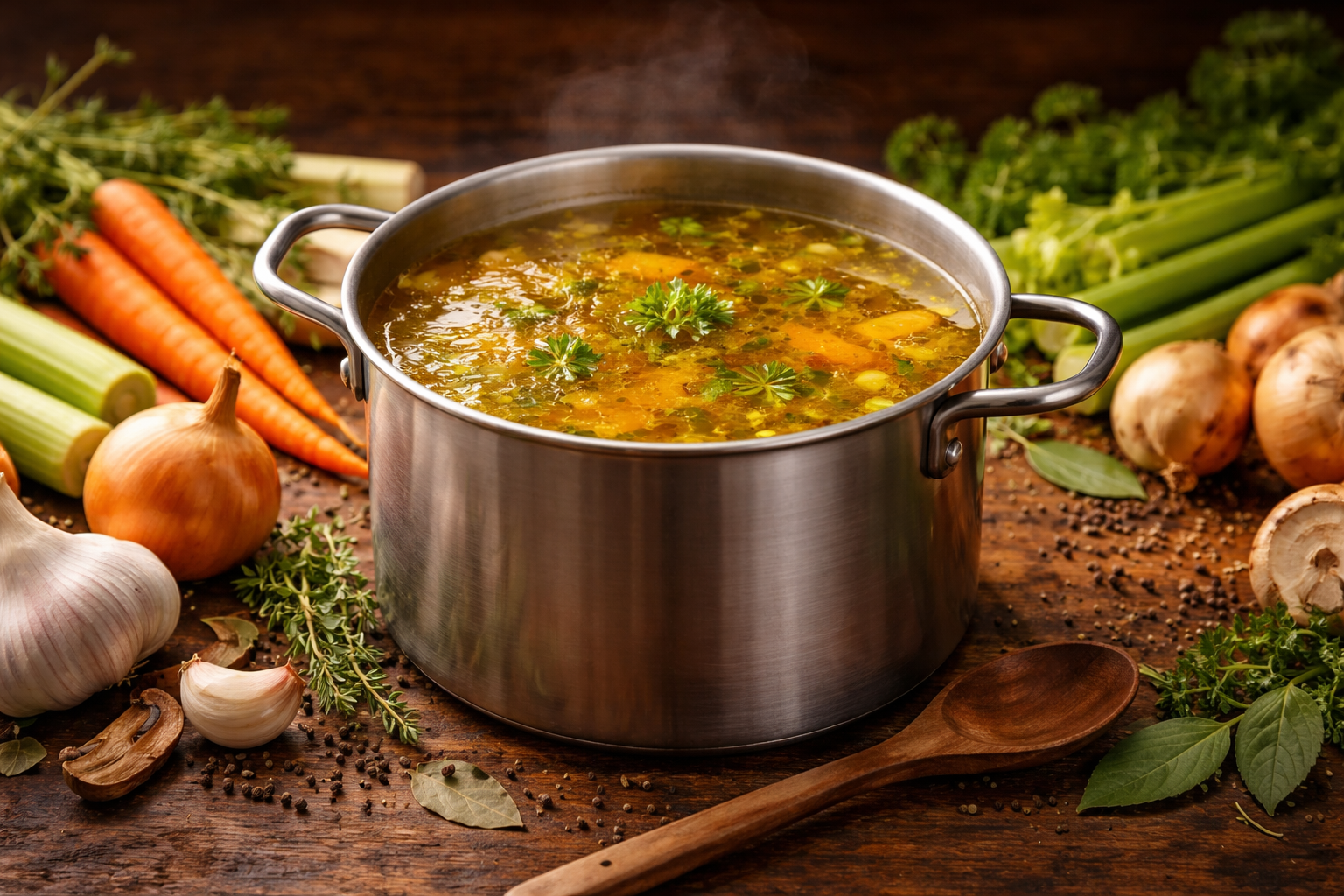
Vegetable broth is a study in extraction and balance—built not on bones or fat, but on the precise layering of aromatics, water content, and time. At its best, it delivers a clean, structured flavor profile: natural sweetness from alliums and carrots, vegetal depth from celery and leeks, and a subtle umami backbone often coaxed from mushrooms, tomato, or seaweed. The goal isn’t intensity for its own sake, but clarity—each component contributing without muddying the whole.
Technique matters. A gentle, controlled simmer preserves brightness and prevents bitterness, while careful ingredient selection avoids overly sulfuric or tannic notes (looking at you, overcooked brassicas). Properly made vegetable broth should taste full yet transparent, with a light body that supports rather than dominates.
Building flavor before the simmer
Building flavor starts before the water ever hits the pot. Taking the time to sweat or lightly roast your mirepoix—onions, carrots, celery—coaxes out their natural sugars and deepens the overall profile of the broth. Sautéing keeps things clean and controlled, enhancing sweetness without introducing bitterness, while roasting adds a more caramelized, slightly darker complexity. Neither is required, but both shift the final result from simply “vegetal” to intentionally layered.
The freezer scrap advantage
Vegetable broth is as much about resourcefulness as it is technique. A well-managed freezer scrap bag can produce a broth just as nuanced as one made from pristine ingredients. Onion skins, carrot peels, celery ends and interior leaves, leek or fennel tops, mushroom stems, herb stems—these aren’t scraps, they’re concentrated flavor.
Not all scraps are equal—and that’s where the nuance comes in. Onion skins deepen color and add subtle sweetness. Mushroom stems bring body and umami. Leek tops contribute a softer, greener allium note, while carrot peels reinforce sweetness. Even small additions can shift the profile. The goal isn’t to throw everything in—it’s to build something intentional from what you already have. The key is curation. Avoid anything overly bitter or sulfuric: brassicas like broccoli, cauliflower, and cabbage can quickly dominate; starchy vegetables like potatoes will cloud both texture and flavor; and overly sweet scraps, like large amounts of bell pepper, can throw off balance.
TIP: If it’s going into your scrap bag, it needs to be properly washed—no exceptions. Dirt and grit don’t cook out; they settle in. I thoroughly wash and dry all of my fruits and vegetables, typically when I bring them home from the grocery store. Taking the time to rinse and dry vegetables before trimming ensures that what you’re saving is flavor, not contamination.
Timing is key
When ingredients go into the pot matters just as much as what goes in. Hardy aromatics—onions, carrots, celery—can simmer from the start, building the foundation. More delicate elements should be added later to preserve their integrity.
Fresh herbs and tender scraps like parsley stems or thyme are best added in the last 5-10 minutes or steeped in the broth as it cools. The same goes for umami boosters like nori or kombu: powerful in small amounts, but easily overwhelming if left too long. Think of them as accents, not the base.
Straining
Once your broth has finished simmering, the final step is refinement. Remove it from heat and use a spider strainer ladle (or slotted spoon) to lift out the larger solids, allowing the liquid to settle for at least 10 minutes before straining. This initial rest helps separate suspended particles and makes for a cleaner pass through your strainer.
Set a mesh strainer over a clean stockpot and pour the broth through, discarding what’s filtered out. Set filtered broth aside and wash both the mesh strainer and the stockpot you initially used for simmering the broth. Line the clean strainer with dampened cheesecloth and strain broth again into clean stockpot. Wetting the cloth beforehand is key—it prevents absorption and preserves your yield. This second pass isn’t always necessary, but it’s the difference between a good broth and one with professional-level clarity.
Storage
From there, cooling becomes just as important as cooking. Let the broth cool slightly at room temperature, then transfer to the refrigerator to chill completely. This not only preserves freshness but also stabilizes the flavor.
In the refrigerator, vegetable broth will keep for about 4–5 days. For longer storage, freezing is the better option—and where a little foresight pays off. Portioning matters. Silicone freezer trays (like Souper Cubes) allow you to freeze broth in consistent, usable amounts. Always chill the broth fully before portioning, then freeze until solid and transfer the cubes to airtight freezer bags. This frees up your trays and gives you a ready supply of broth that can be used exactly as needed—whether that’s a full quart for soup or a small cube to build a pan sauce. Well-stored, frozen broth will hold its integrity for 3–5 months without sacrificing clarity or balance.
Recipes that use this broth
Homemade Vegetable Broth
Vegetable broth is a study in extraction and balance—built not on bones or fat, but on the precise layering of aromatics, water content, and time. At its best, it delivers a clean, structured flavor profile with natural sweetness, vegetal depth, and a subtle umami backbone.
Add 2 medium onions, 3 large carrots, 4 stalks celery, 2 tops leek (or fennel), and 5 cloves garlic to stockpot and lightly sauté.
TIP: You can substitute the onion, carrots, and celery for 4 cups of my Mirepoix recipe.
Once ingredient are slightly tender, add seasonings (bay leaves, salt, and peppercorns) and 12 cups of filtered cold water and slowly bring to a boil over medium-high heat.
Reduce heat to low and simmer gently, covered, for 1 hour.
Remove from heat and add fresh herbs (parsley & thyme) to stockpot.
Let the herbs steep while the broth cools for at least 10 minutes, then use a spider strainer ladle (or slotted spoon) to remove the larger solids to a mixing bowl.
Place a mesh strainer over an empty stock pot (large enough to hold the quantity of broth being poured in) and strain and discard what is filtered by the strainer.
TIP: If the mesh strainer let through small particles, clean the original (now empty) stockpot and mesh strainer; place clean mesh strainer over the clean stockpot and line with 2-4 layers of dampened cheese cloth (wetting it first will prevent the cloth from absorbing the broth); run the broth through the cheesecloth layers for an additional filtering.
Broth will keep in refrigerator for 4-5 days, or you can freeze the broth and store in the freezer for 3-5 months.
SEE NOTES SECTION FOR FREEZER STORAGE TIPS
Notes
NUTRITION NOTE: The nutritional values are for the fresh recipe ingredients listed on the card, but if you are like me, I make my vegetable broth using vegetable scraps I keep in the freezer. Six to seven (6-7) loosely-packed cups of scraps will do the trick, so long as the scraps contain the bulk of ingredients listed on the recipe card.FREEZER STORAGE NOTE: The best way to freeze broth is by utilizing silicone freezer trays, such as Souper Cubes. Make sure broth is completely chilled in the refrigerator before pouring into trays. Freeze broth cubes completely then transfer to airtight freezer bags so that you can free up and reuse the trays for other things.