






Member Features Save ingredients to your Stock, Shopping List, and Avoid List.
Sign In

All-Purpose Flour

Also known asplain flour

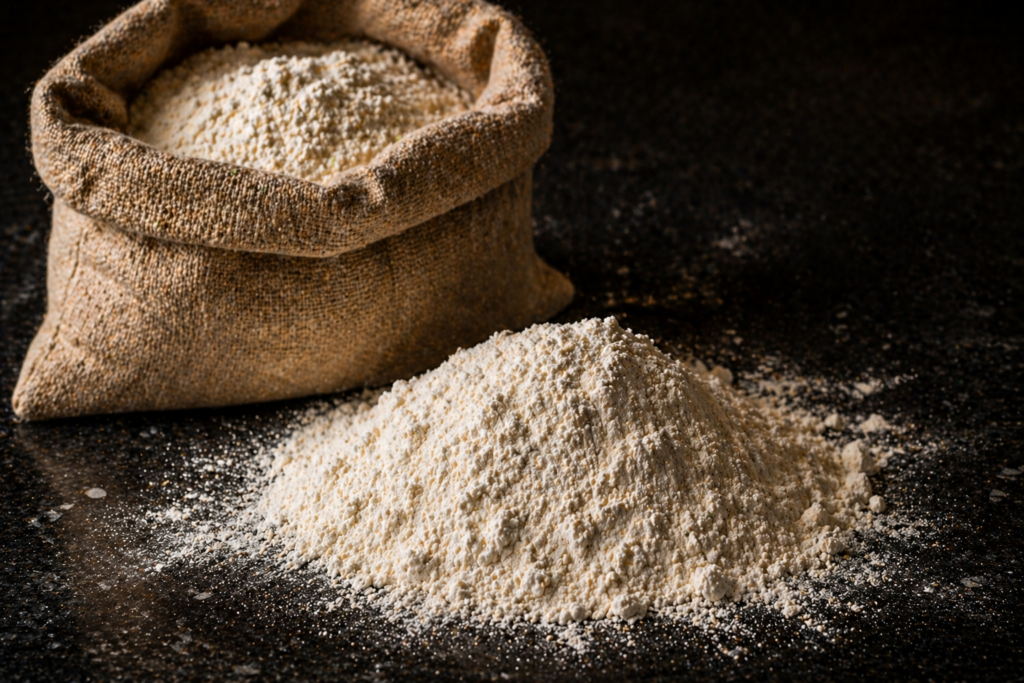
A milled wheat flour with moderate protein content, used for baking, thickening, breading, and general kitchen preparation.

About

All-purpose flour is the workhorse of the baking pantry, valued for its versatility and balance. Milled from wheat to a moderate protein level, it provides enough structure to support everything from tender cakes and cookies to biscuits, quick breads, and lightly structured doughs, without the strength of bread flour or the delicacy of cake flour.

Its adaptability makes it a reliable foundation across both baking and cooking. Beyond baked goods, it’s often used to thicken sauces, coat ingredients for frying, or create batters and breadings. Rather than excelling in one specific application, all-purpose flour succeeds by bridging many—offering consistency, structure, and flexibility wherever it’s used.

Flavor Profile

All-purpose flour has a mild, lightly wheaty flavor that reads as clean and neutral on its own. Its character is subtle rather than expressive, serving more as a foundation than a focal point. When exposed to heat, that softness deepens—developing a warmer, more rounded grain flavor with gently toasted notes that add depth without drawing attention away from the ingredients around it.

EARTHY


Texture Profile

SOFT
Culinary Use

All-purpose flour functions as a foundation across both baking and cooking, shaping structure while remaining largely in the background. In baking, it’s used to form doughs and batters, providing the balance needed for everything from tender cakes and cookies to biscuits and quick breads. In savory applications, it’s often used to dredge and bread proteins, creating a light coating that crisps when cooked.

It also plays a key role in thickening sauces and gravies, where it’s incorporated into roux or slurries to build body and consistency. Rather than defining a dish on its own, all-purpose flour supports and stabilizes, giving form to everything it touches.

Cooking Methods
Sautéed Quick cooking in a small amount of fat. Fried Submerged in hot oil (includes deep-frying and pan-frying). Baked Dry heat in an oven, typically at lower temperatures than roasting.

Prep Notes

Spoon and level for more accurate measuring, or weigh when precision matters. Sift only when a recipe needs extra lightness or even distribution.

Storage Notes

Store in a cool, dry place away from heat and humidity. Keep the container closed between uses to protect freshness and prevent pests.

Shelf Life

Unopened:
Follow package date.
Opened:
6–12 months when stored properly.

Storage Locations
Pantry General shelf-stable storage (dry, room temp). Cool, Dark Place A specific requirement for items sensitive to light/heat (like oils and potatoes).
Storage Methods
Airtight Container The gold standard for dry goods (flour, sugar, cereal) and leftovers to prevent staleness and pests. Keep Dry

Where to Buy

Shop this item online from trusted retailers.

Nutrition Facts Servings per container: ; Serving size: 100 g (100g) Amount per serving: Calories 1,530, Total Fat 1.5g, Sodium 2mg, Total Carbohydrate 77.3g, Protein 10.9g, Calcium 19mg, Iron 5.6mg, Potassium 136mg.
More nutrition
Soluble Fiber not listed, Insoluble Fiber not listed, Sugar Alcohols not listed, Net Carbs 77.3g, Thiamin (B1) 0.9mg, Riboflavin (B2) 0.4mg, Niacin (B3) 6.7mg, Vitamin B6 0.1mg, Folic Acid 160mcg, Phosphorus 108mg, Magnesium 26.7mg, Zinc 0.7mg, Selenium 15.7mcg, Copper 0.2mg, Manganese 0.8mg, Molybdenum 37.6mcg, Water 9.8g.
Nutrition information is estimated using USDA FoodData Central and other reference sources. Actual values may vary based on ingredient variety, preparation method, brand, ripeness, processing, and measurement accuracy.

come back again
Because our site features alcohol, you must be over 21 to enter
are you at least 21 yearold?