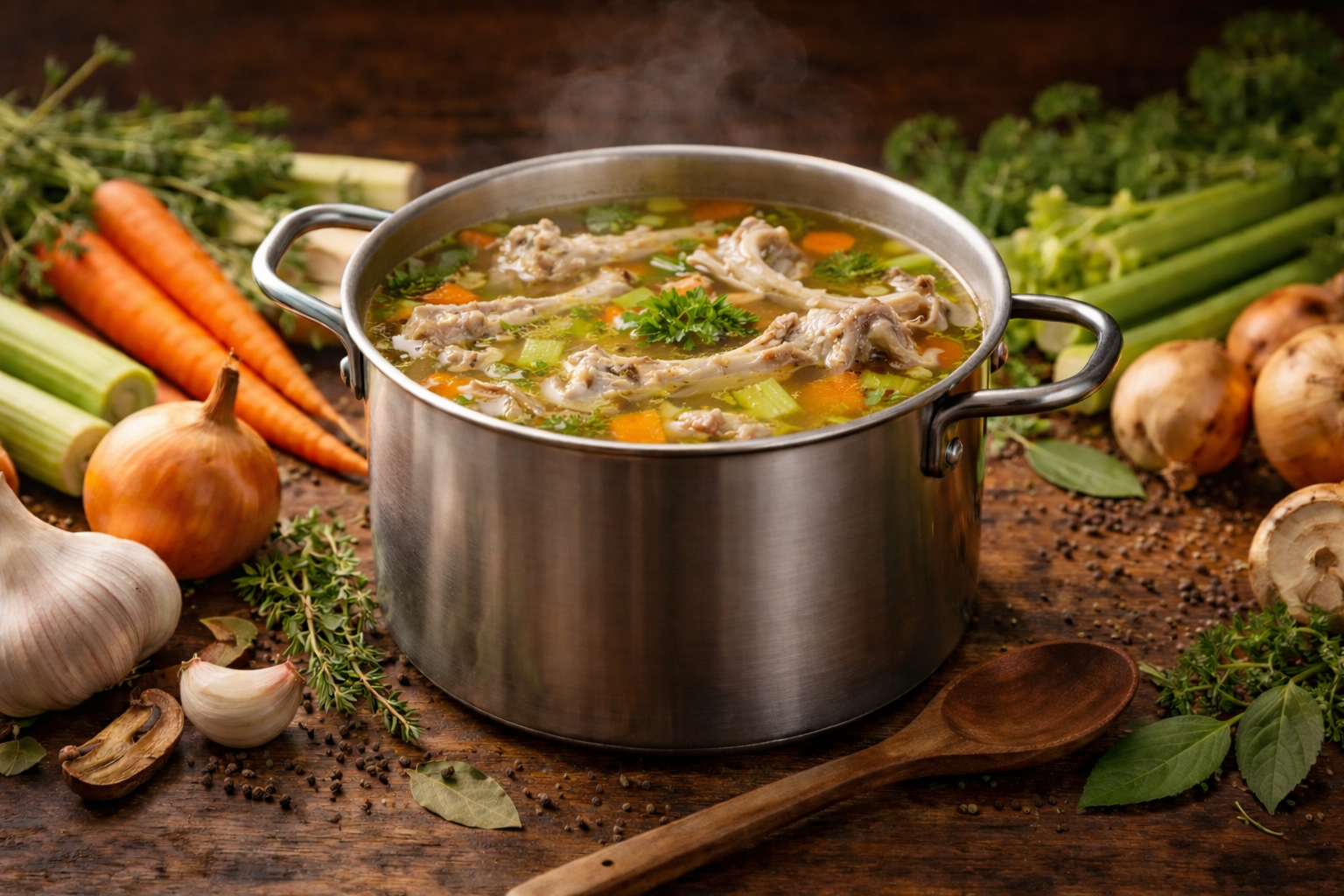
Homemade Chicken Stock

A base with weight

Chicken stock is a study in structure and extraction—where bones, connective tissue, and time work together to create depth that water alone can’t carry. As it simmers, collagen breaks down into gelatin, giving the liquid body and a natural richness that lingers without feeling heavy. Aromatics—onion, carrot, celery—round out the profile, adding subtle sweetness and balance, while herbs and peppercorns provide lift. The result isn’t just flavorful—it’s cohesive, with a quiet density that supports everything built on top of it.

Technique shapes the outcome. A slow, steady simmer keeps the stock clear and refined, allowing impurities to rise and be removed without agitation. Too much movement clouds both flavor and appearance; too little attention leaves behind muddled notes. Properly made chicken stock should be clean yet full, with a gentle viscosity that gives it presence without turning it dense or greasy.

Building depth before the simmer

Flavor begins long before the pot fills with water. Roasting bones and aromatics develops a deeper, more layered stock, introducing caramelization and a darker, more complex backbone. Leaving everything raw produces a lighter, more delicate result—cleaner in flavor, more restrained in color. Both approaches have their place. The choice isn’t about right or wrong, but about what you want the stock to carry forward.

Even within the pot, small decisions compound. A splash of acid helps draw out minerals and structure from the bones. The ratio of bones to water determines body. Time allows everything to settle into itself. None of these elements stand out individually, but together they define the final character.

Using what you have with intention

Chicken stock is as much about economy as it is craft. A well-kept freezer becomes part of the process—carcasses from roasted chickens, backs, wings, and necks saved over time, alongside a steady collection of vegetable trimmings. Onion ends and skins, carrot peels, celery tops and leaves, herb stems—each one held aside not as waste, but as future structure.

What matters is how they come together. Bones provide body and depth; vegetables shape and refine the flavor. Balance is what keeps the stock focused. Too many aromatics can blur the foundation, while overly assertive or sweet additions can pull it off center. The goal is restraint—building something cohesive from what you have, rather than everything you have. When approached this way, the stock carries both intention and efficiency, with nothing unnecessary left behind.

For a deeper breakdown of what belongs in that scrap bag—and what doesn’t—the same principles carry over from vegetable broth. Some vegetables build clean sweetness and depth; others introduce bitterness, sulfur, or muddiness that can throw the entire stock off balance. If you want to get more precise about what to save and what to leave out, the vegetable broth guide walks through those decisions in detail. The rules don’t change here—the bones may provide the structure, but the vegetables still determine how refined the final stock feels.

TIP: If it’s going into your scrap bag, it needs to be properly washed—no exceptions. Dirt and grit don’t cook out; they settle in. I thoroughly wash and dry all of my fruits and vegetables, typically when I bring them home from the grocery store. Taking the time to rinse and dry vegetables before trimming ensures that what you’re saving is flavor, not contamination.

Timing is key

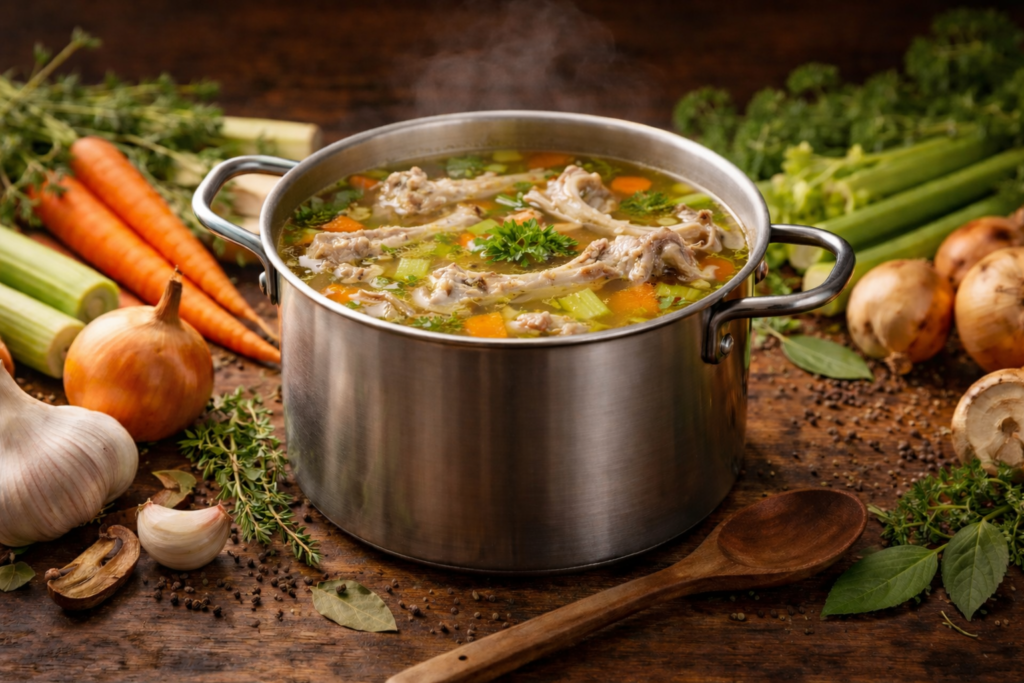
When ingredients go into the pot matters just as much as what goes in. Bones and hardy aromatics—onions, carrots, celery—belong at the start, where they have time to release structure and build the foundation. As the stock develops, fat rises, impurities surface, and the liquid begins to take on body. Managing that process—skimming as needed, maintaining a gentle simmer—keeps the flavor clean and the texture refined.

More delicate elements come later. Fresh herbs, garlic, or peppercorns can be added toward the end or steeped off-heat to preserve their character without dulling their edge. The same restraint applies to any additional flavoring—nothing should compete with the base that’s been slowly built. The goal is depth with clarity, not complexity for its own sake.

Straining

Once the stock has finished simmering, the focus shifts to refinement. Remove it from the heat and use a spider or slotted spoon to lift out bones and larger solids, then let the liquid rest undisturbed for at least 10–20 minutes. This step matters. It allows suspended particles to settle, giving you a cleaner, more controlled strain and a clearer final stock.

Pour the stock through a mesh strainer into a clean pot, discarding what’s left behind. For a more polished result, rinse the strainer, line it with dampened cheesecloth, and strain again. Wetting the cloth helps prevent unnecessary absorption and preserves yield. That second pass isn’t always required, but it brings a level of clarity that sets the stock apart—clean, cohesive, and free of distraction.

Storage

Cooling is part of the process, not an afterthought. Let the stock come down slightly at room temperature, then transfer it to the refrigerator to chill fully. As it cools, the gelatin sets and the fat rises, forming a layer that can be removed or reserved depending on how you plan to use it.

Refrigerated, chicken stock will keep for about 4–5 days. For longer storage, freezing offers more flexibility. Portioning into measured amounts—using silicone trays, like Souper Cubes—gives you control over how it’s used later, whether for a full pot of soup or a small addition to finish a sauce. Once frozen solid, transfer to airtight bags for storage. Properly handled, the stock maintains its structure and flavor for several months, ready to be brought back into whatever you’re building next.

Recipes that use this stock

Homemade Chicken Stock

Chicken stock is built on transformation—where structure comes from collagen, not just composition. As bones gently simmer, they release body and depth, giving the liquid a quiet weight that carries flavor rather than just holding it. Aromatics round the edges, but the foundation is what sets it apart: a subtle richness that coats the palate without feeling heavy.
At its best, chicken stock is clear, layered, and cohesive—savory without being overpowering, with a natural balance between warmth, depth, and lift. It doesn’t announce itself. It supports, reinforces, and connects, turning individual components into something that feels complete.
Print Pin Rate
Category: SIMMER
Cuisine: Global
Course: Soup
Keyword: Chicken, Stock, Vegetables
Prep: 20 minutes
Cook: 4 hours 30 minutes
Cooling Time: 20 minutes
Total: 5 hours 10 minutes
Servings: 8 servings
Calories: 63kcal
Author: TastyDaddy

Ingredients

Bones

Vegetables

Seasoning

Liquid

  • 12 cups filtered water

Herbs

Instructions

Roasting

  • Pre-heat oven to 450℉.
  • Place 2 whole chicken carcasses in large roasting pan.
  • TIP: The same approach doesn’t have to stop at chicken. Turkey bones—whether from a full roast or broken-down parts—can be used on their own or combined with chicken to create a more layered poultry stock. Turkey brings a slightly deeper, richer backbone, while chicken keeps the profile balanced and versatile. Treated the same way, the result shifts subtly in character without changing the technique—just a broader expression of the same foundation.
  • Toss 2 medium onions (washed, skins left on, quartered), 3 large carrots (coarsely chopped), 4 stalks celery(coarsely chopped), 2 tops leek (coarsely chopped), 5 whole garlic cloves (smashed) in 2 tbsp olive oil, salt, and pepper and place in roasting pan with the chicken bones.
  • TIP: You can substitute the onion, carrots, and celery for 4 cups of my Mirepoix recipe.
  • Roast for at least 30 minutes.

Simmering

  • Remove roasting pan from oven and transfer roasted vegetables, bones, and pan drippings into an 8-quart stockpot.
  • TIP: If you don’t want to manage the stovetop, a slow cooker offers a more hands-off approach. The steady, low heat naturally maintains the kind of gentle extraction stock benefits from, without the risk of over-agitation. Add everything to the pot, cover with water, and let it run on low for several hours or overnight. You’ll still want to skim early if needed, but beyond that, it largely takes care of itself—producing a stock that’s just as cohesive, with less active attention.
  • Add seasonings (3 whole bay leaves, 2 tsp sea salt, and 1 tbsp peppercorns) and 12 cups filtered water (cold) and slowly bring to a boil over medium-high heat.
  • Reduce heat to low and simmer gently, covered, for 4 hours.
  • Remove from heat and add fresh herbs (¼ cup parsley & ¼ cup thyme) to stockpot.
  • Let the herbs steep while the broth cools for at least 20 minutes, then use a spider strainer ladle (or slotted spoon) to remove the larger solids to a mixing bowl.

Straining

  • Place a mesh strainer over an empty stock pot (large enough to hold the quantity of broth being poured in) and strain and discard what is filtered by the strainer.
  • TIP: If the mesh strainer let through small particles, clean the original (now empty) stockpot and mesh strainer; place clean mesh strainer over the clean stockpot and line with 2-4 layers of dampened cheese cloth (wetting it first will prevent the cloth from absorbing the broth); run the broth through the cheesecloth layers for an additional filtering.

Storing

  • Broth will keep in refrigerator for 4-5 days, or you can freeze the broth and store in the freezer for 3-5 months.
  • SEE NOTES SECTION FOR FREEZER STORAGE TIPS

Notes

NUTRITION NOTE: The nutritional values are for the fresh recipe ingredients listed on the card, but if you are like me, I make my stock using vegetable scraps I keep in the freezer. Six to seven (6-7) loosely-packed cups of scraps will do the trick, so long as the scraps contain the bulk of ingredients listed on the recipe card.
FREEZER STORAGE NOTE: The best way to freeze broth is by utilizing silicone freezer trays, such as Souper Cubes. Make sure broth is completely chilled in the refrigerator before pouring into trays. Freeze broth cubes completely then transfer to airtight freezer bags so that you can free up and reuse the trays for other things.

Nutrition

Calories: 63kcal | Carbohydrates: 8g | Protein: 1g | Fat: 4g | Saturated Fat: 1g | Polyunsaturated Fat: 0.4g | Monounsaturated Fat: 3g | Sodium: 637mg | Potassium: 219mg | Fiber: 2g | Sugar: 3g | Vitamin A: 4860IU | Vitamin C: 9mg | Calcium: 53mg | Iron: 1mg
come back again
Because our site features alcohol, you must be over 21 to enter
are you at least 21 yearold?