








Member Features Save ingredients to your Stock, Shopping List, and Avoid List.
Sign In

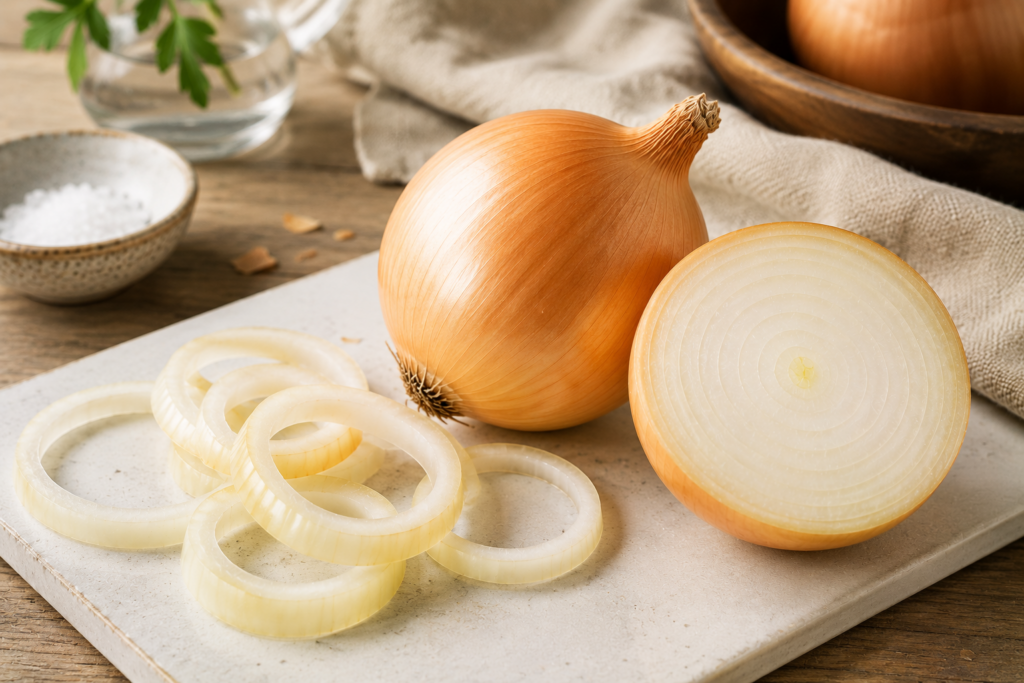
Yellow Onion (/ˈjɛ.loʊ ˈʌn.jən/)

Allium cepa
Also known asAll-Purpose Onion, Brown Onion, Cooking Onion

A versatile all-purpose onion variety known for its balanced pungency, savory depth, and natural sweetness when cooked. Yellow onions are the standard foundation onion used in countless savory dishes worldwide.

Parent:Onion
About

Yellow onions are the backbone of savory cooking. Their balance of pungency, sweetness, moisture, and aromatic depth makes them one of the most versatile ingredients in the kitchen and the default onion called for in countless recipes.

Used in everything from soups and stews to stocks, sauces, braises, roasts, stir-fries, and sautés, yellow onions are especially valued for how dramatically they transform with heat. Raw, they are assertive and sulfurous. Cooked slowly, they become mellow, rich, sweet, and deeply savory.

Their moderate sugar content makes them ideal for caramelization, while their layered structure allows them to disappear into long-cooked dishes or remain pleasantly tender in quicker preparations. This adaptability is one of the reasons yellow onions appear so consistently across global cuisines.

Though other onion varieties may be preferred for specific applications—such as red onions for raw dishes or white onions for sharper freshness—yellow onions remain the quintessential all-purpose cooking onion for foundational savory flavor.

Flavor Profile

Yellow onions strike one of the most balanced flavor profiles among common onion varieties. Raw, they are sharp, sulfurous, earthy, and moderately pungent with enough bite to stand out without becoming overwhelmingly aggressive.

As they cook, yellow onions undergo a dramatic transformation. Their sulfur compounds mellow while natural sugars intensify, creating deep savory sweetness and rich aromatic complexity. Long cooking develops jammy, caramelized flavors with subtle nutty and umami-like qualities.

Because of this balance between sharpness and sweetness, yellow onions are considered the standard all-purpose cooking onion in many Western kitchens.

SWEET
UMAMI
EARTHY
BRIGHT
PUNGENT

Texture Profile

Raw yellow onions are crisp, juicy, and tightly layered with a firm bite that softens gradually during cooking.

When sautéed or sweated, they become tender and silky while retaining body. With extended cooking, yellow onions collapse into soft, jammy strands that blend seamlessly into soups, sauces, braises, and caramelized preparations.

CRUNCHY
TENDER
SOFT
JUICY
Culinary Use

Yellow onions are used across nearly every category of savory cooking. They form the aromatic base for soups, stews, sauces, braises, gravies, stocks, rice dishes, pasta dishes, roasted vegetables, stuffing mixtures, and countless sautéed preparations.

They are especially prized for caramelization, where slow cooking transforms them into deeply sweet, savory, jammy strands with rich complexity.

Yellow onions are also widely diced into mirepoix, sofrito, and other foundational aromatic mixtures alongside ingredients like celery, carrots, garlic, peppers, or herbs. Their balanced flavor allows them to support dishes without overpowering surrounding ingredients.

Cooking Methods
Raw No heat applied. Sautéed Quick cooking in a small amount of fat. Roasted Slow, dry heat in an oven for browning. Grilled Direct heat (usually from below) for char and smokiness. Braised Searing followed by slow cooking in a small amount of liquid. Fried Submerged in hot oil (includes deep-frying and pan-frying). Blanched Briefly boiled then "shocked" in ice water to preserve color and snap. Steamed Cooking with hot vapor to retain nutrients and moisture. Simmered Gentle cooking in liquid just below the boiling point. Baked Dry heat in an oven, typically at lower temperatures than roasting. Broiled Intense direct heat from above. Poached Gently cooked in hot liquid. Seared High-heat browning of the surface. Stewed Slow cooking small pieces fully submerged in liquid. Air Fried High-speed convection to mimic frying with minimal oil.
Best Uses
Aromatic Bases & Simmers Sauces & Gravies Braised Dishes Grilled Dishes Pasta Dishes Rice & Grain Dishes Roasted Dishes Sandwiches & Wraps Soups & Stews Stir-Fries Stuffings & Fillings Sautés Breakfast Dishes

Prep Notes

Keep the root end partially intact while slicing or dicing to help stabilize the onion during prep. A sharp knife minimizes crushing and reduces excessive juice release.

Fine dice works best for soups, sauces, and aromatic cooking bases, while wedges and thicker slices hold up better during roasting, grilling, and braising.

Trimming & Cutting Notes

Trim the stem and root ends before removing the papery outer skin. Remove any bruised, slimy, softened, or sprouted outer layers before use.

For diced onion, leave the root intact and make horizontal and vertical cuts before slicing downward across the grain.

Safety Notes

Yellow onions release sulfur compounds when cut that may irritate the eyes and cause tearing. Using a sharp knife and maintaining good airflow can help minimize irritation.

Storage Notes

Store whole yellow onions in a cool, dark, dry place with good ventilation. Avoid refrigeration for whole onions whenever possible, as excess moisture can accelerate spoilage and softening. Once cut, refrigerate in an airtight container and use within several days for best flavor and texture.

IMPORTANT: Keep onions separate from potatoes, which can shorten their storage life. Once cut, refrigerate in an airtight container.

Freezer Friendly

Yellow onions freeze exceptionally well for cooked applications. Dice or slice before freezing for easier portioning and faster cooking later.

After thawing, the texture softens significantly, making frozen onions best suited for soups, sauces, sautés, braises, and other cooked dishes rather than raw preparations.

Shelf Life

Whole yellow onions can last several weeks to months when stored properly in cool, dry, ventilated conditions.

Cut onions should generally be used within several days when refrigerated in airtight storage.

Spoilage Signs

Discard yellow onions that feel soft, hollow, slimy, moldy, excessively sprouted, or emit sour or fermented odors. Darkened inner layers and moisture buildup near the root are also indicators of spoilage.

Storage Locations
Pantry General shelf-stable storage (dry, room temp). Refrigerator Standard cold storage for perishables. Freezer Long-term sub-zero storage. Cool, Dark Place A specific requirement for items sensitive to light/heat (like oils and potatoes). Hanging / Tiered Baskets Vertical storage for high-ventilation items (onions, garlic).
Storage Methods
Airtight Container The gold standard for dry goods (flour, sugar, cereal) and leftovers to prevent staleness and pests. Mesh / Perforated Bag Allows maximum airflow for dry produce like onions and citrus. Loose / Open No packaging at all; sitting directly on a shelf or counter (best for whole apples or squash). Keep Dry

Did You Know

Yellow onions contain enough natural sugar to caramelize deeply without additional sweeteners, which is why they are the preferred onion for French onion soup and many long-cooked savory dishes.

Buying Tips

Choose yellow onions that feel heavy, dense, and firm with dry, papery skin and no soft spots. Avoid onions with moisture around the neck, visible mold, sprouting, or wrinkled outer layers.

Seasonal Notes

Yellow onions are available year-round, though storage onions are typically harvested in late summer and autumn before being cured for long-term storage and distribution.

Cultural Notes

Yellow onions are foundational to countless culinary traditions around the world and are especially central to French, American, European, Cajun, and comfort-food cooking where long-cooked savory depth is essential.

Where to Buy

Shop this item online from trusted retailers.

Nutrition Facts Servings per container: ; Serving size: 100 g (100g) Amount per serving: Calories 38, Total Fat 0.1g, Saturated Fat 0.0g, Trans Fat 0g, Cholesterol 0mg, Sodium 1mg, Total Carbohydrate 8.6g, Dietary Fiber 1.9g, Total Sugars 4.2g, Protein 0.8g, Vitamin D 0mcg, Calcium 15mg, Iron 0.3mg, Potassium 182mg.
More nutrition
Polyunsaturated Fat 0.0g, Monounsaturated Fat 0.0g, Soluble Fiber not listed, Insoluble Fiber not listed, Sugar Alcohols not listed, Net Carbs 6.7g, Vitamin A 0mcg RAE, Vitamin C 8.2mg, Vitamin E 0.0mg, Vitamin K 0.4mcg, Thiamin (B1) 0.0mg, Riboflavin (B2) 0.0mg, Niacin (B3) 0.1mg, Vitamin B6 0.1mg, Folate 19mcg DFE, Folic Acid 19mcg, Vitamin B12 0mcg, Biotin 0mcg, Pantothenic Acid 0.1mg, Phosphorus 34mg, Iodine 0mcg, Magnesium 9mg, Zinc 0.2mg, Selenium 0mcg, Copper 0.0mg, Manganese 0.1mg, Caffeine 0mg, Alcohol 0g, Water 90.1g.
Nutrition information is estimated using USDA FoodData Central and other reference sources. Actual values may vary based on ingredient variety, preparation method, brand, ripeness, processing, and measurement accuracy.

come back again
Because our site features alcohol, you must be over 21 to enter
are you at least 21 yearold?