American Chop Suey is one of those dishes where the name carries more history than the plate suggests. The term chop suey comes out of Chinese American cooking in the late 19th and early 20th centuries—often used to describe a mixed dish built from whatever ingredients were on hand. As it gained popularity in cities like New York and San Francisco, the name began to drift beyond its original context. Home cooks adopted it more loosely, applying it to one-pot meals that followed the same idea: combine what you have, cook it together, and make it feed a table.
Over time—especially in the Northeast—that concept took on a different identity, shaped by Italian-American kitchens and American home cooking. The ingredients shifted to tomato, pasta, and ground meat, but the underlying idea stayed the same. What remained wasn’t the cuisine—it was the structure: a cohesive, mixed dish built from simple components and made to satisfy.
How It Changes by Region
Because the dish was never standardized, it evolved differently depending on where it landed:
American Chop Suey (New England): Tomato-forward, often a bit looser, closer to a saucy pasta.
American Goulash (Midwest): Thicker, more concentrated, sometimes heavier on seasoning.
Beefaroni (Italian-American, general NE United States): A simpler, more streamlined stovetop version—ground beef and pasta in a smoother tomato sauce, typically with fewer vegetables and a more uniform consistency, reflecting Italian-American red sauce influence.
Johnny Marzetti (Ohio Valley): Often baked, occasionally layered, and more likely to incorporate cheese from the start.
Slumgullion (Upper Midwest and Western US): A more rustic, frontier-style version—often simpler, looser, and highly adaptable, sometimes stretching ingredients further with extra liquid or fewer aromatics.
Same foundation—different expressions shaped by local kitchens.
Building This Version
This version leans into control—treating each component with intention so the final dish holds together instead of blending into something indistinct. The base starts with onion and green bell pepper—standard aromatics for this dish. Celery isn’t traditional, but it’s part of how I grew up eating it. It adds a subtle vegetal depth and texture that carries through the sauce. In our kitchen, it was always around—either from the store in the off-season or pulled straight from the garden—so it became part of the build.
Garlic follows, just enough to bloom. Then the meat. Ground beef forms the base, but Italian sausage—sweet, mild, or hot—can be added depending on how you want to shape the flavor. Sweet or mild sausage rounds things out and leans more classic. Hot sausage adds heat and a sharper edge that cuts through the richness.
The Sauce: Flexible by Design
The sauce is layered to control both texture and balance:
Diced tomatoes for structure
Tomato soup for body and built-in richness
Passata for smoothness
Tomato paste for depth
Beef stock to add liquid for the final pasta cook and to bring it all together
There’s room to move here. A can of diced tomatoes with green chilis adds a subtle heat and brightness. Fresh garden tomatoes—when available—bring a cleaner, more natural acidity and a lighter texture that shifts the entire feel of the dish. I grew up seeing a spoonful of sugar added to cut through the sharpness of stewed tomatoes.
Instead, this version balances that same idea at the source—using a combination of passata and tomato soup. The soup leans slightly sweeter and richer, which softens the acidity and creates a smoother, more velvety base—especially once everything comes together with the cheese.
Why the Pasta Is Soaked, Not Boiled
Traditionally, this dish is made with elbow macaroni—and it works. But for leftovers, it tends to soften too much. Cavatappi or mini penne hold their shape better, giving the dish more structure even after it’s been refrigerated and reheated. My family would probably give me a strange look with this step, but instead of cooking the pasta separately (like I’d learned), I now soak my pasta in hot water and finish cooking it directly in the sauce later.
That shift does two things:
The pasta absorbs the flavor of the sauce as it finishes cooking.
The reserved soaking water introduces starch that helps bind everything together. It’s not optional, regardless of cooking before or soaking—it’s what tightens the sauce so it clings to the pasta instead of sitting around it.
The Velveeta Adjustment
Cheese isn’t part of the traditional New England version I grew up with, but during my time in Michigan, it was a common addition—usually shredded and mixed in or layered through. The problem was consistency. Shredded cheese tends to go stringy, and once it cools, it can separate or settle, leaving the bottom of the pot coated in congealed cheese.
Velveeta solves that. It melts cleanly into the sauce, creating a smooth, cohesive finish without turning the dish into something heavy or overly cheesy. Combined with the slightly sweeter, more rounded tomato soup base, it creates a texture that feels unified from edge to edge without separation.
Final Thoughts
American Chop Suey was never meant to be exact. It’s a dish shaped by what’s available, what’s familiar, and what works. The name comes from one place, the ingredients from another, and the method from somewhere in between. Handled with intention, it becomes something structured—balanced, consistent, and built to hold together from the first bite to the last.
You’ll find the full method outlined below, step by step—but the key is in how each stage builds on the last. From properly softening the aromatics, to layering the sauce, to finishing the pasta directly in the pot, each move is designed to control texture and consistency rather than leaving it to chance.
American Chop Suey
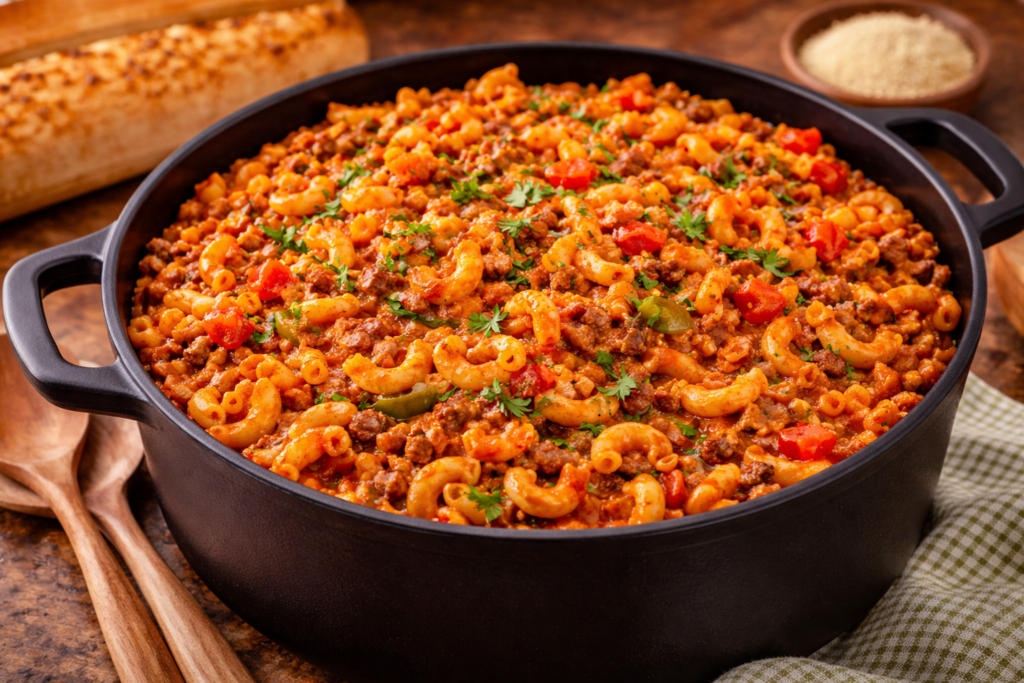
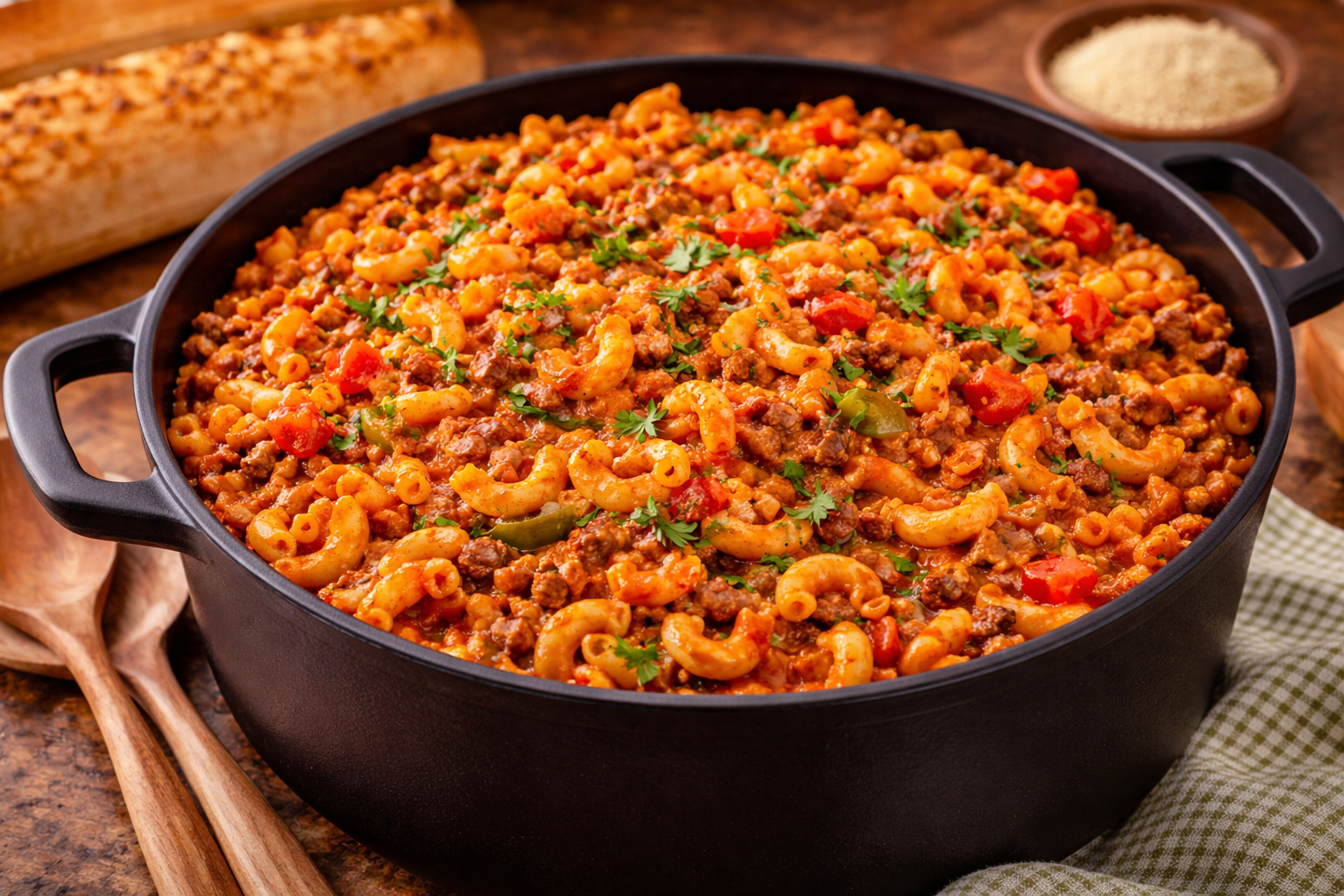
American Chop Suey is a one-pot classic built on simplicity done well—elbow macaroni folded into a savory tomato and beef sauce with softened onions, peppers, celery, and garlic. It’s hearty without being heavy, balancing acidity from the tomatoes with the richness of the meat, while a touch of Velveeta melts in to give the sauce a smoother, more cohesive finish.The result is a dish that eats like comfort but holds its structure—sauce clinging to every curve of pasta, each bite consistent from start to finish. Depending on where you are, you might hear it called American Goulash, Johnny Marzetti, or something similar, but the foundation stays the same: familiar, unfussy, and built to satisfy.
Thoroughly wash and dry green pepper, celery, onion, garlic, and parsley.
Soak the Pasta
Instead of cooking the pasta (as most recipes call for), I soak my pasta in hot water for about 20 minutes—while I prepare the rest of the ingredients—and finish cooking it in the sauce later.
The traditional recipe calls for elbow macaroni, but you can use other tubular pasta. I like to use cavatappi or mini penne (because they hold up better for leftovers).
Cut the Vegetables
With the butcher block and chef's knife, dice 1 large yellow onion and set aside in prep bowl.
Chop 2 stalks celery and set aside in prep bowl.
Dice 1 whole green bell pepper and set aside in prep bowl.
Mince 2 cloves garlic and set aside in prep bowl.
Trim stems off parsley and coarsely chop leaves, enough to fill ¼ cup.
Cook Vegetables
Heat Dutch oven over medium high heat and melt 2 tbsp butter.
Add diced onion, diced green pepper, and chopped celery to Dutch oven and cook until tender.
Add minced garlic to Dutch oven and brown for 1-2 minutes.
Remove cooked vegetables from pan and set aside in mixing bowl.
Brown Meat
Add 1 lb ground beef to Dutch oven and season with 1 tbsp Kosher salt, ½ tsp black pepper, 1 tsp dried oregano, 1 tsp dried basil, 1 tsp onion powder, 1 tsp paprika, and 1 tsp celery seed directly in pan.
If you'd like to make the dish a bit more hearty, add the optional 1 lb ground sausage.
Once meat is browned, drain excess fat.
Return meat to pan and add 1 tbsp Worcestershire sauce, stirring to combine.
The Sauce
Return veggies back to pan.
Empty 14 oz diced tomatoes (undrained) to pan; stir to combine
If you would like to add a little kick to the dish, substitute the plain diced tomatoes with a can mixed with green chilis instead.
Add 10.75 oz tomato soup, 10 oz passata (or tomato sauce), 6 oz tomato paste, and 2-3 cups beef stock; stir to combine and bring to a boil.
Add Pasta
While sauce is heating to a boil, reserve 1 cup of pasta soaking water; set aside.
Strain pasta with colander.
Once pot has started to boil, add pre-soaked pasta and reserved pasta water to pot and stir to combine.
Cover with lid and let pasta simmer for 5-7 minutes (or until desired tenderness).
Cheese
While pasta is cooking, cut 12 oz Velveeta cheese into cubes (so that it will melt easier).
Once pasta has finished cooking, add Velveeta cheese cubes to pot and stir until combined.
Serve
Garnish each serving with grated parmesan cheese and freshly-chopped parsley.