











Member Features Save ingredients to your Stock, Shopping List, and Avoid List.
Sign In

Shallot (/ˈʃælət/)

Allium cepa var. aggregatum
Also known asFrench Shallot, True Shallot, Echalote

A small allium prized for its mild onion flavor, subtle garlic notes, and natural sweetness. Shallots are valued for their ability to provide aromatic depth without the sharp intensity of larger onions.

About

Shallots occupy a unique position within the allium family, offering a flavor profile that combines the sweetness of onions with the aromatic complexity of garlic. Their smaller size, delicate texture, and balanced flavor have made them indispensable in many professional kitchens and culinary traditions around the world.

Particularly associated with French cuisine, shallots are widely used in vinaigrettes, pan sauces, compound butters, reductions, and seafood dishes where a full-sized onion would be too assertive. Their ability to provide depth without dominating a dish makes them exceptionally versatile.

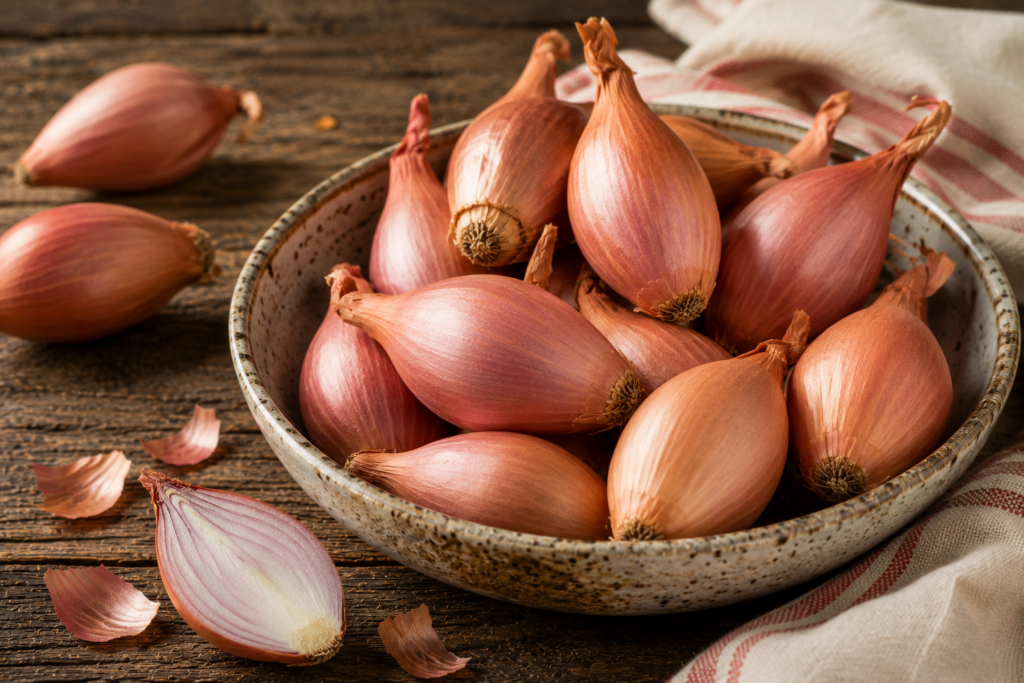
Unlike larger bulb onions, shallots typically grow in clusters of multiple bulbs. Their papery skins range from coppery tan to reddish-purple depending on the variety, while their flesh tends to be pale purple, pink, or off-white.

Whether minced raw into dressings, caramelized into sauces, or gently sautéed into aromatic foundations, shallots contribute elegance, balance, and complexity to countless savory dishes.

Flavor Profile

Shallots offer a refined balance of sweetness, mild pungency, and aromatic depth that falls somewhere between onion and garlic. Their flavor is noticeably gentler than most onions, with fewer aggressive sulfur notes and a subtle savory complexity that makes them especially popular in sauces and fine dining applications.

Raw shallots possess a delicate sharpness and slight sweetness that works beautifully in vinaigrettes, dressings, relishes, and uncooked garnishes. When cooked, their flavor becomes mellow, buttery, and lightly sweet while retaining enough aromatic character to remain noticeable without overwhelming surrounding ingredients.

Compared to yellow onions, shallots are less assertive, less sulfurous, and more elegant in flavor, making them a favorite when subtlety is desired.

SWEET
UMAMI
EARTHY
PUNGENT

Texture Profile

Raw shallots are crisp, juicy, and finely layered with a texture similar to onions but on a smaller scale.

As they cook, shallots soften rapidly into silky, tender pieces that integrate seamlessly into sauces, soups, braises, and sautéed preparations. Their relatively small cell structure allows them to break down more quickly than larger onions while contributing smooth texture and aromatic depth.

CRUNCHY
TENDER
SOFT
JUICY
Culinary Use

Shallots are commonly minced, sliced, diced, or finely grated into sauces, vinaigrettes, dressings, marinades, compound butters, pan sauces, and seafood preparations.

They are especially popular in French cooking, where they frequently appear in reductions, beurre blanc, mignonette sauces, and classic vinaigrettes. Their delicate flavor also complements poultry, fish, shellfish, mushrooms, eggs, potatoes, and fresh herbs.

Raw shallots are often preferred over onions in dressings and uncooked preparations because of their milder flavor and lower sulfur intensity.

Cooking Methods
Raw No heat applied. Sautéed Quick cooking in a small amount of fat. Roasted Slow, dry heat in an oven for browning. Grilled Direct heat (usually from below) for char and smokiness. Braised Searing followed by slow cooking in a small amount of liquid. Fried Submerged in hot oil (includes deep-frying and pan-frying). Simmered Gentle cooking in liquid just below the boiling point. Baked Dry heat in an oven, typically at lower temperatures than roasting. Seared High-heat browning of the surface. Air Fried High-speed convection to mimic frying with minimal oil.
Best Uses
Aromatic Bases & Simmers Dressings & Vinaigrettes Marinades Sauces & Gravies Spice Blends & Rubs Stocks & Broths Braised Dishes Grilled Dishes Pasta Dishes Rice & Grain Dishes Roasted Dishes Soups & Stews Stir-Fries Stuffings & Fillings Garnishes Sautés

Prep Notes

Peel away the papery outer skin before slicing or dicing. Because shallots are smaller than onions, a sharp knife helps maintain clean cuts and minimize bruising.

Fine mincing is especially useful in vinaigrettes, pan sauces, and dressings where texture should remain subtle and evenly distributed.

Trimming & Cutting Notes

Trim the root and stem ends before removing the outer skin. Discard any dried, softened, sprouted, or damaged layers before use.

Large shallots may naturally separate into multiple lobes that can be used individually.

Storage Notes

Store whole shallots in a cool, dry, dark location with good airflow. Avoid excessive humidity, which can accelerate sprouting and spoilage.

Once cut, refrigerate in an airtight container and use within several days for best quality.

Freezer Friendly

Shallots freeze well for cooked applications. Dice or slice before freezing for convenient future use.

Like onions, thawed shallots lose much of their crisp texture and are best reserved for soups, sauces, braises, and sautéed dishes.

Shelf Life

Whole shallots can last several weeks to months when stored properly in cool, dry, ventilated conditions.

Cut shallots should generally be used within several days when refrigerated.

Spoilage Signs

Discard shallots that become soft, slimy, moldy, hollow, excessively sprouted, or develop sour odors. Darkened flesh and moisture accumulation beneath the skin are also signs of deterioration.

Storage Locations
Pantry General shelf-stable storage (dry, room temp). Refrigerator Standard cold storage for perishables. Freezer Long-term sub-zero storage. Cool, Dark Place A specific requirement for items sensitive to light/heat (like oils and potatoes). Hanging / Tiered Baskets Vertical storage for high-ventilation items (onions, garlic).
Storage Methods
Airtight Container The gold standard for dry goods (flour, sugar, cereal) and leftovers to prevent staleness and pests. Mesh / Perforated Bag Allows maximum airflow for dry produce like onions and citrus. Loose / Open No packaging at all; sitting directly on a shelf or counter (best for whole apples or squash).

Did You Know

Many classic French sauces rely on shallots rather than onions because their lower sulfur content and natural sweetness create a more delicate and balanced flavor profile.

Buying Tips

Choose shallots that feel firm, dense, and heavy for their size with dry, intact skins. Avoid bulbs that show signs of softness, sprouting, mold, or moisture accumulation.

Seasonal Notes

Shallots are typically harvested from late summer into early autumn and store exceptionally well, making them widely available throughout the year.

Cultural Notes

Shallots are especially important in French, Southeast Asian, and Middle Eastern cuisines, where their delicate flavor is used to build complexity without overwhelming a dish. They are widely regarded as one of the most versatile and refined members of the allium family.

Where to Buy

Shop this item online from trusted retailers.

Nutrition Facts Servings per container: ; Serving size: 100 g (100g) Amount per serving: Calories 301, Total Fat 0.1g, Saturated Fat 0.0g, Trans Fat 0g, Cholesterol 0mg, Sodium 12mg, Total Carbohydrate 16.8g, Dietary Fiber 3.2g, Total Sugars 7.9g, Protein 2.5g, Vitamin D 0mcg, Calcium 37mg, Iron 1.2mg, Potassium 334mg.
More nutrition
Polyunsaturated Fat 0.0g, Monounsaturated Fat 0.0g, Soluble Fiber not listed, Insoluble Fiber not listed, Sugar Alcohols not listed, Net Carbs 13.6g, Vitamin A 0mcg RAE, Vitamin C 8mg, Vitamin E 0.0mg, Vitamin K 0.8mcg, Thiamin (B1) 0.1mg, Riboflavin (B2) 0.0mg, Niacin (B3) 0.2mg, Vitamin B6 0.3mg, Folate 34mcg DFE, Folic Acid 34mcg, Vitamin B12 0mcg, Pantothenic Acid 0.3mg, Phosphorus 60mg, Magnesium 21mg, Zinc 0.4mg, Selenium 1.2mcg, Copper 0.1mg, Manganese 0.3mg, Caffeine 0mg, Alcohol 0g, Water 79.8g.
Nutrition information is estimated using USDA FoodData Central and other reference sources. Actual values may vary based on ingredient variety, preparation method, brand, ripeness, processing, and measurement accuracy.

come back again
Because our site features alcohol, you must be over 21 to enter
are you at least 21 yearold?