
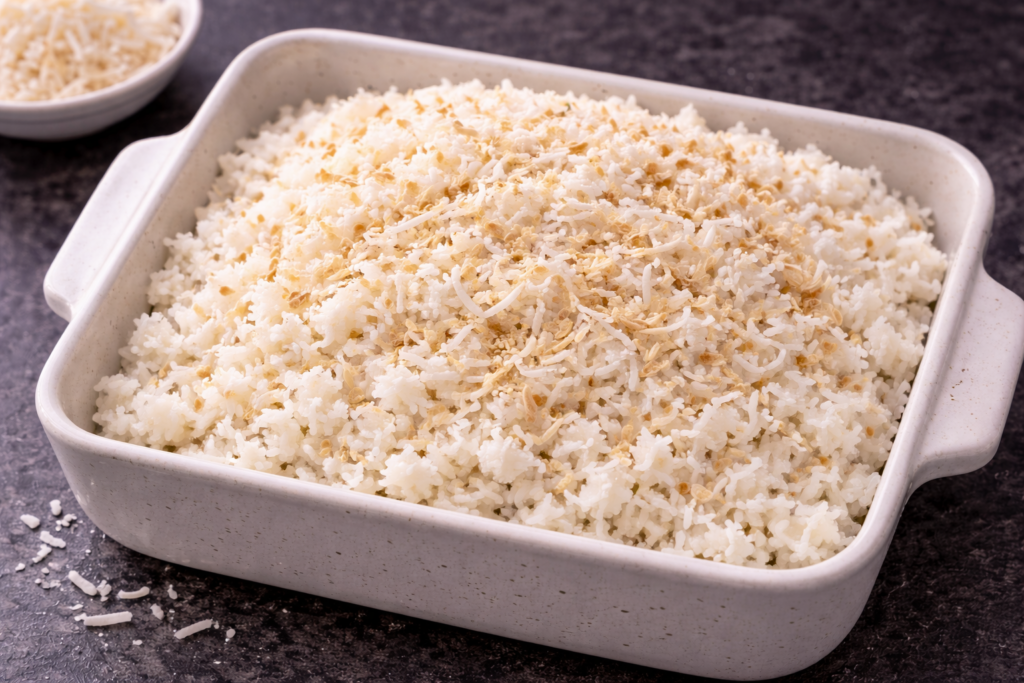
Tender jasmine rice baked in coconut milk until perfectly fluffy and fragrant. This simple oven method creates consistently perfect coconut rice without the need to babysit a pot on the stove.
Perfect Oven-Baked Coconut Rice
Tender jasmine rice baked in coconut milk until perfectly fluffy and fragrant. This simple oven method creates consistently perfect coconut rice without the need to babysit a pot on the stove.
Print
Pin
Servings: 4 servings
Calories: 546kcal
Equipment
- 4-in-1 strainer (or mesh collander)
Ingredients
- 2 cups jasmine rice
- 14 oz coconut milk
- 1 cup water
- 4 tsp coconut palm sugar
- ½ tsp Kosher salt
Instructions
Rinsing & Soaking Rice
- Using a 4-in-1 strainer, rinse 2 cups jasmine rice until nearly clear. This step removes excess starch that typically coats the grains, which would make the rice on the sticky/clumpy side when cooked with the coconut milk.
- Once rinsed, soak rice for 1 hour.
Preparing Rice
- Once the rice has soaked for an hour, strain; let continue to drain for 5 minutes while you move onto the next step.
- Preheat oven to 400℉.
- While the rice is straining and the oven is preheating, add 14 oz coconut milk, 8 oz water, and 4 tsp coconut sugar to a sauce pan and bring to a simmer, stirring to make sure the coconut sugar is dissolved.
- Pour drained rice into an 8" square baking dish and add warmed liquid mixture over the top, using a wooden spoon or spatula for a quick mix, and cover with foil.
OPTIONAL SPICE & FLAVOR ADDITIONS: This coconut rice recipe goes well with a diverse variety of cuisines and can also be tailored to fit the cuisine you are planning to pair with it by adding additional spices or ingredients—from ginger, garlic, cumin, curry, lemongrass, cilantro, pandam, or kaffir lime leaves. Some variations have you add ingredients in this step, while others have you add them at the end. See Recipe Notes below.
Cooking Rice
- Place pan in 400 ℉ preheated oven and cook undisturbed for 40 minutes.
Rest Time
- After 40 minutes, remove from oven and let rest on trivet on counter for an additional 15 minutes undisturbed. DO NOT lift foil until the 15-minute rest time has passed.
- Remove foil and fluff rice with wooden spoon or spatula.
- Serve and enjoy.
OPTIONAL SPICE & FLAVOR ADDITIONS: Some variations in the Recipe Notes below have you add additional ingredients here.
Notes
- Coconut Lime Rice: stir in the juice and zest of one lime once rice is fully cooked and fluffed. Pairs well with the following cuisines:
- Southeast Asian (Thai, Malaysian)
- Polynesian (Hawai'ian)
- Carribbean (Jamaican Jerk)
- Mexican
- Cilantro Lime Coconut Rice: stir in the juice and zest of one lime and ½ cup loosely-packed cilantro once rice is fully cooked and fluffed. Pairs well with the following cuisines:
- Thai
- Carribbean (Jamaican Jerk)
- Mexican
- Thai Coconut Rice: season the coconut milk mixture with ⅛ tsp turmeric, ½ tsp garlic powder, ½ tsp onion powder, 1 tsp ground ginger. Before covering with foil, add two Pandam leaves (tied in a knot) -OR- 2-3 kaffir lime leaves submerged in the liquid. I've also substituted the Pandam or kaffir leaves with 1 tbsp of lemongrass paste because I had it on hand, and it worked beautifully. Pairs well with the following cuisines:
- Southeast Asian (Thai, Malaysian, Indian)
- North Asian (Korean)
- Carribbean
- Coconut Ginger Rice: season the coconut milk mixture with 2 tsp ground ginger (or ginger paste). Pairs well with the following cuisines:
- Southeast Asian (Thai, Malaysian, Indian)
- North Asian (Korean)
- Carribbean
- Chifa (aka Chinese-Peruvian Fusion)
Nutrition
Calories: 546kcal | Carbohydrates: 80g | Protein: 9g | Fat: 22g | Saturated Fat: 19g | Polyunsaturated Fat: 0.4g | Monounsaturated Fat: 1g | Sodium: 319mg | Potassium: 325mg | Fiber: 1g | Sugar: 3g | Vitamin C: 1mg | Calcium: 46mg | Iron: 4mg