Black Orchard Old Fashioned

Black Orchard Old Fashioned leans into depth without losing its edge. ZingBing Syrup brings a layered sweetness—ginger up front, cherry just behind—while bourbon anchors the drink with warmth and structure. Angostura adds familiar spice, and black walnut bitters round everything out with a subtle, nutty richness that lingers on the finish.

It drinks darker than a classic Old Fashioned, but more defined—sweetness sharpened by bite, fruit grounded by bitterness. The result is balanced, composed, and just a little unexpected without straying from what makes the original work.


Black Orchard Old Fashioned

Dark fruit, sharpened.

The Black Orchard Old Fashioned leans deeper than the classic without losing its structure—ZingBing Syrup brings ginger heat and tart cherry, while black walnut bitters round it out with a subtle, nutty finish. It’s familiar at its core, just pushed slightly darker and more defined.

A classic, adjusted.

At its heart, this is still an Old Fashioned. The structure doesn’t change—spirit, sugar, bitters—but the syrup shifts the balance.

ZingBing replaces the sugar cube with something that already carries contrast. Ginger adds lift, cherry adds depth, and together they give the drink more shape before the bourbon even enters the glass. The role of the bitters becomes more important here, not less. Angostura keeps the drink grounded in its original profile, while black walnut adds a layer that softens and deepens without getting in the way.

Building the drink in the glass.

Like any Old Fashioned, this comes down to control more than complexity. Start with the syrup and bitters so they integrate fully. Once the ice goes in, the pour and stir should be deliberate—just enough to chill and slightly dilute, but not enough to flatten the edges. The goal is to keep the progression intact: ginger up front, cherry through the middle, bourbon and spice on the finish.

The orange peel isn’t just garnish here. Warming it before expressing pulls out a deeper, slightly caramelized citrus oil that sits on top of the drink and ties everything together.

Where it lands.

It drinks darker than a classic Old Fashioned, but more structured—sweetness held in check, not leading the way. When it’s balanced, the drink moves cleanly:

  • bright ginger heat at the front
  • cherry and bourbon through the center
  • warm spice and walnut lingering at the end

What I typically serve with it.

This is the version I pair with my Lomo Saltado. The ginger in the syrup leans into the aromatics in the stir-fry instead of competing with them, while the black walnut bitters echo the nuttiness in the coconut rice. It ends up feeling cohesive across the plate—nothing fighting for attention, everything reinforcing the same flavor direction.

It also holds up well alongside grilled or roasted meats, or with darker, nut-forward desserts—but it’s at its best when it’s part of a full build rather than standing on its own.

You’ll find the full method outlined below. The process is simple, but the details matter—small adjustments in dilution, expression, and balance are what make this version work.

Black Orchard Old Fashioned

The Black Orchard Old Fashioned leans into depth without losing its edge. My ZingBing Syrup brings a layered sweetness—ginger up front, cherry just behind—while bourbon anchors the drink with warmth and structure. Angostura adds familiar spice, and black walnut bitters round everything out with a subtle, nutty richness that lingers on the finish.
It drinks darker than a classic Old Fashioned, but more defined—sweetness sharpened by bite, fruit grounded by bitterness. The result is balanced, composed, and just a little unexpected without straying from what makes the original work.

Print Pin
Category: THIRST
Cuisine: Global
Course: Drinks
Keyword: Angostura Bitters, Black Walnut Bitters, Bourbon, Cherry, Ginger
Prep: 3 minutes
Total: 3 minutes
Servings: 1 drink
Calories: 140kcal
Author: TastyDaddy

Ingredients

Instructions

  • In an Old Fashioned (rocks) glass, add ¼ oz ZingBing simple syrup, 2 dashes Angostura bitters, and 1 dash Fee Brothers Black Walnut bitters.
  • Add ice sphere to glass and pour 2 oz bourbon over sphere.
  • With your bar spoon, stir contents of glass to chill the cocktail.
  • With a vegetable peeler (or knife), remove an inch-wide section of an orange peel. Be sure not to cut past the pith (white part) so that the flesh of the orange isn't exposed.
  • Strike a match and gently heat the orange part of the rind with the flame for 5-10 seconds.
  • While holding match between the glass and the peel, give the rind a gentle squeeze to express the oil; the citrus oil will flame and settle onto the drink.
  • Take the orange side of the peel and rub along the rim of the glass—this will ensure the remaining oil will flavor and scent the entire rim; place orange peel in glass.
  • Skewer a Filthy® cherry with a garnish pick and toss in glass alongside the peel.

Nutrition

Calories: 140kcal | Carbohydrates: 1g | Sodium: 1mg | Potassium: 1mg | Sugar: 0.3g | Iron: 0.02mg
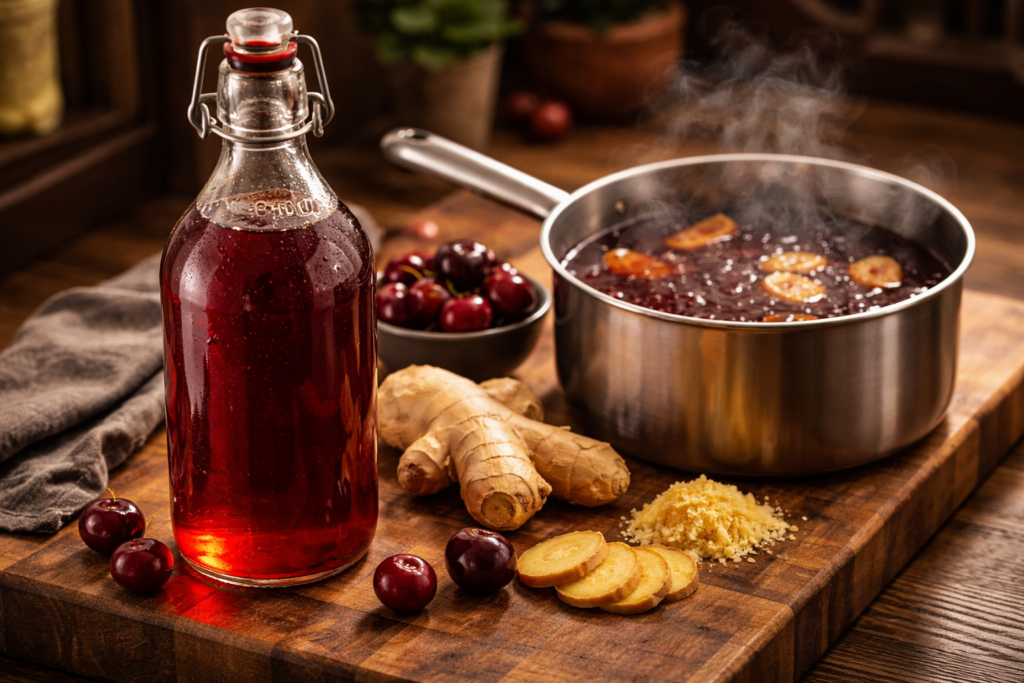
ZingBing Simple Syrup

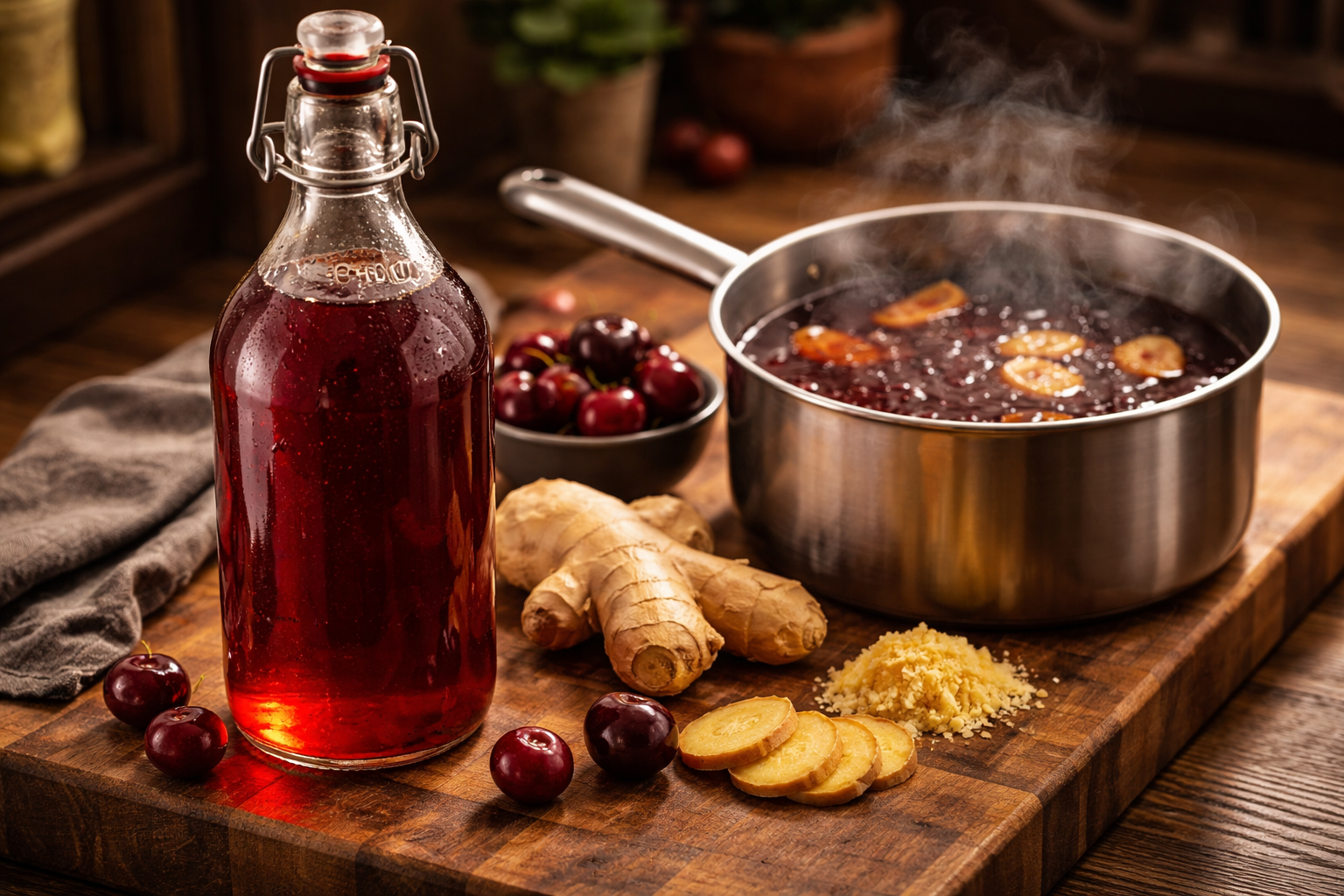
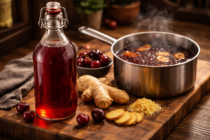
ZingBing Syrup is a sharp, fruit-driven simple syrup that leads with the clean bite of fresh ginger before rounding into the deep, tart sweetness of cherry. It’s built for contrast—bright, slightly punchy, and structured enough to cut through richer flavors without getting lost. The ginger keeps it lifted; the cherry gives it body.

Use it anywhere you want sweetness with edge: stirred into bourbon or rye for a darker, spiced profile, shaken into citrus-forward cocktails for added depth, or brushed into desserts where a little acidity keeps things from going flat.

ZingBing Simple Syrup

Sweet with a bite.

ZingBing Syrup is built on contrast—sharp, aromatic ginger layered over the deep, slightly tart sweetness of Bing cherries. It’s not just a way to sweeten something. It’s a way to shape it. At its core, this syrup is about balance. The ginger keeps things lifted and bright, while the cherry brings body and depth. Together, they create something that feels clean, structured, and just a little bit unexpected.

Where the flavor starts.

What makes this syrup different isn’t just the ingredients—it’s how they come together from the start. Instead of dissolving sugar first and infusing afterward, the process begins by working the ginger and cherries directly into the sugar. As they’re muddled, the ginger releases its oils and the cherries give up their juice, staining the sugar and building flavor before any heat is applied.

By the time the water goes in, the base is already doing more than just sweetening. It’s carrying aroma, acidity, and a bit of bite—everything that gives the finished syrup its edge.

Building structure into something simple.

Simple syrup tends to lean one-dimensional if you let it. This one doesn’t. A few small choices make the difference:

  • freshly grated ginger for a clean, immediate heat
  • Bing cherries for their deeper, slightly tart profile
  • a controlled simmer to steep without dulling the brightness

The goal isn’t to overpower—it’s to layer. The ginger shouldn’t dominate, and the cherry shouldn’t feel heavy. They meet in the middle, supported by just enough sweetness to hold everything together.

The balance in the finish.

When it’s done right, ZingBing lands in that space between sweet, tart, and sharp. The ginger hits first, the cherry follows, and the sweetness lingers just long enough to tie it together without flattening it. It’s the kind of syrup that doesn’t disappear into whatever you’re using it in—it actually defines it.

What I typically use it in.

ZingBing is flexible, but it works best where contrast matters.

At the bar

  • stirred into bourbon or rye for depth and a subtle spiced fruit note
  • shaken with gin for something brighter and more aromatic
  • added to sparkling wine or soda for a lighter, sharper build

In the kitchen

  • brushed into cakes or layered desserts
  • spooned over ice cream or soft cheeses
  • used to make a vinaigrette
  • reduced slightly further into a glaze for pork or duck

A note before you start.

This recipe is straightforward, but a few details matter:

  • Don’t skip the muddling step—that’s where the flavor is built
  • Keep the heat controlled—you’re steeping, not aggressively reducing
  • Let the syrup fully chill before using—the flavor settles and rounds out as it rests

Recipes that use this syrup...

You’ll find the full method outlined below, from building the base in the sugar to simmering and straining the finished syrup.

ZingBing Simple Syrup

ZingBing Simple Syrup is a sharp, fruit-driven simple syrup that leads with the clean bite of fresh ginger before rounding into the deep, tart sweetness of cherry. It’s built for contrast—bright, slightly punchy, and structured enough to cut through richer flavors without getting lost. The ginger keeps it lifted; the cherry gives it body.
Use it anywhere you want sweetness with edge: stirred into bourbon or rye for a darker, spiced profile, shaken into citrus-forward cocktails for added depth, or brushed into desserts where a little acidity keeps things from going flat.
Print Pin
Category: THIRST
Cuisine: Global
Course: Drinks
Keyword: Cherry, Ginger, Simple Syrup
Prep: 30 minutes
Cook: 30 minutes
Cooling Time: 4 hours 15 minutes
Total: 5 hours 15 minutes
Servings: 24 servings
Calories: 145kcal
Author: TastyDaddy

Ingredients

Instructions

Infusion Ingredient Prep

  • Wash ginger root and cherries (if using fresh) thoroughly.
  • Run the edge of a spoon along the ginger root to loosen and peel the skin, discarding, and rinse the root. Dry with paper towel.
  • Grate about ¼ cup (4 tbsp) of ginger.
  • If you are using fresh cherries, remove cherry pits. Skip to next step if using frozen.
  • Coarsely chop cherries until you have approximately 3 cups of cherries.

Syrup Prep

  • Pour 3 cups of granulated white sugar into 6-cup stockpot.
  • Pour ¼ cup (4 tbsp) grated ginger on top of sugar and muddle ginger into sugar to infuse the flavor into it.
  • Once ginger is integrated with the sugar, add 3 cups of chopped cherries onto sugar and muddle into sugar until sugar is stained with cherry juice completely.
  • Add 3 cups filtered water onto muddled sugar and stir to combine.
  • TIP: Instead of muddling, you can combine the water, ginger, and cherries into a blender until well blended and pour into the stockpot over sugar; however, I have found that muddling/infusing the flavors into the sugar creates a better flavor.

Cooking

  • Bring ingredients to a boil in the stockpot until sugar is completely dissolved.
  • Reduce heat to a medium simmer and let ingredients steep for at least 30 minutes.
  • Remove stockpot from heat and let cool for at least 15 minutes.

Straining

  • Place mesh strainer over large pot or bowl (deeper than the depth of the strainer so that the liquid clears the bottom of the strainer).
  • Slowly pour contents of simmered liquid into strainer. Using muddler, gently press as much liquid from the contents of the strainer as possible (without damaging your strainer from the pressure).

Storing

  • Pour syrup into glass swing-top bottle (or jar if you don't have a bottle) and store at least 4 hours in the fridge to cool. Overnight cooling is even better.

Nutrition

Serving: 1oz | Calories: 145kcal | Carbohydrates: 36g | Protein: 1g | Fat: 0.1g | Saturated Fat: 0.002g | Polyunsaturated Fat: 0.002g | Monounsaturated Fat: 0.002g | Sodium: 4mg | Potassium: 5mg | Fiber: 1g | Sugar: 33g | Vitamin A: 538IU | Vitamin C: 0.05mg | Calcium: 15mg | Iron: 0.3mg

Lomo Saltado

Flash-seared beef meets blistered vegetables, ají amarillo, and a ginger-laced soy reduction in this bold Peruvian staple. Served with crisp fries and rice, it’s a study in contrast—smoky wok heat, bright spice, and layered savory flavor.

Lomo Saltado

Wok this way.

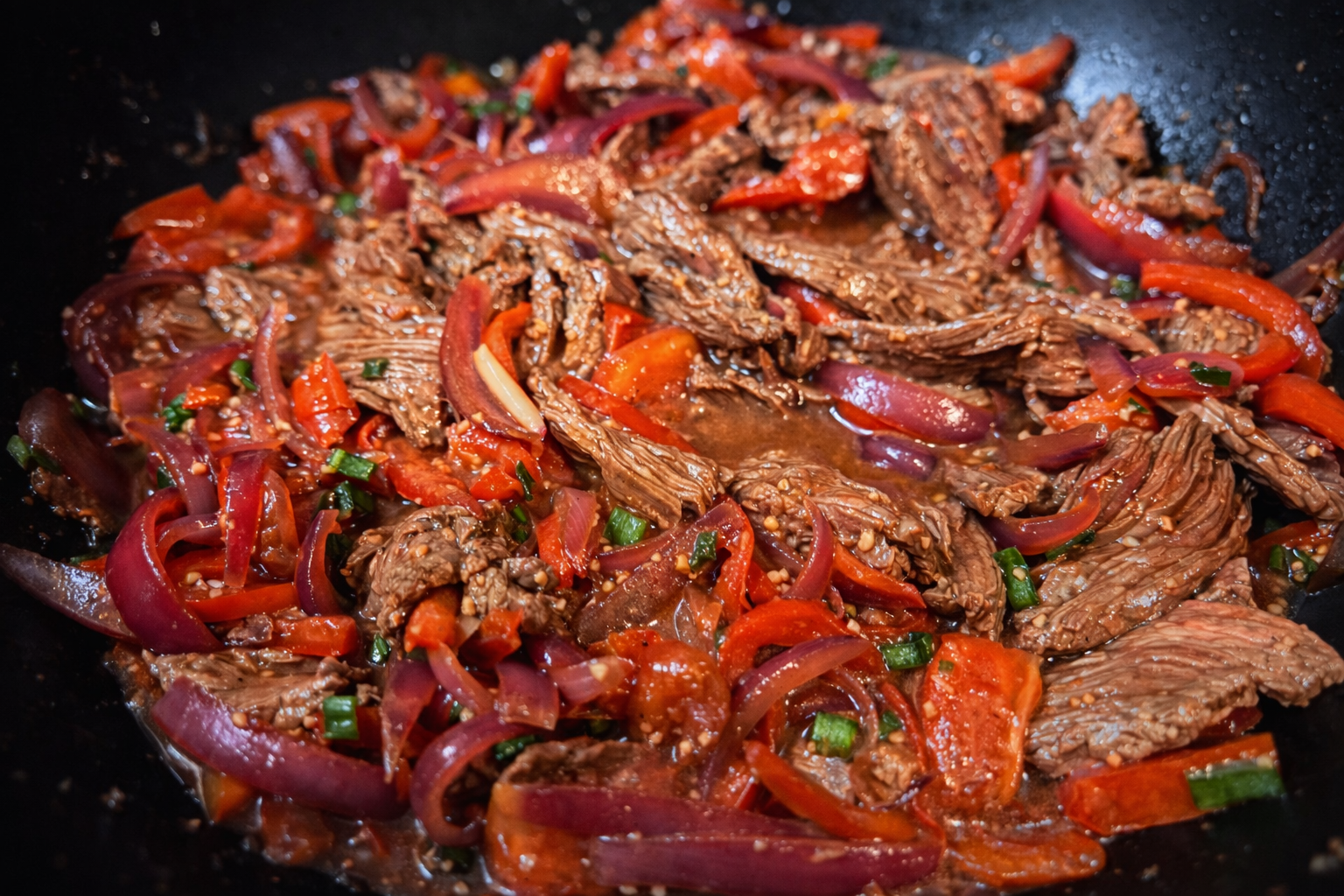
Lomo Saltado is one of those dishes that perfectly captures what makes Peruvian cuisine so exciting. It’s bold, fast, and deeply satisfying—tender strips of beef seared over high heat and tossed with onions, tomatoes, and a savory sauce that comes together in minutes.

At its heart, the dish reflects the Chinese influence on Peruvian cooking—what’s known as Chifa—where wok techniques meet local ingredients and flavors. This version stays true to that spirit while leaning a little more intentionally into the aromatics and balance that make the stir-fry so vibrant.

Honoring the Chifa roots.

What makes Lomo Saltado unique isn’t just the ingredients—it’s the technique. The dish emerged from Chinese immigrant communities in Peru who adapted familiar stir-fry methods to the ingredients available to them, creating something entirely new in the process. Soy sauce, garlic, and high-heat cooking bring unmistakable Chinese influence, while tomatoes and aji peppers ground the dish firmly in Peru. That fusion is the entire identity of Lomo Saltado. It isn’t meant to feel purely one thing or the other—it’s meant to live comfortably in the middle.

For me, the goal is to preserve that balance while sharpening the flavors just enough to let each component stand on its own.

Building flavor inside the pan.

Because this dish cooks quickly, every ingredient needs to pull its weight. Instead of relying only on soy sauce and vinegar to carry the flavor, I like to build a little more depth into the stir-fry itself. That starts with a few small additions:

    • aji amarillo paste
    • a touch of freshly grated ginger
    • red wine vinegar or rice wine vinegar

Fresh aji amarillo peppers can be difficult to find where I live, so I typically use yellow bell peppers for their color and gentle sweetness, then bring the true Peruvian flavor back into the dish with aji amarillo paste. The paste adds that distinctive fruity heat without overwhelming the stir-fry.

The grated ginger gives the dish a subtle aromatic lift that nods to its chifa roots, while the vinegar adds brightness and keeps the sauce from feeling too heavy. I usually reach for red wine vinegar or rice wine vinegar, both of which complement the soy sauce beautifully and help round out the pan. None of it overwhelms the dish. It simply builds layers.

The magic of the stir-fry.

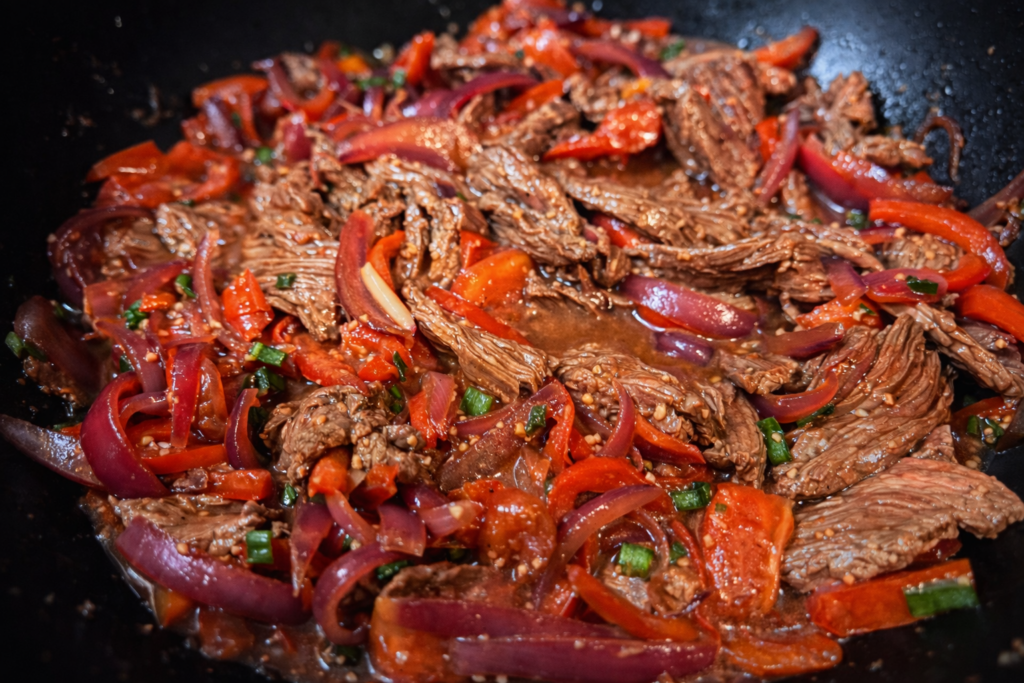
Lomo Saltado works because of contrast—high heat against fresh ingredients, savory depth balanced by brightness. The beef caramelizes quickly, the onions soften while still keeping their bite, and the tomatoes release just enough juice to bring everything together in a glossy, flavorful sauce.

When it’s done right, the dish feels vibrant and alive—rich without being heavy, bold without being complicated. It’s the kind of stir-fry that proves how powerful a handful of well-chosen ingredients can be when they meet a hot pan and a little intention.

What I typically serve with it.

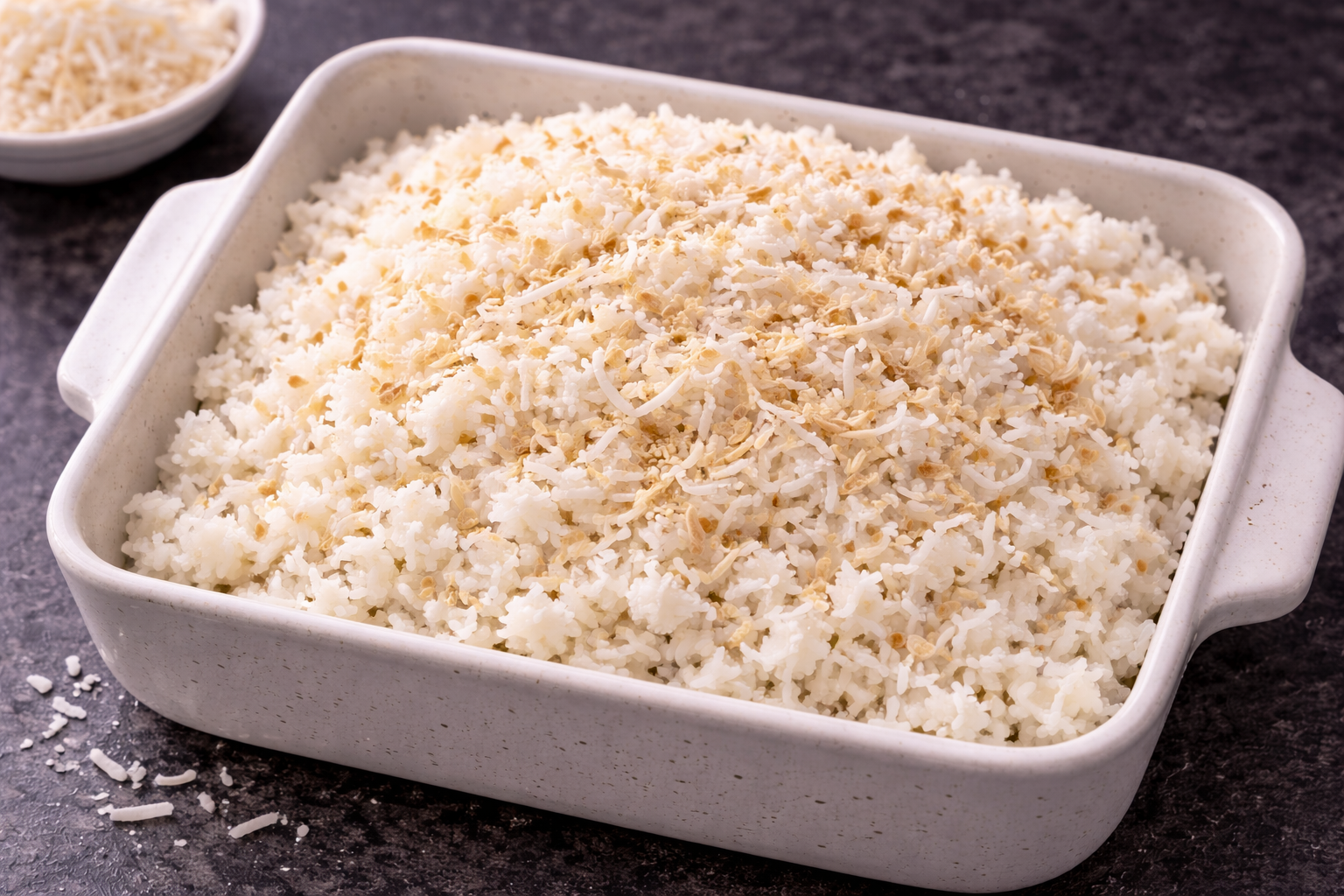
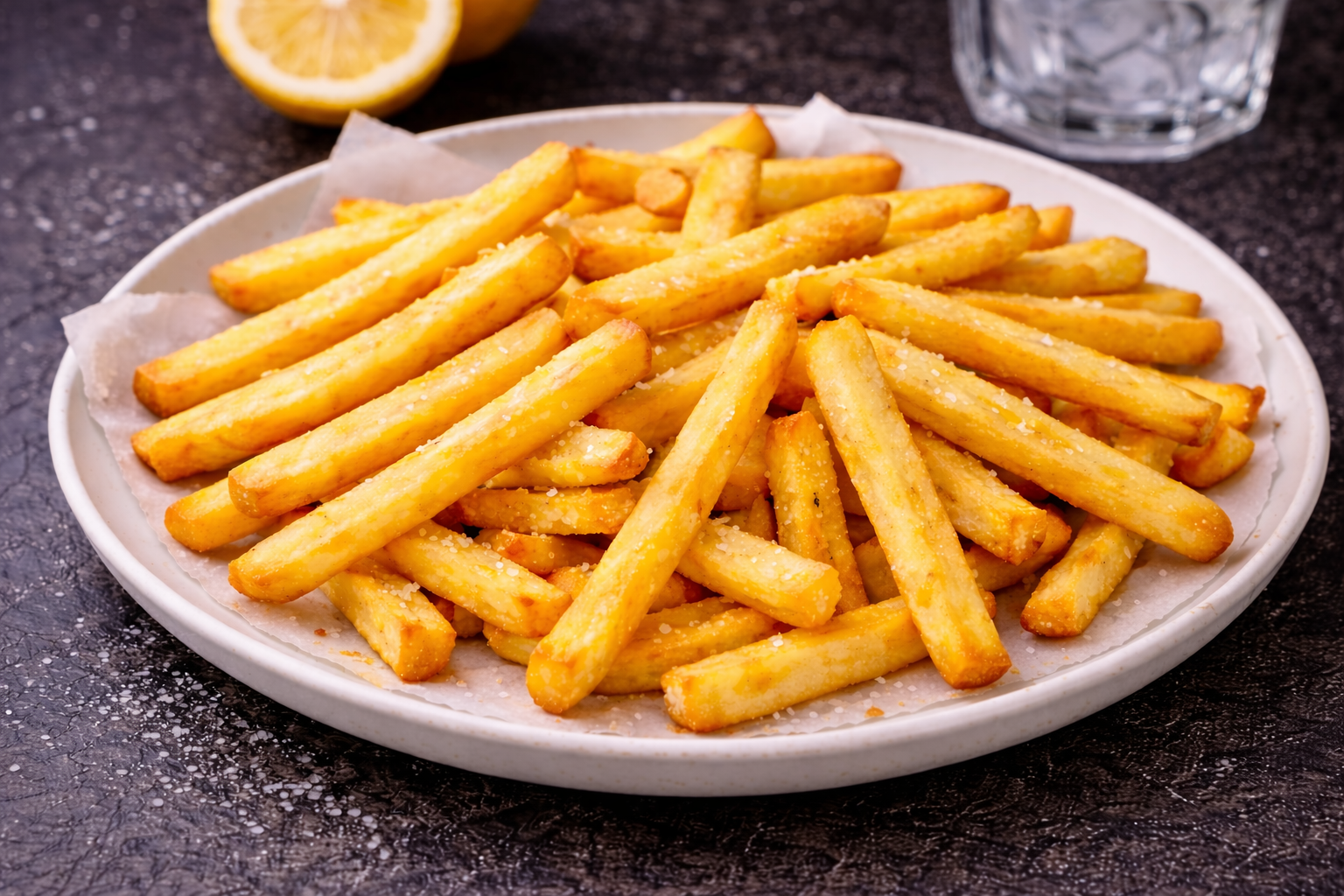
Traditionally, Lomo Saltado is served with BOTH white rice and fries (some recipes even suggest stirring the fries into the sauce before serving, but I am personally not a fan of this method). I still have the fries part of the traditional recipe linked below, but I have a coconut recipe linked, which is the side I now typically pair with it (versus the white rice). The sweetness of the coconut balances the saltiness of the fries and the tangy-umami flavors of the sauce. I also add a bit of ginger into my coconut rice to complement the flavor of the beef stir-fry nicely.

Want a more in-depth glance at the full meal preparation of Lomo Saltado with both sides? Check out my post below, which leads you step-by-step through my prep and cooking process so that everything is timed perfectly:

You’ll find the full method outlined below, from searing the beef to bringing the stir-fry together in the pan. The process moves quickly—high heat and timing matter more than complexity. If you make it, let me know how it turns out—and what you paired it with.

Lomo Saltado

Flash-seared beef meets blistered vegetables, ají amarillo, and a ginger-laced soy reduction in this bold Peruvian staple. Served with crisp fries and rice, it’s a study in contrast—smoky wok heat, bright spice, and layered savory flavor.
Print Pin
Category: FEAST
Cuisine: Peruvian
Course: Main Course
Keyword: Ají Amarillo, Beef, Chifa, Ginger, Red Onion, Stir Fry, Tomato
Prep: 20 minutes
Cook: 15 minutes
Total: 30 minutes
Servings: 4 servings
Calories: 335kcal
Author: TastyDaddy

Ingredients

Marinade

Sauce

Stir Fry

  • 1 lb steak (sliced medium thin)
  • 1 whole red onion (sliced in wedges)
  • 4 tsp garlic (minced)
  • 3 whole roma tomatoes (sliced in wedges)
  • 1 whole Ají amarillo pepper (sliced)
  • SUBSTITUTION: Fresh Ají amarillo peppers aren't easy to find, so if you can't find one in your area, feel free to substitute a small yellow or orange bell pepper.
  • 5 stalks green onions (ends trimmed, cut into 1" pieces)
  • ¼ cup cilantro (chopped)
  • 2-3 tbsp vegetable oil (or canola oil)

Garnish

Instructions

Slicing the Steak

  • Using a butcher's block and a Santoku knife, slice your meat into medium thin slices—thin enough that they won't take a long time to cook, but thick enough so they won't overcook when seared.
  • TIP: As with any meat, it slices better when a bit firmer. I place my steak in the freezer for about 12-15 minutes before slicing.
    PRO TIP: While the meat is chilling in the freezer, move to next steps and prepare the marinade and sauce.

Marinade

  • Combine 2 tbsp soy sauce, 1 tsp minced garlic, 1 tsp ginger paste.
  • TIP: If you selected a tougher cut of meat, add ¼ tsp baking soda to your marinade. Baking soda will help loosen the protein fibers, making it easier to chew. You can also use meat tenderizer.
  • Pour prepared marinade over sliced meat in a marinade dish and marinate in refrigerator at least 10 minutes.
  • TIP: If you used baking soda in your marinade due to a tougher cut of meat, increase your marinating time to 1 hour.

Sauce

  • In a 2-cup measuring glass (spouted), combine 3 tbsp soy sauce, 1 tbsp oyster sauce, 1 tbsp red wine (or rice wine) vinegar, 1 tbsp Ají amarillo paste, 1 tsp ginger paste, and 1 tsp cornstarch.
  • Blend with whisk and set aside.

Vegetable Prep

  • Wash all vegetables before cutting.
  • If you've already sliced your meat, wash your butcher's block (or cutting board) before prepping your vegetables.
  • You'll be using your Chef's knife to prep the vegetables.
  • Slice red onion into ½" wedges and set aside in a ramekin (or small bowl).
  • Cut top (stem side) off roma tomatoes and slice into ½" wedges. If your tomatoes are particularly seed-heavy, remove them an add them into your sauce mixture. Set tomato wedges aside in ramekin (or small bowl).
  • Slice Ají amarillo pepper (or bell pepper, if substituting) and set aside in ramekin.
  • Trim white ends off 7 stalks of green onions.
    Slice 5 stalks into 1" pieces, setting aside in ramekin.
    Take remaining 2 stalks and coarsely chop, setting aside in separate ramekin for garnish later.
  • PRO TIP: If you leave at least 1½-2" of green stalk above the white root end, you can wrap a rubber band loosely around the bunch to hold together and add to a shallow dish of water. The onion stalks will regenerate after a few days and you can plant in a small pot to put in a windowsill to always have fresh green onions on hand.
  • Remove cilantro leaves from stems (discard the stems) and coarsely chop leaves, setting aside about ¼ cup in one ramekin and about 2 tbsp in an additional ramekin for garnish later.

Cooking the Stir Fry

  • Remove marinated sliced beef from fridge and strain marinade from meat; this will prevent excessive splatter while searing
  • Add about 1 tbsp of vegetable (or canola) oil to wok over high heat until it starts to shimmer.
  • Sear the meat in batches for about 2 minutes, flipping as needed to ensure an even cook. Remove from heat and add to mixing bowl or plate (I opt for a bowl because adding the meat in batches means the top layer will hold the heat in for the layers below it.
  • TIP: I leave my meat pretty pink in the middle for two reasons: 1) The meat will continue to cook a bit more as it rests in the bowl or plate; 2) The meat is added back to the wok in the final steps, and adding it to a bubbling sauce will cook it slightly more. You don't want to overcook your meat and make it tough.
  • Once all meat is seared, drain excess oil and juices from wok. Add 1 tbsp of fresh oil to wok and bring back to med-high heat until it starts to shimmer.
  • Add the ramekin of onions and sauté for 1 minute.
  • Add in 4 tsp minced garlic and sauté for another minute.
  • Add in ramekins of tomatoes, cilantro, and green onions and cook for another 2 minutes or until tomatoes are slightly tender but still have their shape.
  • Add sauce to pan and bring to a low simmer to thicken the sauce.
  • Turn off heat and add meat back into wok, mixing and thoroughly incorporating with other ingredients until sauce coats the meat.
  • Garnish with cilantro and green onions.

Nutrition

Calories: 335kcal | Carbohydrates: 7g | Protein: 27g | Fat: 23g | Saturated Fat: 8g | Polyunsaturated Fat: 5g | Monounsaturated Fat: 9g | Trans Fat: 0.04g | Cholesterol: 69mg | Sodium: 1764mg | Potassium: 466mg | Fiber: 1g | Sugar: 1g | Vitamin A: 324IU | Vitamin C: 7mg | Calcium: 39mg | Iron: 3mg