Recaíto

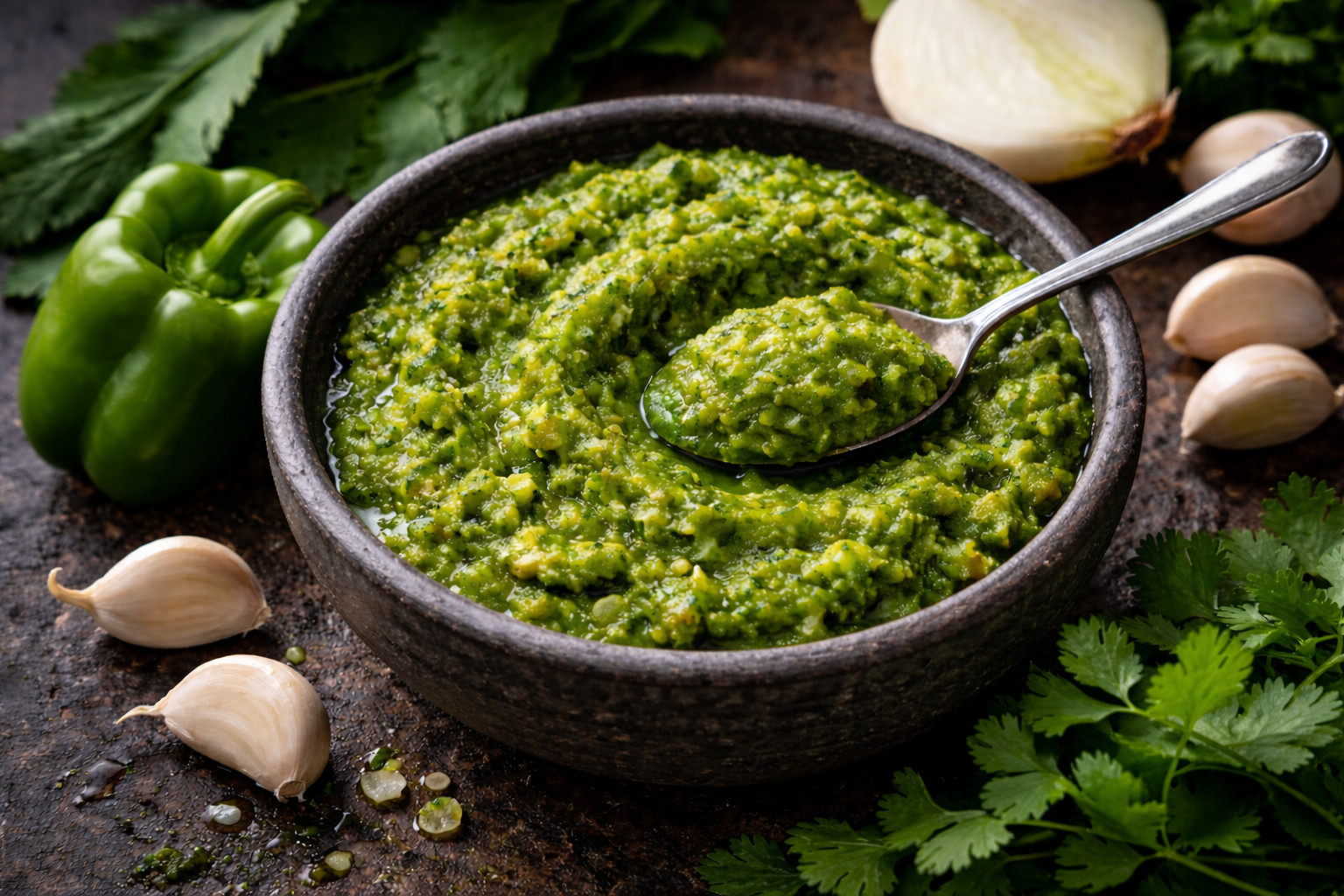
Recaíto is a green, herb-forward aromatic base used throughout Puerto Rican cooking, built from peppers, onion, garlic, and fresh herbs blended into a coarse paste. It’s the backbone of dishes like arroz con gandules, beans, and stews, where it’s added at the start to establish flavor that carries through the entire dish.
Recaíto

What It Is and Where It Comes From

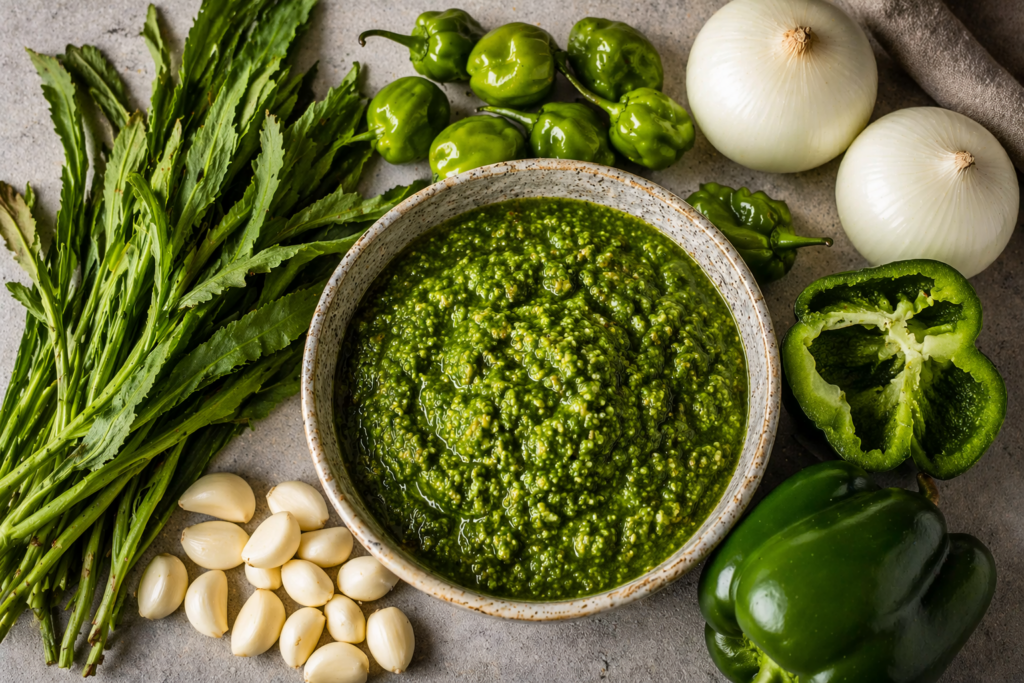
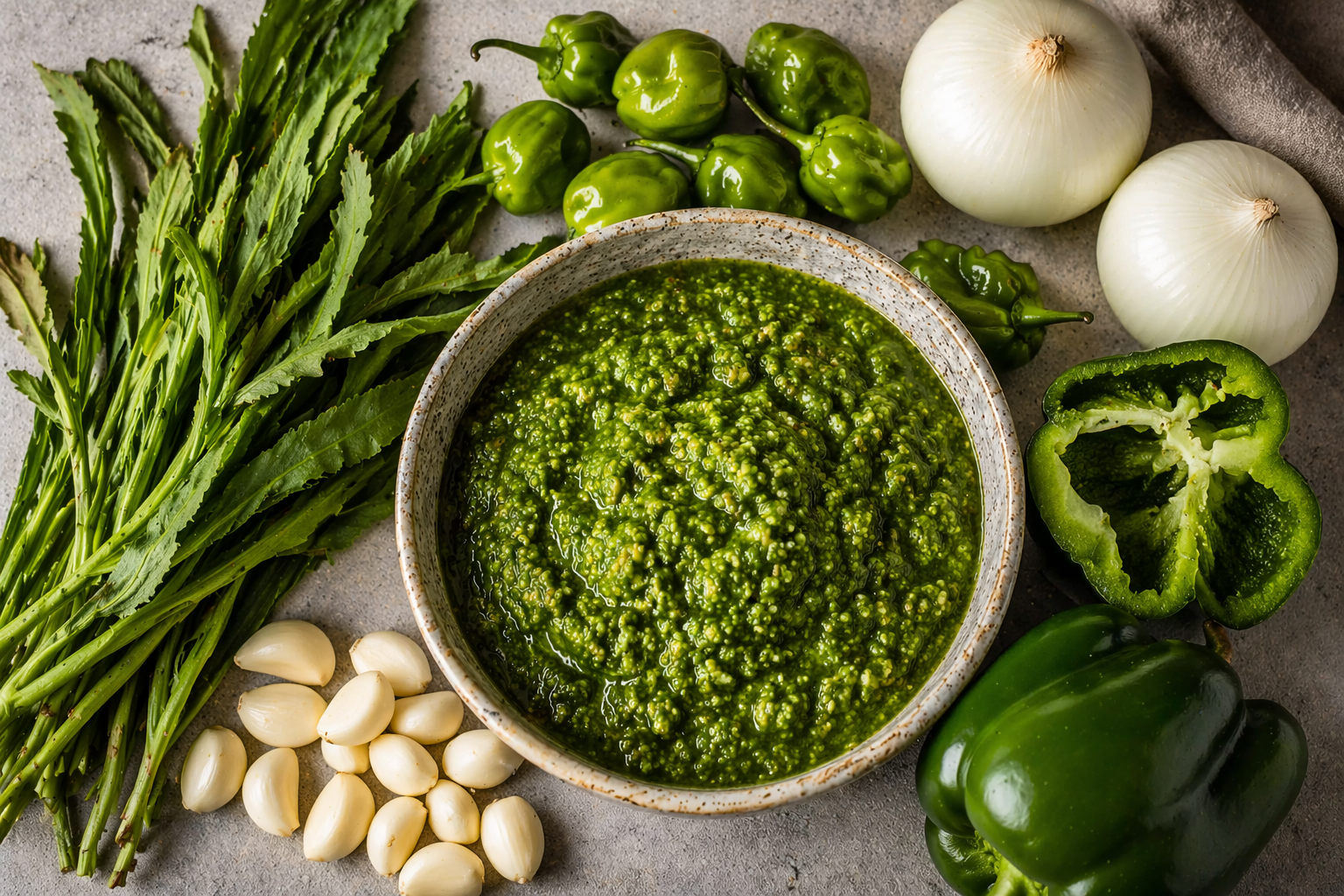
Recaíto is a green, herb-forward aromatic base used throughout Puerto Rican cooking, built from peppers (green bell and ají dulce), onion, garlic, and fresh herbs (culantro and cilantro) blended into a coarse paste. It’s the backbone of dishes like arroz con gandules, beans, and stews, where it sets the direction of the flavor from the first step..

the ingredients that define it

Recaíto is built from a small group of ingredients, but each one plays a specific role in shaping its flavor. Its character comes from the balance between fresh herbs and mild, aromatic peppers, creating a base that is both bright and savory with a depth that builds as it cooks. The texture allows it to disperse quickly in the pan, coating ingredients and setting the tone early, so that every layer of the dish develops from the same foundation.

Recao (Culantro)

At the center of it all is recao, also known as culantro. Despite the similar name, it is not a typo or variation of cilantro—they are two distinct plants with different structures and flavor profiles. This is where recaíto gets its name, and it’s what gives the blend its defining character.

While often compared to cilantro, the flavor is more concentrated and slightly deeper, with a more pronounced herbal edge. The leaves are long and serrated rather than soft and feathery, and they hold up well in blended preparations, giving the mixture a more persistent, grounded flavor.

Cilantro

Cilantro works alongside recao, adding brightness and lift. It softens the intensity of culantro without replacing it, keeping the blend balanced and preventing it from feeling too dense.

ajíes dulces

Ajíes dulces are small, aromatic peppers commonly used in Caribbean cooking. They resemble small habaneros in shape but carry little to no heat. Instead, they bring a gentle sweetness and a distinct fragrance that defines the aroma of recaíto.

Green bell (or Cubanelle) peppers

These form the base of the pepper component. Green bell peppers bring a slightly bitter, vegetal edge, while cubanelle peppers are milder and a bit sweeter. Either works well, with the choice subtly influencing the final balance.

onion and garlic

Onion and garlic provide body and depth. Onion adds moisture and a mild sweetness, while garlic brings sharpness that mellows once cooked, anchoring the brighter elements of the blend.

How It Works

Recaíto is prepared in advance by blending the ingredients into a coarse paste using a blender or food processor, allowing the flavors to combine before they ever reach the pan. This creates a mixture that is already unified, so it develops as a whole rather than as separate components during cooking.

Because of this, it is commonly made in batches and kept on hand. It can be refrigerated for short-term use or frozen in small portions, making it easy to incorporate into dishes without additional preparation.

How It’s Used

Recaíto is added to hot oil at the beginning of cooking and briefly sautéed to release its aroma. From there, the rest of the dish is built on top of it, whether that’s rice, beans, or a stew. The amount used depends on the dish, but even a small quantity has a noticeable impact. Additional spoonfuls can be added later if needed, allowing the flavor to be adjusted as the dish develops.

storage

Recaíto is typically made in batches and stored for later use. It can be kept in an airtight container in the refrigerator for up to a week, though its flavor is best when used within a few days. For longer storage, it can be portioned into small containers or frozen in ice cube trays, then transferred to a sealed bag once solid. Freezing in cubes makes it easy to use—depending on the size, just add a cube or two directly to the pan when starting a dish. This approach keeps the process efficient while preserving the integrity of the blend.

Recipes that Use recaíto

Recaíto

Recaíto is a green, herb-forward aromatic base used throughout Puerto Rican cooking, built from peppers, onion, garlic, and fresh herbs blended into a coarse paste. It’s the backbone of dishes like arroz con gandules, beans, and stews, where it’s added at the start to establish flavor that carries through the entire dish.
Its character comes from the balance between fresh herbs and mild, aromatic peppers, creating a base that is both bright and savory with a depth that builds as it cooks. The texture allows it to disperse quickly in the pan, coating ingredients and setting the tone early, so that every layer of the dish develops from the same foundation.
Print Pin Rate
Category: HARVEST
Cuisine: Puerto Rican
Course: Cooking Base
Keyword: Ají Dulce, Cilantro, Cubanelle, Culantro, Garlic, Green Bell Pepper, Onion
Prep: 15 minutes
Total: 15 minutes
Servings: 10 servings
Calories: 26kcal

Ingredients

Instructions

Washing & Prep

  • Wash and dry 2 medium green bell pepper, 2 medium onions, 1 bunch culantro, 6 small ajíes dulces, and cilantro.
  • Peel onion and coarsely chop.
  • Removed stem, seeds, and piths from 2 medium green bell pepper and 6 small ajíes dulces; coarsely chop.
  • Peel and cut ends off 20 cloves garlic.
  • Coarsely chop ½ cup cilantro, loosely packed.

Food Processor

  • Add prepped ingredients and 1 bunch culantro to food processor and pulse until thoroughly blended.

Storage

  • Store recaíto in airtight jar in fridge for immediate use.
  • OR pour into silicone ice cube molds and freeze for future use; remove from mold and store frozen recaíto cubes in freezer bag.

Nutrition

Calories: 26kcal | Carbohydrates: 6g | Protein: 1g | Fat: 0.1g | Saturated Fat: 0.03g | Polyunsaturated Fat: 0.03g | Monounsaturated Fat: 0.01g | Sodium: 4mg | Potassium: 106mg | Fiber: 1g | Sugar: 2g | Vitamin A: 197IU | Vitamin C: 23mg | Calcium: 19mg | Iron: 0.3mg
Sofrito

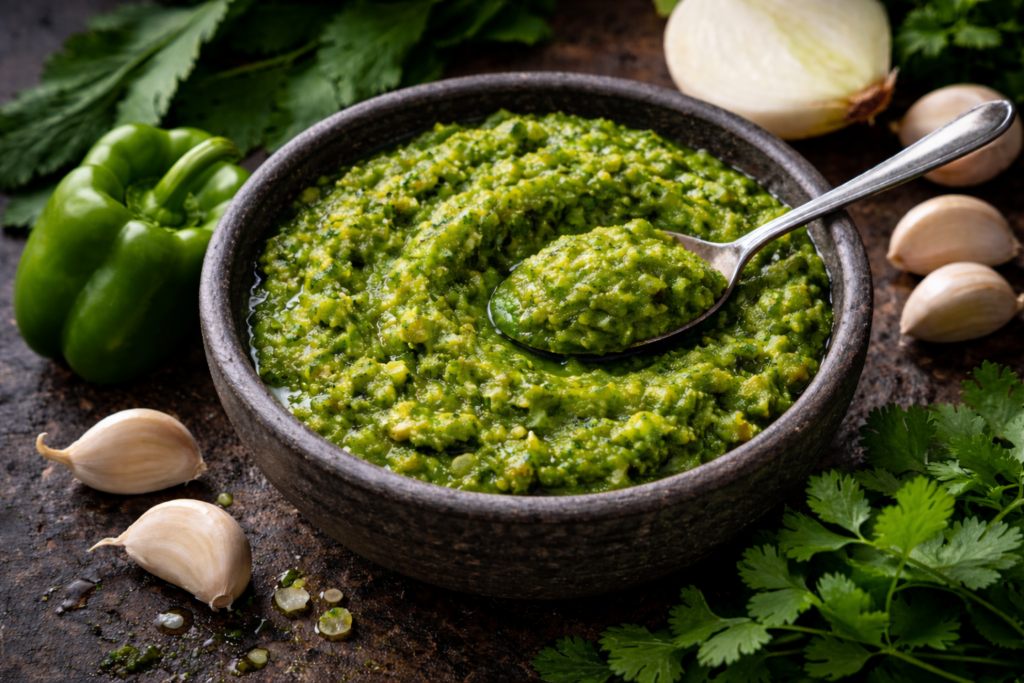
Sofrito is a foundational aromatic blend used across Latin and Caribbean cuisines, built from a combination of peppers, onion, garlic, and herbs that are either finely chopped or blended into a paste and used at the start of a dish. While the ingredients and technique vary by region, the purpose remains consistent: to establish flavor early, allowing it to develop and carry through everything that follows.

Some versions are cooked briefly in oil to deepen and round out their intensity, while others are added fresh, bringing brightness and immediacy to the dish. Whether subtle or assertive, sofrito shapes the identity of what’s being made, providing a base that ties ingredients together and defines the overall flavor from the very first step.

Sofrito

What It Is and Where It Comes From

Sofrito is a foundational aromatic base used across Spanish, Latin American, and Caribbean cuisines. At its core, it’s a blend of alliums, peppers, and often tomatoes or herbs, used to establish flavor at the very start of a dish. What ties them together isn’t a single ingredient or method, but their role: sofrito is the first layer of flavor, the point where a dish begins to take shape.

The name comes from the Spanish verb sofreír, meaning “to sauté,” and in its earliest form, that’s exactly what it was—a mixture built in the pan, slowly cooked to develop depth and sweetness. As the technique moved across regions, it evolved. Some versions remain rooted in that slow, cooked approach, while others incorporate fresh herbs or are prepared as blended pastes ahead of time.

How It Works

Sofrito works by establishing a base that everything else builds on. In some traditions, it’s made directly in the pan—onions, garlic, peppers, and sometimes tomatoes cooked gently in oil until softened, sweetened, and fully integrated. This slow transformation develops depth over time, creating a foundation that feels rounded and cohesive.

In others, the ingredients are blended beforehand into a coarse paste using a blender or food processor, often with fresh herbs. In this form, sofrito is prepared in advance and used as needed, shifting the process. Instead of building flavor gradually from separate components, the mixture is already unified before it ever hits the heat.

How It’s Used

Sofrito is typically added at the beginning of cooking, introduced to hot oil so it can bloom and release its aroma before other ingredients are added. Because it forms the foundation, it doesn’t sit in the background. In rice dishes, it defines how the grains absorb flavor from the start. In beans and stews, it provides continuity through longer cooking, anchoring the dish as liquid is added and reduced. In sauces, it sets the direction early, shaping how everything that follows develops. The amount used depends on the preparation, but it’s often added with intention rather than excess. A measured quantity establishes the base, and additional amounts can be layered in if the dish calls for it—reinforcing flavor without overwhelming it.

Variations

Sofrito shifts from region to region, reflecting local ingredients and cooking styles. Texture can range from finely minced to fully blended, depending on how it’s meant to integrate into the dish. The balance of ingredients—how much onion, how much pepper, whether herbs or tomatoes take the lead—changes the character, but not the purpose.

Some versions are cooked down with tomatoes and olive oil, leaning deeper and slightly sweeter. Others are greener and more aromatic, built with fresh herbs and milder peppers. In some kitchens, it’s always made to order in the pan; in others, it’s kept on hand as a prepared blend, ready to be used at a moment’s notice.

Recipes that Use Sofrito

Soffritto

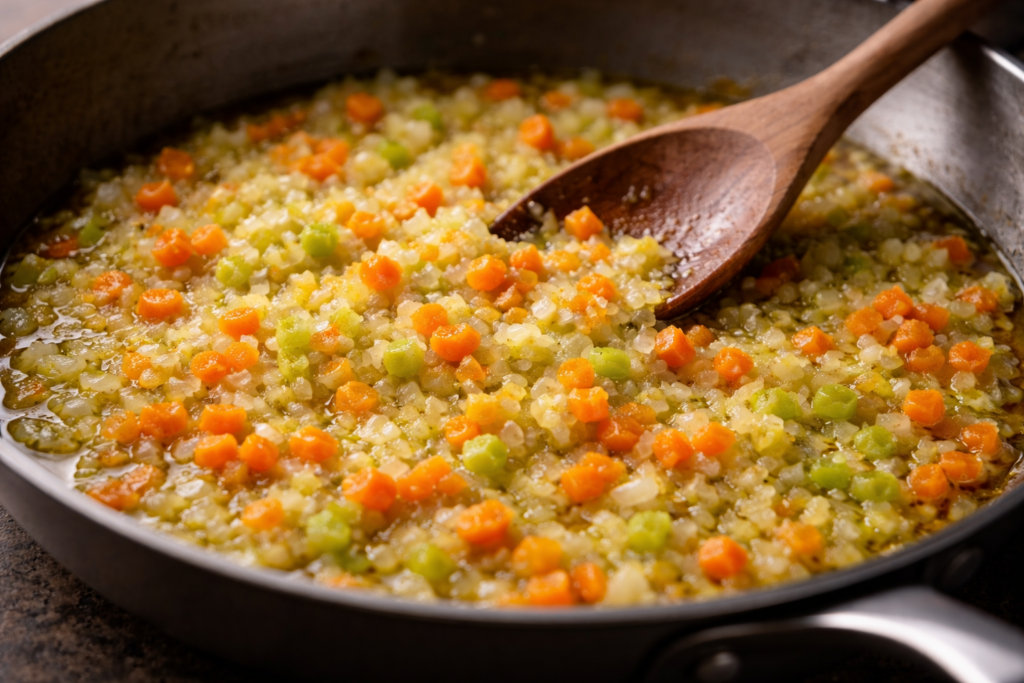
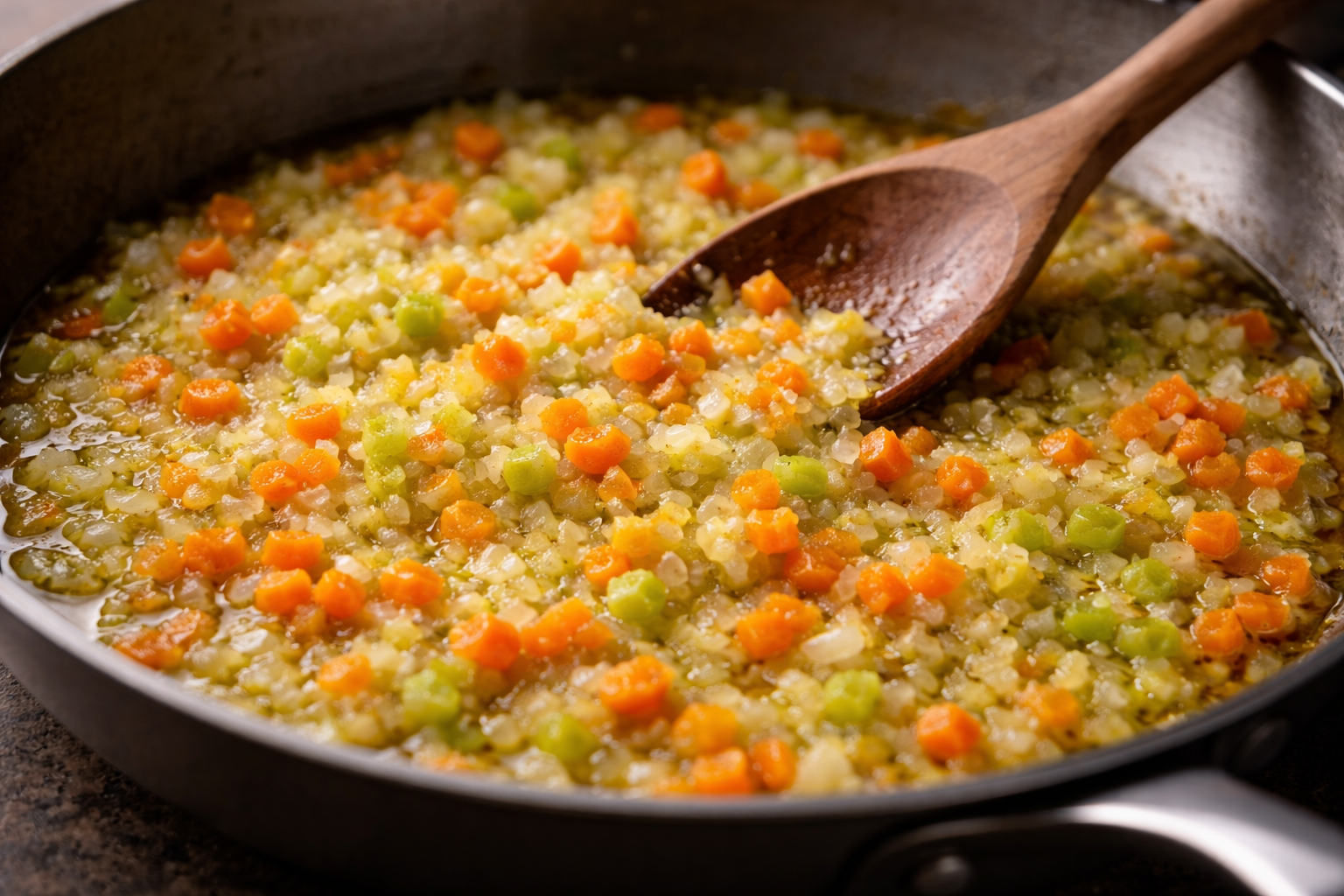
Soffritto is the foundation of Italian cooking, built from finely chopped onion, carrot, and celery gently cooked in olive oil until softened and aromatic. As the vegetables release their moisture and natural sweetness, they come together into a cohesive base that carries flavor through the entire dish. Used in sauces, soups, and braises, soffritto shapes how a dish develops from the start, providing depth and balance without ever drawing attention to itself.

Soffritto

What It Is and Where It Comes From

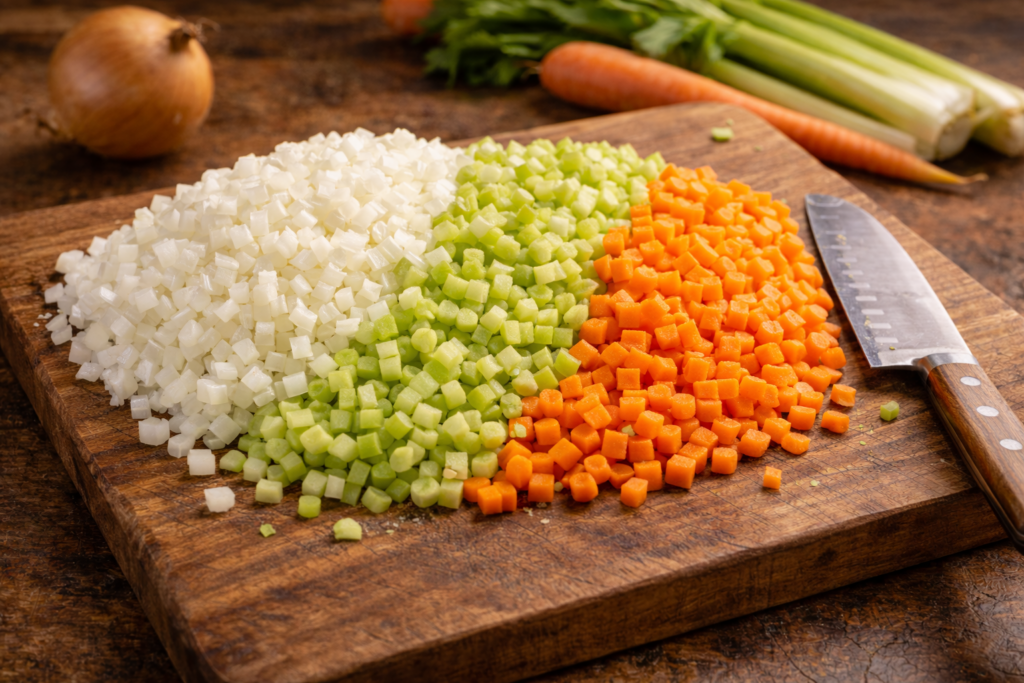
In Italian cooking, the foundation for building flavor begins before anything touches heat, with battuto—a finely chopped mixture of onion, carrot, and celery prepared as the base for what follows. The name comes from battere, meaning “to chop,” and it refers to the preparation itself: a deliberate, uniform cut that determines how the vegetables will cook and integrate. This step sets the structure, ensuring that the ingredients will break down evenly and fully once introduced to the pan.

Once that mixture meets olive oil and heat, it becomes soffritto. The name comes from soffriggere, meaning “to gently fry,” which reflects both the technique and the restraint behind it. This is not a hard sauté or a quick step meant to move things along. It is a controlled process that prepares the base of a dish before anything else is introduced.

Although the ingredients closely resemble those used in French mirepoix, the approach in Italian cooking leans toward finer cuts and a more deliberate cook. The vegetables are often chopped small enough to break down as they soften, allowing them to integrate fully into the dish rather than remain distinct. By the time the next ingredients are added, the soffritto is no longer a collection of vegetables, but a unified base that supports everything that follows.

How It Works

Soffritto develops through time, heat, and restraint. As the vegetables cook in olive oil, they begin to release moisture, softening gradually and losing the sharpness they carry in their raw state. The onion becomes sweeter and more rounded, the carrot deepens that sweetness, and the celery introduces a subtle bitterness that keeps the mixture balanced. The oil acts as both a cooking medium and a carrier, absorbing these changes and distributing them evenly.

The process is defined by what does not happen as much as what does. There is no aggressive browning, no attempt to push the vegetables toward caramelization. Instead, the goal is to bring them to a point where they are fully softened, lightly sweet, and aromatic without taking on color. At that stage, the individual ingredients stop standing apart and begin to function as a cohesive whole, forming a base that can carry the rest of the dish.

How It’s Used

Soffritto is used at the beginning of a dish, but its role extends far beyond that first step. It establishes a base that continues to influence how ingredients interact as the cooking progresses. In ragù, it sets the tone before the meat is introduced, shaping how the fat carries flavor through a long simmer. In soups and stews, it gives structure to the broth, creating a sense of continuity that allows each addition to feel connected rather than separate.

Its impact is most noticeable in what it prevents. Without it, dishes often feel fragmented, with ingredients that sit alongside one another instead of forming a cohesive whole. With it, the transition from one stage of cooking to the next becomes more seamless, and the final result carries a depth that feels built rather than assembled.

How to Work With It

Working with soffritto is less about movement and more about control. The process begins with olive oil over moderate heat, allowing the vegetables to soften gradually rather than sear on contact. A small amount of salt early in the cook helps draw out moisture, encouraging even breakdown and preventing the edges from taking on color too quickly.

From there, the focus shifts to timing and observation. The vegetables should move from firm and opaque to tender and slightly translucent, with a soft sheen from the oil and a fully developed aroma. This stage is easy to rush, but doing so interrupts the transformation that gives soffritto its function. Keeping the heat steady and allowing the mixture to develop fully ensures that the base is balanced before anything else is added.

Variations

While the classic combination of onion, carrot, and celery remains consistent, soffritto is not entirely fixed in its composition. The proportions of each ingredient can shift depending on the dish, allowing for adjustments in sweetness, brightness, and overall balance. A heavier hand with onion or carrot will bring more sweetness, while increasing the celery introduces a slightly more vegetal, structured note.

Additional elements may be included depending on the context. Garlic is sometimes added, though often later in the process to prevent it from becoming too dominant or bitter. In richer dishes, pancetta or other cured meats can be introduced, contributing both fat and a deeper savory quality. Herbs such as parsley may also appear, though typically as a supporting component rather than a defining one.

Texture is another point of variation. A finer cut allows the soffritto to dissolve more completely into the dish, while a slightly larger cut gives it more presence. Both approaches are used, with the choice depending on how integrated the base is meant to be in the final result.

Mirepoix

Mirepoix is the quiet starting point behind countless dishes—onion, carrot, and celery cooked low and slow to build depth from the ground up. It’s less about the ingredients themselves and more about how they’re handled, setting the tone for everything that follows.

Mirepoix

What It Is and Where It Comes From

Pronounced meer-PWAH, mirepoix is the classic French combination of onion, carrot, and celery—traditionally in a 2:1:1 ratio—used as the starting point for everything from soups and stocks to braises and sauces. The name traces back to Charles Pierre Gaston François de Lévis, the Duc de Mirepoix—whose chef de cuisine is credited with popularizing the aromatic base in 18th-century France by naming it in honor of his patron.

At its core, mirepoix is about building flavor early, before anything else has a chance to define the dish. The vegetables themselves are simple, but once they’re cut and gently cooked, they begin to shift—softening, sweetening, and losing their edges. By the time you move on to the next step, they’re no longer three separate ingredients. They’ve become a base. You’ll see versions of this idea across cuisines—different vegetables, different fats, different directions—but the role is always the same: establish balance from the start so everything that follows has somewhere to land.

How to Prepare It

Mirepoix doesn’t require perfect knife work, but it does benefit from consistency. The size of the cut should reflect how it’s being used. Larger pieces make sense in stocks or broths where everything will be strained out later. Smaller dice work better when the mirepoix stays in the dish, softening into sauces, stews, or braises.

Once it hits the pan, the focus shifts to heat and timing. Mirepoix is cooked gently—low to medium-low, usually in butter or a neutral oil, depending on the direction of the dish—butter for richness and roundness, oil when you want a cleaner base or higher heat tolerance. The vegetables are given time to release moisture and soften without taking on color. The goal isn’t browning. It’s that point where the onion turns translucent, the carrot loses its firmness, and the celery settles into the background.

Push the heat too hard, and that shift never quite happens. The vegetables cook, but they don’t relax, and the flavor stays a step short of where it should be. Once you move past that gentle phase and introduce color, you’re no longer building a mirepoix—you’re moving into something deeper, closer to a roasted or fond-driven base. Given a little time, though, everything evens out and the base starts to feel cohesive.

Why It Matters

Mirepoix doesn’t stand out, but it sets the tone for everything that follows. It’s the first point where separate ingredients begin to behave like a single thing—where sweetness, aromatics, and structure start to settle into place instead of competing for space. Given the time it needs, it softens the edges before they ever reach the rest of the dish. The onion loses its sharpness, the carrot rounds things out, the celery brings just enough lift to keep it from feeling heavy. By the time liquid is added or heat is increased, that balance is already in motion.

It also carries forward in ways that aren’t always obvious. A well-built mirepoix doesn’t just sit at the bottom of the pan—it moves through the entire dish, shaping how flavors layer, how aromas open up, and how everything finishes on the palate. When it’s right, you don’t notice it. You just notice that the dish feels complete.

Mirepoix

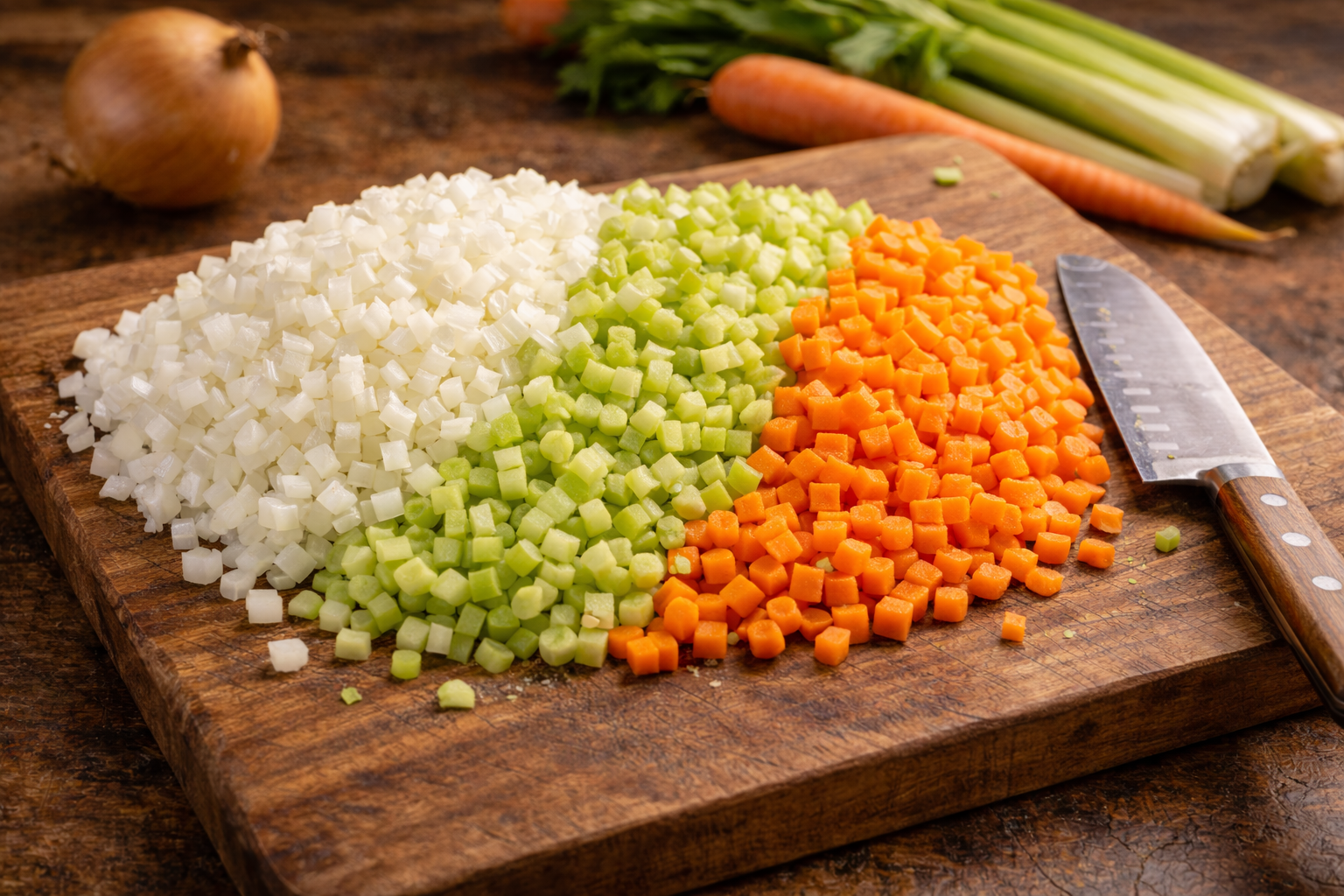
Pronounced meer-PWAH, mirepoix is the classic French combination of onion, carrot, and celery—traditionally in a 2:1:1 ratio—used as the starting point for everything from soups and stocks to braises and sauces.
Print Pin Rate
Category: HARVEST
Cuisine: French
Course: Cooking Base
Keyword: Carrot, Celery, Onion
Prep: 15 minutes
Cook: 10 minutes
Total: 25 minutes
Servings: 4 servings
Calories: 100kcal
Author: TastyDaddy

Ingredients

Instructions

Washing & Prepping Vegetables

  • It is very important to thoroughly wash and dry 2 medium yellow onion, 4 stalks celery, and 3 large carrots before starting to cut.
  • Peel washed onion and remove tough outer layers of onions. Remove both root and leaf ends of washed celery stalks. Trim top of carrots. If carrots still appear a bit dirty after washing, you can give them a quick peel; be sure to rewash them after peeling.
  • TIP: If onion peels, celery trimmings, and carrot tops are completely dirt-free, save them in your freezer scrap bag to use in stocks and broths.

Chopping Vegetables

  • With your butcher block and chef knife, cut onion, celery, and carrot according to the type of recipe you'll be using the mirepoix in:
    • Sauce or stir fry = small dice (⅛ - ¼ inch pieces)
    • Stews and soups = medium dice (½ inch pieces)
    • Stocks and broths = large dice (1 - 2 inch pieces)

Cooking

  • Melt the butter in a medium or large skillet or pot over medium heat. Add the onions, celery, and carrots, tossing to coat them evenly. Cook, stirring often, until the vegetables are tender and the onions turn soft and translucent, about 10 minutes.

Nutrition

Calories: 100kcal | Carbohydrates: 12g | Protein: 1g | Fat: 6g | Saturated Fat: 4g | Polyunsaturated Fat: 0.3g | Monounsaturated Fat: 1g | Trans Fat: 0.2g | Cholesterol: 15mg | Sodium: 116mg | Potassium: 359mg | Fiber: 3g | Sugar: 5g | Vitamin A: 9377IU | Vitamin C: 8mg | Calcium: 48mg | Iron: 0.4mg

Aromatic Blends

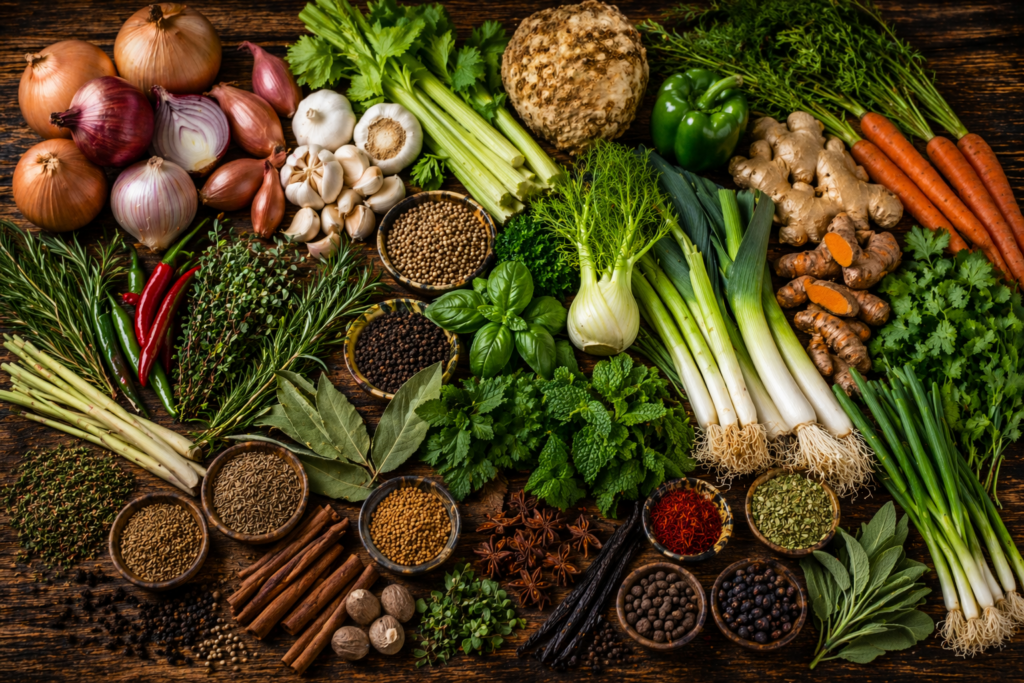
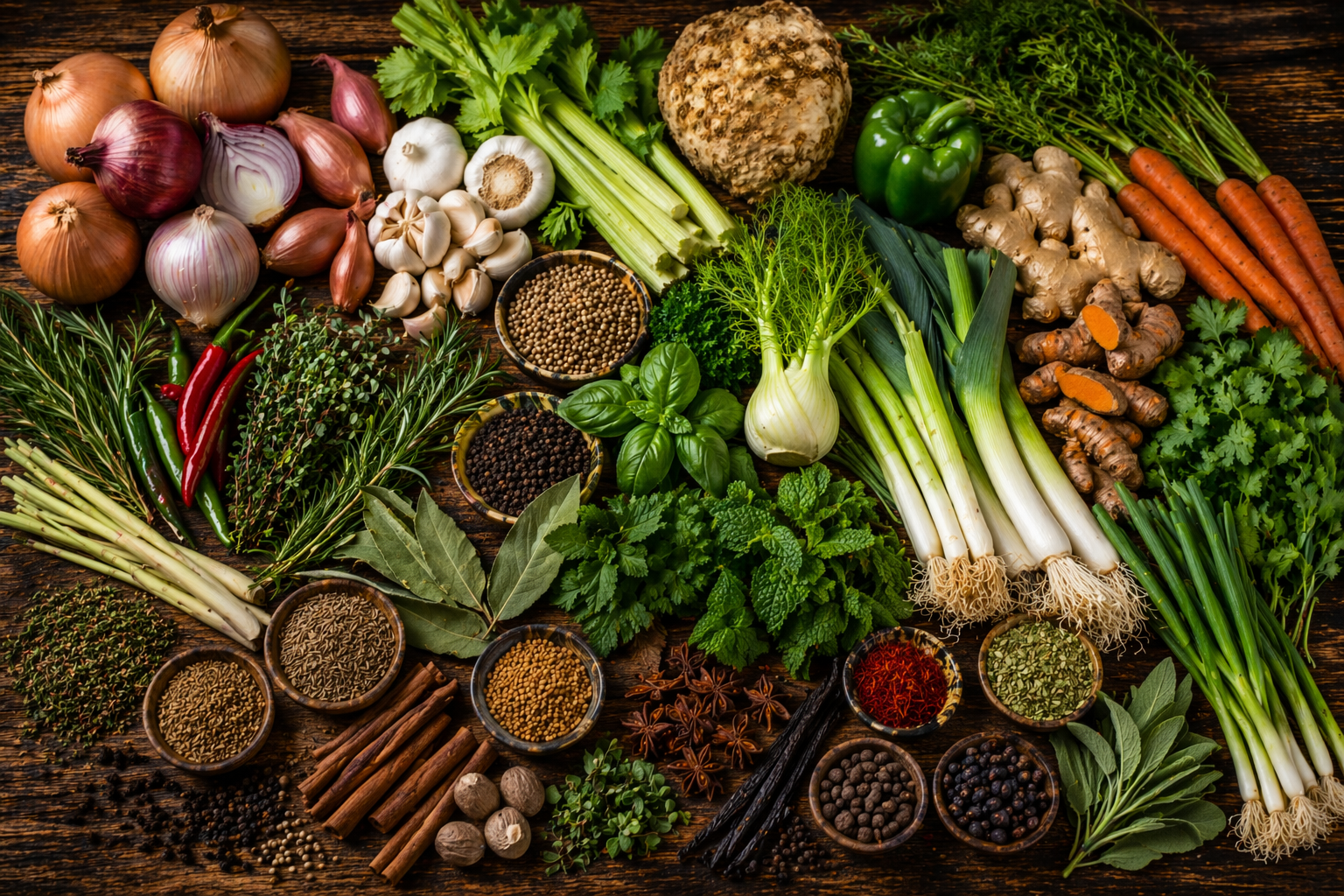
Aromatic blends are where cooking begins—long before a dish takes shape on the plate. By gently cooking a combination of vegetables, herbs, and fat at the start, you create a foundation that allows everything else to develop with depth and cohesion. As these ingredients soften and transform, they move from sharp and separate to something unified, carrying flavor forward into every layer that follows.

Across cuisines, the ingredients may change, but the purpose remains the same: build flavor early so the dish doesn’t have to chase it later. Understanding how to work with aromatics—how heat, fat, and time shape their character—gives you control over the final result. It’s a simple step, but one that defines how everything else comes together.

Aromatic Blends

Where It Begins

Every cuisine begins in a similar place, even if it doesn’t immediately appear that way on the plate. Before proteins are seared, before liquids are added, and before seasoning is adjusted, there is almost always a foundational step where a combination of vegetables, herbs, and fat is brought together and gently cooked. This process is not meant to finish a dish, but to prepare it—to establish a base that everything else will build from. That base is what we refer to as an aromatic blend.

While the ingredients themselves vary across regions and traditions, the intent remains consistent. Whether the base leans on onion, garlic, carrot, celery, peppers, or a mix of herbs and spices, it serves the same purpose: to create depth early in the cooking process. Rather than relying on complexity added later, the dish develops from within, shaped by the transformation that happens in those first few minutes over heat.

What Happens in the Pan

When raw aromatics are introduced to heat and fat, the change is gradual but significant. The initial sharpness of onion or garlic begins to soften as moisture is released and cooked off. As that moisture evaporates, natural sugars concentrate, allowing the ingredients to take on a subtle sweetness that wasn’t present in their raw state. At the same time, the fat in the pan absorbs and distributes these developing flavors, creating a medium that carries them forward into the rest of the dish.

This stage is less about visual cues and more about sensory awareness. The sound shifts as the water content decreases, the aroma becomes more rounded and less aggressive, and the texture transitions from firm to tender. What begins as a collection of distinct components gradually becomes something cohesive, no longer functioning as separate ingredients but as a unified base that can support additional layers of flavor.

Why It Matters

Aromatic blends influence how a dish develops from start to finish, often in ways that are not immediately obvious but are clearly felt in the final result. When this step is handled with care, the flavors of the dish tend to integrate more naturally. Liquids added later carry more depth because they are built on an already developed base, and proteins introduced to the pan absorb and reflect those underlying flavors rather than sitting apart from them.

When the process is rushed or overlooked, the absence becomes apparent in a different way. The ingredients may still be properly cooked, and the seasoning may be technically correct, but the dish can feel disjointed. Flavors remain isolated rather than connected, and the overall result lacks the sense of cohesion that defines a well-built dish. This is not a matter of adding more ingredients or adjusting seasoning at the end; it is a matter of how the dish was constructed from the beginning.

A Shared Structure Across Cuisines

Although aromatic blends are often associated with specific culinary traditions, their underlying structure is remarkably consistent across cultures. Different cuisines arrive at their own combinations based on available ingredients, regional preferences, and historical context, but they all follow the same foundational approach: something is cooked down first, allowed to transform, and then used as the base for everything that follows.

In some traditions, this process is subtle and restrained, with the aromatics cooked gently to preserve their softness and sweetness. In others, it is more assertive, allowing for deeper browning and a more pronounced flavor profile. There are also variations in texture, ranging from finely minced blends that nearly dissolve into the dish to larger cuts that maintain more of their structure. Despite these differences, the purpose remains unchanged. Each variation reflects a different expression of the same core idea: that flavor is built, not simply added.

Working With Aromatics

Approaching aromatic blends effectively requires attention to a few key elements, all of which influence how the ingredients behave in the pan. Heat should be controlled rather than aggressive, allowing the vegetables to soften and release moisture before any attempt is made to develop color. Fat plays an essential role, both in preventing scorching and in carrying flavor throughout the dish. Early seasoning, particularly with salt, helps draw out moisture and encourages even cooking.

Time is the factor that ties all of this together. Allowing the aromatics to move through their stages—from raw and sharp to softened and fragrant, and eventually to lightly developed or browned—gives you control over the final character of the dish. A gentler approach produces a softer, more integrated base, while a longer cook with slightly higher heat introduces deeper, more complex notes. The key is not in choosing one method over another, but in understanding how each approach shapes the result.

Where Everything Builds From

Once the aromatic base is established, the rest of the cooking process becomes more cohesive. Deglazing the pan pulls up not just browned bits, but concentrated flavor that has already been developed through the aromatics. Stocks and sauces gain additional depth because they are built on something that has already undergone transformation. Proteins and other primary ingredients are introduced into an environment that supports and enhances them, rather than one that requires them to carry the dish on their own.

This foundation allows each subsequent step to build with greater intention. Instead of layering flavors in isolation, the dish develops as a continuous progression, with each addition interacting with what has already been established. The result is not simply more flavorful, but more unified, with each component contributing to a cohesive whole.

A Starting Point, Not a Formula

Aromatic blends are best understood as a framework rather than a fixed set of rules. While specific combinations are tied to particular cuisines, the broader concept is flexible and adaptable. Ingredients can be adjusted based on what is available or what the dish calls for, and proportions can shift to emphasize certain characteristics over others.

Understanding this flexibility allows you to move beyond simply replicating established blends and begin using them more intentionally. Rather than following a prescribed combination, you can think in terms of balance, structure, and outcome, shaping the aromatic base to suit the direction of the dish. This approach not only deepens your understanding of individual cuisines, but also gives you the tools to adapt and create with greater confidence.

Explore the Blends

Each aromatic blend reflects the ingredients, techniques, and preferences of the cuisine it comes from, offering a more specific look at how this foundational step is applied in practice. Exploring these individual blends provides insight into how different regions approach the same underlying concept, and how those choices influence the final dish.

By looking at them side by side, the shared structure becomes clearer, as does the range of expression that exists within it. What changes from one blend to another is not the purpose, but the way that purpose is carried out.