Recaíto

Recaíto is a green, herb-forward aromatic base used throughout Puerto Rican cooking, built from peppers, onion, garlic, and fresh herbs blended into a coarse paste. It’s the backbone of dishes like arroz con gandules, beans, and stews, where it’s added at the start to establish flavor that carries through the entire dish.
Recaíto

What It Is and Where It Comes From

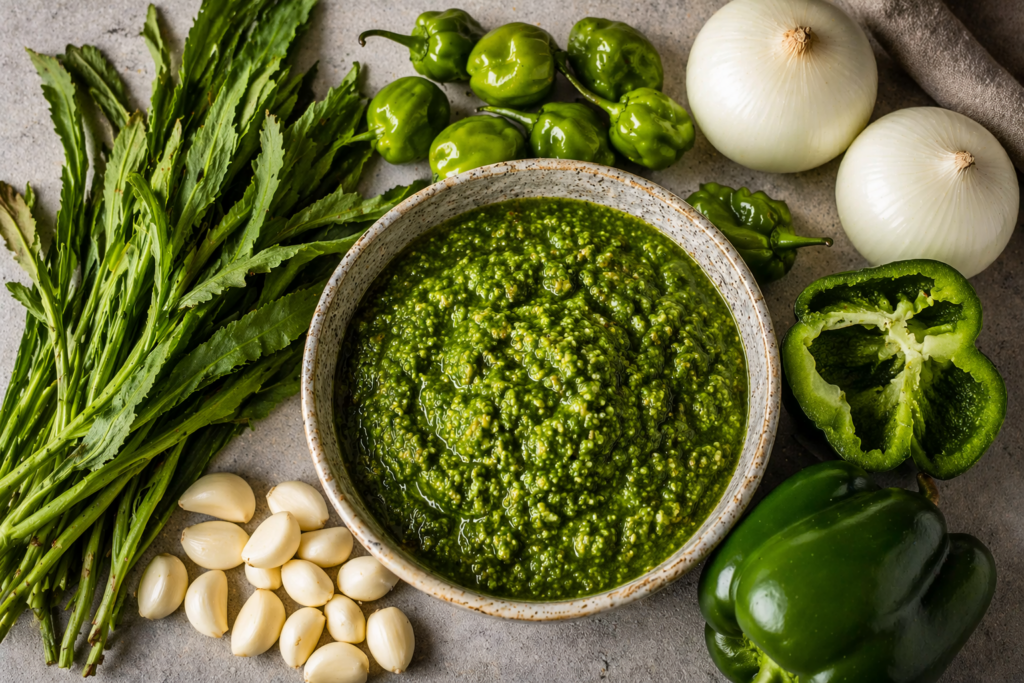
Recaíto is a green, herb-forward aromatic base used throughout Puerto Rican cooking, built from peppers (green bell and ají dulce), onion, garlic, and fresh herbs (culantro and cilantro) blended into a coarse paste. It’s the backbone of dishes like arroz con gandules, beans, and stews, where it sets the direction of the flavor from the first step..

the ingredients that define it

Recaíto is built from a small group of ingredients, but each one plays a specific role in shaping its flavor. Its character comes from the balance between fresh herbs and mild, aromatic peppers, creating a base that is both bright and savory with a depth that builds as it cooks. The texture allows it to disperse quickly in the pan, coating ingredients and setting the tone early, so that every layer of the dish develops from the same foundation.

Recao (Culantro)

At the center of it all is recao, also known as culantro. Despite the similar name, it is not a typo or variation of cilantro—they are two distinct plants with different structures and flavor profiles. This is where recaíto gets its name, and it’s what gives the blend its defining character.

While often compared to cilantro, the flavor is more concentrated and slightly deeper, with a more pronounced herbal edge. The leaves are long and serrated rather than soft and feathery, and they hold up well in blended preparations, giving the mixture a more persistent, grounded flavor.

Cilantro

Cilantro works alongside recao, adding brightness and lift. It softens the intensity of culantro without replacing it, keeping the blend balanced and preventing it from feeling too dense.

ajíes dulces

Ajíes dulces are small, aromatic peppers commonly used in Caribbean cooking. They resemble small habaneros in shape but carry little to no heat. Instead, they bring a gentle sweetness and a distinct fragrance that defines the aroma of recaíto.

Green bell (or Cubanelle) peppers

These form the base of the pepper component. Green bell peppers bring a slightly bitter, vegetal edge, while cubanelle peppers are milder and a bit sweeter. Either works well, with the choice subtly influencing the final balance.

onion and garlic

Onion and garlic provide body and depth. Onion adds moisture and a mild sweetness, while garlic brings sharpness that mellows once cooked, anchoring the brighter elements of the blend.

How It Works

Recaíto is prepared in advance by blending the ingredients into a coarse paste using a blender or food processor, allowing the flavors to combine before they ever reach the pan. This creates a mixture that is already unified, so it develops as a whole rather than as separate components during cooking.

Because of this, it is commonly made in batches and kept on hand. It can be refrigerated for short-term use or frozen in small portions, making it easy to incorporate into dishes without additional preparation.

How It’s Used

Recaíto is added to hot oil at the beginning of cooking and briefly sautéed to release its aroma. From there, the rest of the dish is built on top of it, whether that’s rice, beans, or a stew. The amount used depends on the dish, but even a small quantity has a noticeable impact. Additional spoonfuls can be added later if needed, allowing the flavor to be adjusted as the dish develops.

storage

Recaíto is typically made in batches and stored for later use. It can be kept in an airtight container in the refrigerator for up to a week, though its flavor is best when used within a few days. For longer storage, it can be portioned into small containers or frozen in ice cube trays, then transferred to a sealed bag once solid. Freezing in cubes makes it easy to use—depending on the size, just add a cube or two directly to the pan when starting a dish. This approach keeps the process efficient while preserving the integrity of the blend.

Recipes that Use recaíto

Recaíto

Recaíto is a green, herb-forward aromatic base used throughout Puerto Rican cooking, built from peppers, onion, garlic, and fresh herbs blended into a coarse paste. It’s the backbone of dishes like arroz con gandules, beans, and stews, where it’s added at the start to establish flavor that carries through the entire dish.
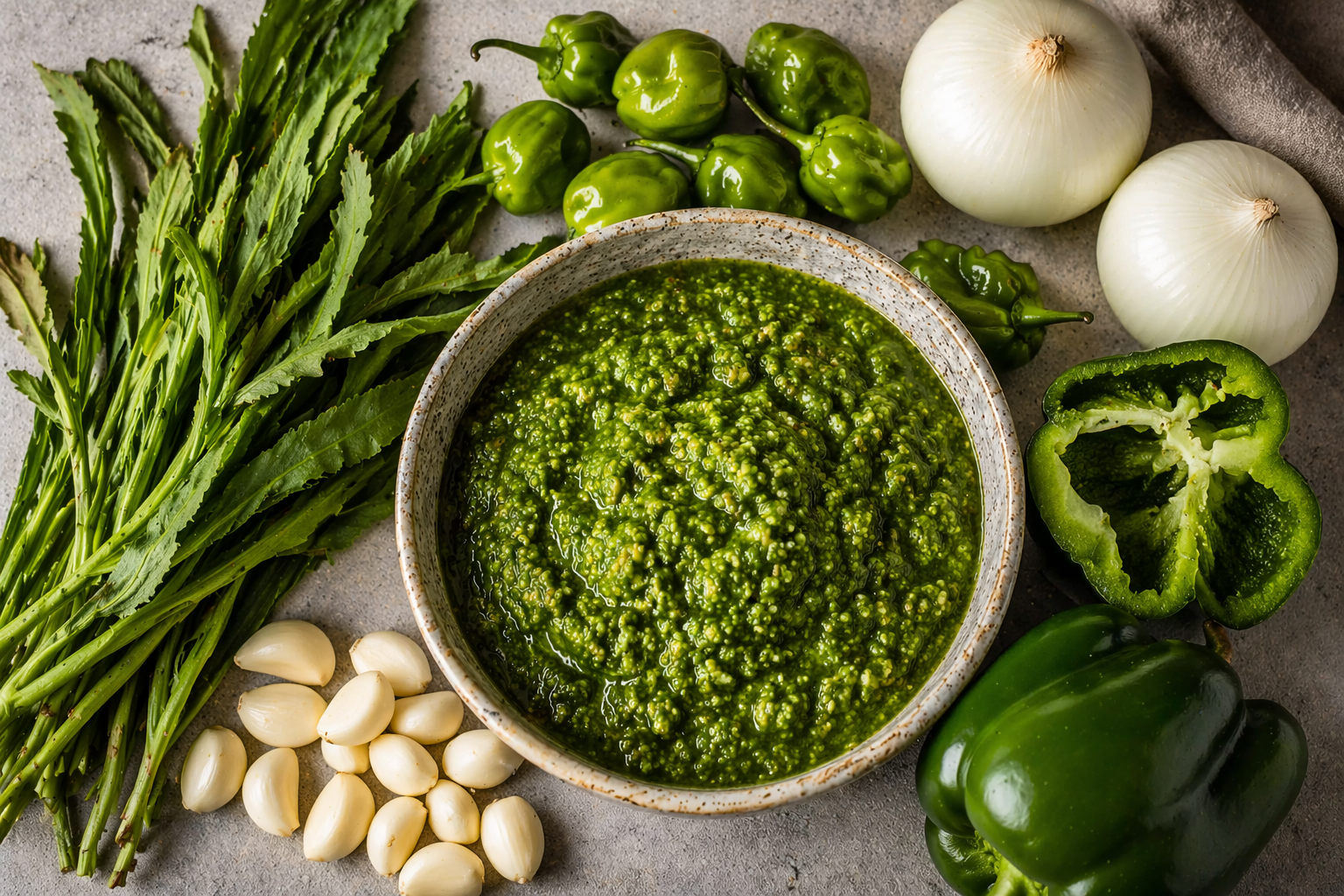
Its character comes from the balance between fresh herbs and mild, aromatic peppers, creating a base that is both bright and savory with a depth that builds as it cooks. The texture allows it to disperse quickly in the pan, coating ingredients and setting the tone early, so that every layer of the dish develops from the same foundation.
Print Pin Rate
Category: HARVEST
Cuisine: Puerto Rican
Course: Cooking Base
Keyword: Ají Dulce, Cilantro, Cubanelle, Culantro, Garlic, Green Bell Pepper, Onion
Prep: 15 minutes
Total: 15 minutes
Servings: 10 servings
Calories: 26kcal

Ingredients

Instructions

Washing & Prep

  • Wash and dry 2 medium green bell pepper, 2 medium onions, 1 bunch culantro, 6 small ajíes dulces, and cilantro.
  • Peel onion and coarsely chop.
  • Removed stem, seeds, and piths from 2 medium green bell pepper and 6 small ajíes dulces; coarsely chop.
  • Peel and cut ends off 20 cloves garlic.
  • Coarsely chop ½ cup cilantro, loosely packed.

Food Processor

  • Add prepped ingredients and 1 bunch culantro to food processor and pulse until thoroughly blended.

Storage

  • Store recaíto in airtight jar in fridge for immediate use.
  • OR pour into silicone ice cube molds and freeze for future use; remove from mold and store frozen recaíto cubes in freezer bag.

Nutrition

Calories: 26kcal | Carbohydrates: 6g | Protein: 1g | Fat: 0.1g | Saturated Fat: 0.03g | Polyunsaturated Fat: 0.03g | Monounsaturated Fat: 0.01g | Sodium: 4mg | Potassium: 106mg | Fiber: 1g | Sugar: 2g | Vitamin A: 197IU | Vitamin C: 23mg | Calcium: 19mg | Iron: 0.3mg
Sofrito

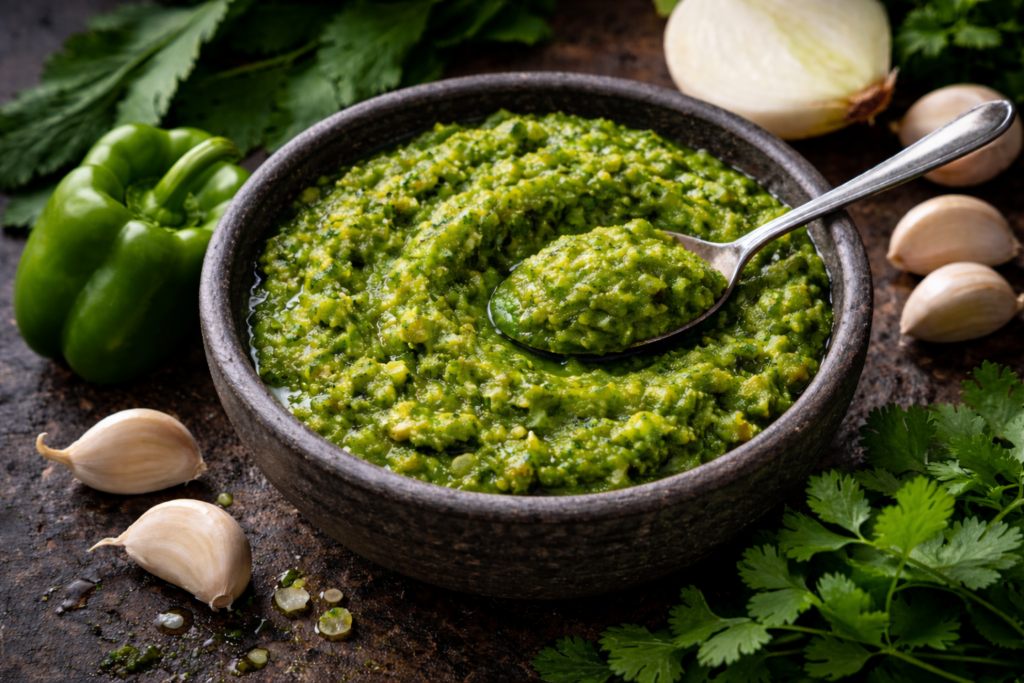
Sofrito is a foundational aromatic blend used across Latin and Caribbean cuisines, built from a combination of peppers, onion, garlic, and herbs that are either finely chopped or blended into a paste and used at the start of a dish. While the ingredients and technique vary by region, the purpose remains consistent: to establish flavor early, allowing it to develop and carry through everything that follows.

Some versions are cooked briefly in oil to deepen and round out their intensity, while others are added fresh, bringing brightness and immediacy to the dish. Whether subtle or assertive, sofrito shapes the identity of what’s being made, providing a base that ties ingredients together and defines the overall flavor from the very first step.

Sofrito

What It Is and Where It Comes From

Sofrito is a foundational aromatic base used across Spanish, Latin American, and Caribbean cuisines. At its core, it’s a blend of alliums, peppers, and often tomatoes or herbs, used to establish flavor at the very start of a dish. What ties them together isn’t a single ingredient or method, but their role: sofrito is the first layer of flavor, the point where a dish begins to take shape.

The name comes from the Spanish verb sofreír, meaning “to sauté,” and in its earliest form, that’s exactly what it was—a mixture built in the pan, slowly cooked to develop depth and sweetness. As the technique moved across regions, it evolved. Some versions remain rooted in that slow, cooked approach, while others incorporate fresh herbs or are prepared as blended pastes ahead of time.

How It Works

Sofrito works by establishing a base that everything else builds on. In some traditions, it’s made directly in the pan—onions, garlic, peppers, and sometimes tomatoes cooked gently in oil until softened, sweetened, and fully integrated. This slow transformation develops depth over time, creating a foundation that feels rounded and cohesive.

In others, the ingredients are blended beforehand into a coarse paste using a blender or food processor, often with fresh herbs. In this form, sofrito is prepared in advance and used as needed, shifting the process. Instead of building flavor gradually from separate components, the mixture is already unified before it ever hits the heat.

How It’s Used

Sofrito is typically added at the beginning of cooking, introduced to hot oil so it can bloom and release its aroma before other ingredients are added. Because it forms the foundation, it doesn’t sit in the background. In rice dishes, it defines how the grains absorb flavor from the start. In beans and stews, it provides continuity through longer cooking, anchoring the dish as liquid is added and reduced. In sauces, it sets the direction early, shaping how everything that follows develops. The amount used depends on the preparation, but it’s often added with intention rather than excess. A measured quantity establishes the base, and additional amounts can be layered in if the dish calls for it—reinforcing flavor without overwhelming it.

Variations

Sofrito shifts from region to region, reflecting local ingredients and cooking styles. Texture can range from finely minced to fully blended, depending on how it’s meant to integrate into the dish. The balance of ingredients—how much onion, how much pepper, whether herbs or tomatoes take the lead—changes the character, but not the purpose.

Some versions are cooked down with tomatoes and olive oil, leaning deeper and slightly sweeter. Others are greener and more aromatic, built with fresh herbs and milder peppers. In some kitchens, it’s always made to order in the pan; in others, it’s kept on hand as a prepared blend, ready to be used at a moment’s notice.

Recipes that Use Sofrito

American Chop Suey

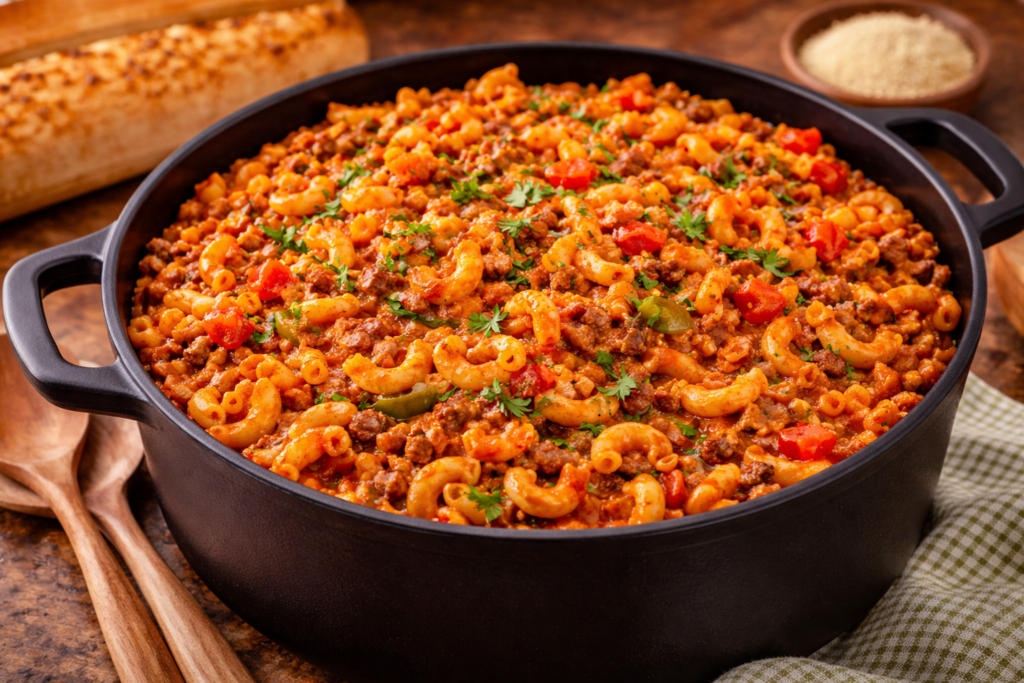
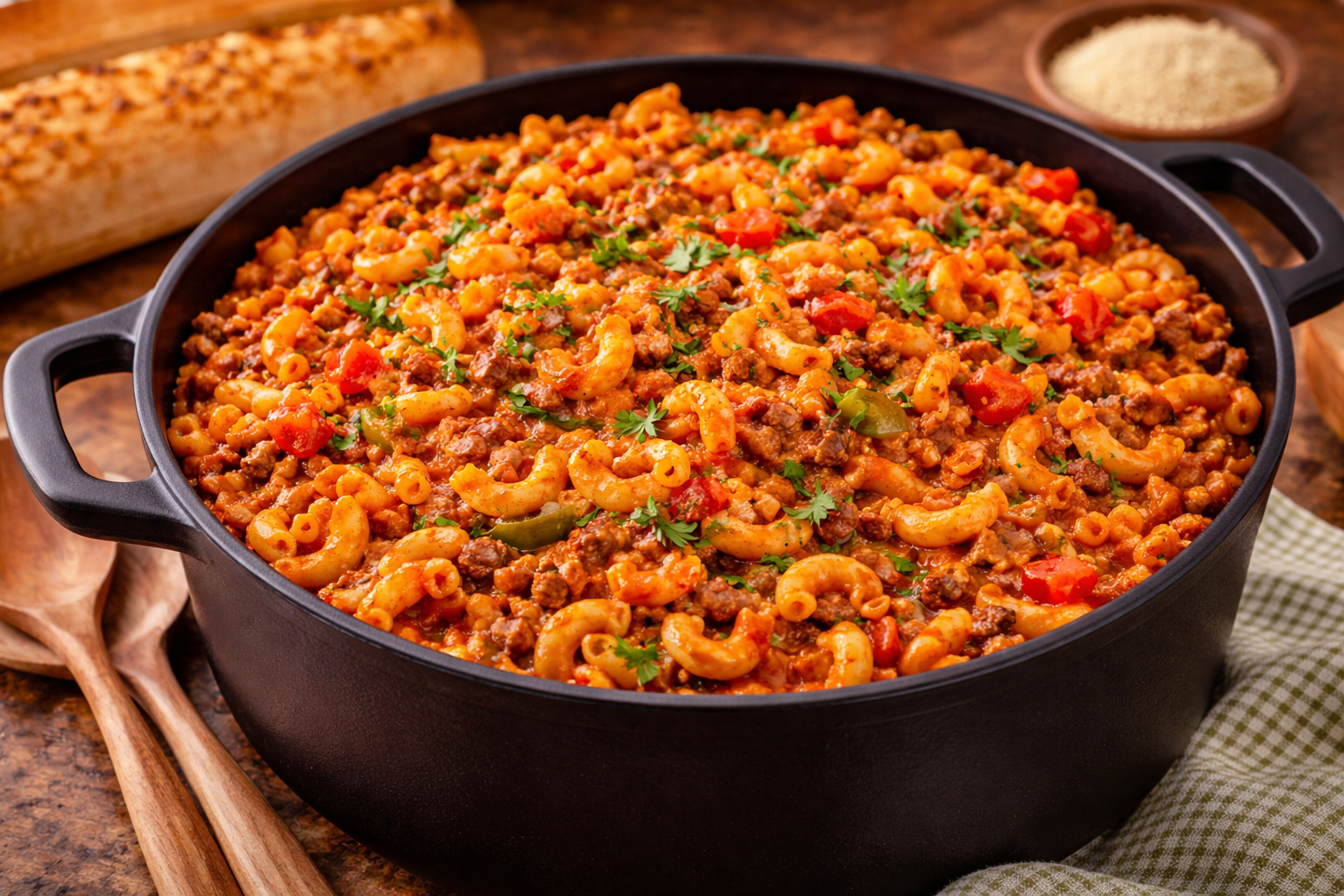
American Chop Suey is a one-pot classic built on simplicity done well—elbow macaroni folded into a savory tomato and beef sauce with softened onions, peppers, celery, and garlic. It’s hearty without being heavy, balancing acidity from the tomatoes with the richness of the meat, while a touch of Velveeta melts in to give the sauce a smoother, more cohesive finish.

The result is a dish that eats like comfort but holds its structure—sauce clinging to every curve of pasta, each bite consistent from start to finish. Depending on where you are, you might hear it called American Goulash, Johnny Marzetti, or something similar, but the foundation stays the same: familiar, unfussy, and built to satisfy.

American Chop Suey

A Regional Classic

American Chop Suey is one of those dishes where the name carries more history than the plate suggests. The term chop suey comes out of Chinese American cooking in the late 19th and early 20th centuries—often used to describe a mixed dish built from whatever ingredients were on hand. As it gained popularity in cities like New York and San Francisco, the name began to drift beyond its original context. Home cooks adopted it more loosely, applying it to one-pot meals that followed the same idea: combine what you have, cook it together, and make it feed a table.

Over time—especially in the Northeast—that concept took on a different identity, shaped by Italian-American kitchens and American home cooking. The ingredients shifted to tomato, pasta, and ground meat, but the underlying idea stayed the same. What remained wasn’t the cuisine—it was the structure: a cohesive, mixed dish built from simple components and made to satisfy.

How It Changes by Region

Because the dish was never standardized, it evolved differently depending on where it landed:

  • American Chop Suey (New England): Tomato-forward, often a bit looser, closer to a saucy pasta.
  • American Goulash (Midwest): Thicker, more concentrated, sometimes heavier on seasoning.
  • Beefaroni (Italian-American, general NE United States): A simpler, more streamlined stovetop version—ground beef and pasta in a smoother tomato sauce, typically with fewer vegetables and a more uniform consistency, reflecting Italian-American red sauce influence.
  • Johnny Marzetti (Ohio Valley): Often baked, occasionally layered, and more likely to incorporate cheese from the start.
  • Slumgullion (Upper Midwest and Western US): A more rustic, frontier-style version—often simpler, looser, and highly adaptable, sometimes stretching ingredients further with extra liquid or fewer aromatics.

Same foundation—different expressions shaped by local kitchens.

Building This Version

This version leans into control—treating each component with intention so the final dish holds together instead of blending into something indistinct. The base starts with onion and green bell pepper—standard aromatics for this dish. Celery isn’t traditional, but it’s part of how I grew up eating it. It adds a subtle vegetal depth and texture that carries through the sauce. In our kitchen, it was always around—either from the store in the off-season or pulled straight from the garden—so it became part of the build.

Garlic follows, just enough to bloom. Then the meat. Ground beef forms the base, but Italian sausage—sweet, mild, or hot—can be added depending on how you want to shape the flavor. Sweet or mild sausage rounds things out and leans more classic. Hot sausage adds heat and a sharper edge that cuts through the richness.

The Sauce: Flexible by Design

The sauce is layered to control both texture and balance:

  • Diced tomatoes for structure
  • Tomato soup for body and built-in richness
  • Passata for smoothness
  • Tomato paste for depth
  • Beef stock to add liquid for the final pasta cook and to bring it all together

There’s room to move here. A can of diced tomatoes with green chilis adds a subtle heat and brightness. Fresh garden tomatoes—when available—bring a cleaner, more natural acidity and a lighter texture that shifts the entire feel of the dish. I grew up seeing a spoonful of sugar added to cut through the sharpness of stewed tomatoes.

Instead, this version balances that same idea at the source—using a combination of passata and tomato soup. The soup leans slightly sweeter and richer, which softens the acidity and creates a smoother, more velvety base—especially once everything comes together with the cheese.

Why the Pasta Is Soaked, Not Boiled

Traditionally, this dish is made with elbow macaroni—and it works. But for leftovers, it tends to soften too much. Cavatappi or mini penne hold their shape better, giving the dish more structure even after it’s been refrigerated and reheated. My family would probably give me a strange look with this step, but instead of cooking the pasta separately (like I’d learned), I now soak my pasta in hot water and finish cooking it directly in the sauce later.

That shift does two things:

  • The pasta absorbs the flavor of the sauce as it finishes cooking.
  • The reserved soaking water introduces starch that helps bind everything together. It’s not optional, regardless of cooking before or soaking—it’s what tightens the sauce so it clings to the pasta instead of sitting around it.

The Velveeta Adjustment

Cheese isn’t part of the traditional New England version I grew up with, but during my time in Michigan, it was a common addition—usually shredded and mixed in or layered through. The problem was consistency. Shredded cheese tends to go stringy, and once it cools, it can separate or settle, leaving the bottom of the pot coated in congealed cheese.

Velveeta solves that. It melts cleanly into the sauce, creating a smooth, cohesive finish without turning the dish into something heavy or overly cheesy. Combined with the slightly sweeter, more rounded tomato soup base, it creates a texture that feels unified from edge to edge without separation.

Final Thoughts

American Chop Suey was never meant to be exact. It’s a dish shaped by what’s available, what’s familiar, and what works. The name comes from one place, the ingredients from another, and the method from somewhere in between. Handled with intention, it becomes something structured—balanced, consistent, and built to hold together from the first bite to the last.

You’ll find the full method outlined below, step by step—but the key is in how each stage builds on the last. From properly softening the aromatics, to layering the sauce, to finishing the pasta directly in the pot, each move is designed to control texture and consistency rather than leaving it to chance.

American Chop Suey

American Chop Suey is a one-pot classic built on simplicity done well—elbow macaroni folded into a savory tomato and beef sauce with softened onions, peppers, celery, and garlic. It’s hearty without being heavy, balancing acidity from the tomatoes with the richness of the meat, while a touch of Velveeta melts in to give the sauce a smoother, more cohesive finish.
The result is a dish that eats like comfort but holds its structure—sauce clinging to every curve of pasta, each bite consistent from start to finish. Depending on where you are, you might hear it called American Goulash, Johnny Marzetti, or something similar, but the foundation stays the same: familiar, unfussy, and built to satisfy.
Print Pin
Category: FEAST
Cuisine: American, Italian-American, Midwest, New England, Southern
Course: Main Course
Keyword: Comfort, Ground Beef, Macaroni, Tomato
Prep: 15 minutes
Cook: 25 minutes
Resting Time: 10 minutes
Total: 50 minutes
Servings: 8 servings
Calories: 629kcal
Author: TastyDaddy

Ingredients

Instructions

Wash the Vegetables

  • Thoroughly wash and dry green pepper, celery, onion, garlic, and parsley.

Soak the Pasta

  • Instead of cooking the pasta (as most recipes call for), I soak my pasta in hot water for about 20 minutes—while I prepare the rest of the ingredients—and finish cooking it in the sauce later.
  • The traditional recipe calls for elbow macaroni, but you can use other tubular pasta. I like to use cavatappi or mini penne (because they hold up better for leftovers).

Cut the Vegetables

  • With the butcher block and chef's knife, dice 1 large yellow onion and set aside in prep bowl.
  • Chop 2 stalks celery and set aside in prep bowl.
  • Dice 1 whole green bell pepper and set aside in prep bowl.
  • Mince 2 cloves garlic and set aside in prep bowl.
  • Trim stems off parsley and coarsely chop leaves, enough to fill ¼ cup.

Cook Vegetables

  • Heat Dutch oven over medium high heat and melt 2 tbsp butter.
  • Add diced onion, diced green pepper, and chopped celery to Dutch oven and cook until tender.
  • Add minced garlic to Dutch oven and brown for 1-2 minutes.
  • Remove cooked vegetables from pan and set aside in mixing bowl.

Brown Meat

  • Add 1 lb ground beef to Dutch oven and season with 1 tbsp Kosher salt, ½ tsp black pepper, 1 tsp dried oregano, 1 tsp dried basil, 1 tsp onion powder, 1 tsp paprika, and 1 tsp celery seed directly in pan.
  • If you'd like to make the dish a bit more hearty, add the optional 1 lb ground sausage.
  • Once meat is browned, drain excess fat.
  • Return meat to pan and add 1 tbsp Worcestershire sauce, stirring to combine.

The Sauce

  • Return veggies back to pan.
  • Empty 14 oz diced tomatoes (undrained) to pan; stir to combine
  • If you would like to add a little kick to the dish, substitute the plain diced tomatoes with a can mixed with green chilis instead.
  • Add 10.75 oz tomato soup, 10 oz passata (or tomato sauce), 6 oz tomato paste, and 2-3 cups beef stock; stir to combine and bring to a boil.

Add Pasta

  • While sauce is heating to a boil, reserve 1 cup of pasta soaking water; set aside.
  • Strain pasta with colander.
  • Once pot has started to boil, add pre-soaked pasta and reserved pasta water to pot and stir to combine.
  • Cover with lid and let pasta simmer for 5-7 minutes (or until desired tenderness).

Cheese

  • While pasta is cooking, cut 12 oz Velveeta cheese into cubes (so that it will melt easier).
  • Once pasta has finished cooking, add Velveeta cheese cubes to pot and stir until combined.

Serve

  • Garnish each serving with grated parmesan cheese and freshly-chopped parsley.

Nutrition

Calories: 629kcal | Carbohydrates: 45g | Protein: 35g | Fat: 35g | Saturated Fat: 14g | Polyunsaturated Fat: 3g | Monounsaturated Fat: 13g | Trans Fat: 1g | Cholesterol: 106mg | Sodium: 2453mg | Potassium: 1398mg | Fiber: 4g | Sugar: 15g | Vitamin A: 1594IU | Vitamin C: 23mg | Calcium: 334mg | Iron: 5mg