Drinkware isn’t about aesthetics—it’s about intention. Different drinks call for different vessels, each designed to influence temperature, dilution, aroma, and overall experience. From glass to metal, the material and shape both play a role in how a drink is served and how it evolves. The right choice enhances what’s already there, while the wrong one works against it. Learn the difference, and your drinks instantly feel more dialed in.
Drinkware 101: Choosing the Right Vessel for Every Drink
Introduction
Drinkware isn’t about aesthetics—it’s about intention. Different drinks call for different vessels, each designed to influence temperature, dilution, aroma, and overall experience. From glass to metal, the material and shape both play a role in how a drink is served and how it evolves. The right choice enhances what’s already there, while the wrong one works against it. Learn the difference, and your drinks instantly feel more dialed in.
Shot glasses
Shot glasses are built for precision and immediacy, delivering controlled portions in a single, direct serve. While often grouped together, their variations influence both volume and presentation.
The modern shot glass became standardized in the United States in the late 19th to early 20th century, as saloons and distilleries began formalizing pour sizes for consistency and taxation. Earlier versions existed in Europe as small spirit cups, but the American bar culture is what cemented their modern use.
A pony shot typically holds around 1 ounce, a term that dates back to 19th-century American bartending, where “pony” referred to a smaller-than-standard measure.
A shooter glass, generally 2 to 3 ounces, emerged later alongside layered and novelty shots in late 20th-century bar culture, where visual presentation became part of the experience.
Short / Spirit-Forward Glasses
These glasses are designed for drinks served over ice, where dilution is gradual and intentional. Their shorter, wider form allows for stirring, aromatic expression, and controlled evolution.
Old Fashioned Glass - 6 to 10 oz
The Old Fashioned glass, also known as a rocks glass, lowball, or tumbler, typically holds between 6 to 10 ounces. Its wide opening allows for easy stirring and the expression of citrus oils, making it ideal for spirit-forward cocktails like the Old Fashioned or Negroni, where the drink develops as the ice melts.
Tall glasses are built for drinks with length—cocktails that incorporate mixers, carbonation, or larger volumes of ice. Their vertical design helps preserve structure while maintaining balance over time. The rise of tall drinkware is closely tied to the late 19th and early 20th centuries, when carbonation became more widely available and drinks began incorporating soda water as a key component.
The Delmonico glass, typically 5 to 9 ounces, is named after Delmonico’s restaurant in New York, one of the first fine dining establishments in the United States. It represents an early form of structured mixed-drink service, functioning as a more compact highball.
A highball glass, generally 8 to 12 ounces, takes its name from the “highball” style of drink—spirit topped with a larger proportion of mixer. The term dates back to late 19th-century railroad slang, later adopted into bar culture.
A Collins glass, typically 10 to 14 ounces, is named after the Tom Collins cocktail, popularized in the 19th century. Its taller shape accommodates longer, citrus-forward drinks that require both dilution and volume.
A zombie glass, usually 12 to 16 ounces or more, emerged in the mid-20th century alongside tiki culture, designed for larger, multi-ingredient cocktails that required both capacity and visual presence.
Stemmed Cocktail Glasses (Served “Up”)
Tall glasses are built for drinks with length—cocktails that incorporate mixers, carbonation, or larger volumes of ice. Their vertical design helps preserve structure while maintaining balance over time. The rise of tall drinkware is closely tied to the late 19th and early 20th centuries, when carbonation became more widely available and drinks began incorporating soda water as a key component.
The martini glass, or cocktail glass, typically 6 to 10 ounces, evolved in the early 20th century during Prohibition-era cocktail culture. Its exact origin is debated, but it became iconic as cocktails shifted toward being served chilled and without ice.
A coupe glass, generally 5 to 8 ounces, dates back to 17th-century France and was originally used for champagne. It later rose in popularity during the early 20th century—particularly the Prohibition and “Gatsby” era—before becoming a staple for cocktails served up due to its stability and shape.
The Nick & Nora glass, typically 4 to 6 ounces, is named after characters in The Thin Man films of the 1930s, reflecting a more refined, controlled cocktail service style.
A cordial glass, typically 1.5 to 2 ounces, has roots in European after-dinner drinking traditions, designed for liqueurs served in small, concentrated portions.
A brandy snifter, ranging from 8 to 18 ounces, originated in 18th-century Europe, designed to warm the spirit slightly while concentrating aroma through its narrow opening.
An absinthe glass, generally 6 to 10 ounces, became popular in 19th-century France, often featuring a reservoir to guide the traditional dilution ritual.
Large-Format & Aromatic Cocktail Glasses
These glasses are designed for drinks that rely on volume, ice, and aromatic layering, where the experience extends beyond the liquid itself. Their larger bowls and taller profiles create space not just for the drink, but for garnishes, dilution, and movement as the cocktail evolves. Ice plays a more active role here, slowly integrating into the drink over time, while the wider openings allow aromas—often from citrus, herbs, or botanicals—to develop and reach the nose before the first sip. In many cases, presentation becomes part of the function, with the glass helping to frame both the visual and sensory experience in a way that smaller, more restrained vessels cannot.
The margarita glass, typically 10 to 16 ounces, evolved in the mid-20th century alongside the cocktail itself, designed to highlight salted rims and citrus-forward profiles.
A hurricane glass, often 16 to 20 ounces, was popularized in New Orleans at Pat O’Brien’s in the 1940s, designed specifically for the Hurricane cocktail.
A sling glass, typically 10 to 14 ounces, traces its origins to the Singapore Sling and similar long-form cocktails from the late 19th to early 20th century.
The Copa de Balón, generally 16 to 20 ounces, originates from Spain, where it became standard for gin and tonic service, emphasizing botanical aroma through its wide bowl.
Wine Glasses
Wine glassware is designed around aroma, aeration, and temperature control, with its evolution closely tied to European wine traditions. The shape and size of the bowl influence how much air interacts with the wine, how aromas are captured and directed, and how the liquid moves across the palate. Narrower glasses help preserve cooler temperatures and focus more delicate notes, while wider bowls allow fuller-bodied wines to open up and develop complexity. Over time, these distinctions became more intentional, with specific glass styles emerging to complement different types of wine rather than simply serving them.
A red wine glass, generally 12 to 18 ounces, is designed with a broader bowl to allow for aeration, helping to open up aromas and soften tannins while enhancing overall depth.
A balloon-style red wine glass, typically 16 to 22 ounces, developed over centuries to enhance aeration and aromatic complexity in fuller-bodied wines like Burgundy.
A champagne flute, typically 6 to 10 ounces, became popular in the 18th and 19th centuries as sparkling wine production advanced, designed to preserve carbonation.
A grappa glass, typically 3 to 6 ounces, developed in Italy to concentrate the intense aromatics of distilled grape spirits.
Beer Glasses
Beer glassware is deeply tied to European brewing traditions, where specific shapes evolved to complement different styles. Over time, brewers and drinkers recognized that factors like foam retention, carbonation, and aroma all change depending on the vessel. Taller, tapered glasses highlight clarity and preserve effervescence, while wider bowls allow aromas to develop and support a fuller head. Even elements like rim shape and glass thickness play a role in how the beer is perceived, turning what might seem like a simple pour into a more intentional and style-driven experience.
An American pint glass (or Shaker), typically 16 ounces, features a slightly-tapered, cylindrical shape and is one of the most versatile, widely-used beer glasses. Common in American bars, it’s suitable for a broad range of styles—from ales and lagers to stouts—though isn’t optimized for any one in particular.
A nonic (or Imperial) pint, usually 16 to 20 ounces, is an English variation of the pint glass, distinguished by a slight ridge near the top. That ridge improves grip, prevents chipping when stacked, and helps support a more stable head, making it well-suited for British ales and pub-style service.
A pilsner glass, generally 12 to 16 ounces, is tall, slim, and slightly tapered. Its shape showcases clarity and color while preserving carbonation and supporting a defined head, making it ideal for pilsners, lagers, and other lighter, effervescent beers.
A tulip glass, typically 12 to 16 ounces, features a bulbous body with a flared rim. This design traps and concentrates aroma while promoting head retention, making it particularly well-suited for Belgian ales, IPAs, and saisons where aroma plays a central role.
A snifter, usually 8 to 14 ounces, has a wide bowl and short stem, allowing the beer to be gently swirled. This enhances aromatic release while concentrating those aromas at the rim, making it ideal for high-ABV beers like imperial stouts, barleywines, and stronger IPAs.
A weizen glass, typically 16 to 23 ounces, is tall with thin walls and a distinctive curved profile. Its shape supports a large, stable head while allowing the beer’s signature banana and clove aromas—common in wheat beers—to fully develop.
A goblet or chalice, generally 12 to 20 ounces, is thick-walled and stemmed, designed to handle heavier, more complex beers. Its wide bowl allows for aromatic development, while the sturdy construction supports higher carbonation and richer styles like Belgian ales and German bocks.
A stange (or rye glass), usually 6 to 10 ounces, is tall, slender, and cylindrical. Its narrow shape preserves carbonation and directs delicate aromas, making it ideal for lighter, more subtle beers like Kölsch, Gose, and other crisp, low-profile styles.
A beer mug, typically 12 to 20 ounces or more, is thick, durable, and handled to maintain temperature and reduce heat transfer. Traditionally rooted in German beer culture, it’s well-suited for lagers and easy-drinking session beers.
Specialty Glasses
Not all drinkware is defined by shape alone. Some vessels are built around temperature, material, or the overall experience of the drink, playing a more active role in how it’s served and perceived. In these cases, the material itself becomes part of the function—whether it’s metal amplifying cold, glass retaining heat, or ceramic insulating the drink over time. These choices don’t just support the drink; they shape how it feels in the hand, how it’s presented, and how it’s experienced from start to finish.
A tiki mug, generally 12 to 20 ounces or more, is typically made from ceramic and emerged in mid-20th century tiki culture, where presentation and escapism were central to the drinking experience.
A milkshake glass, typically 12 to 16 ounces, developed alongside American diner culture in the early to mid-20th century, designed for thick, blended drinks (like Mudslides) served with straws and spoons.
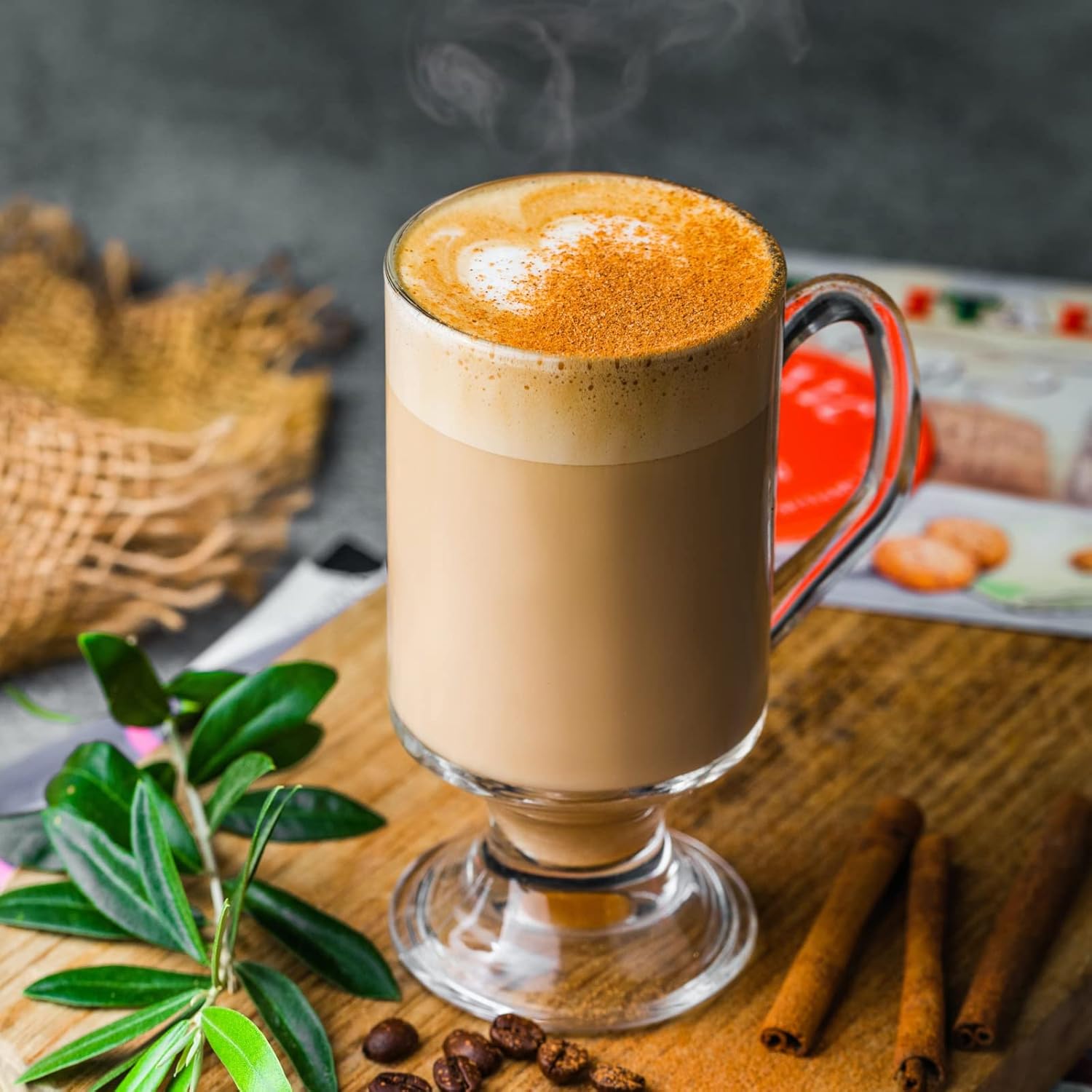
An Irish coffee glass, generally 8 to 12 ounces, originated in the mid-20th century with the Irish Coffee itself, designed to handle heat while showcasing layered presentation.
A julep cup, typically 10 to 12 ounces, dates back to the American South in the 18th and 19th centuries, where metal cups were used to keep drinks cold in warm climates. Its frosted exterior became part of the identity of the Mint Julep.
A mule mug, usually 12 to 16 ounces, was popularized in the 1940s alongside the Moscow Mule, largely as a marketing tool, but its copper construction became integral to the drink’s identity.
Final Thoughts
Drinkware isn’t about having more options—it’s about having the right one for the drink in front of you. Once you understand how size, shape, and material influence balance, temperature, and aroma, you stop treating the vessel as an afterthought and start using it as part of the build. The glass becomes an extension of the technique, guiding how the drink is mixed, served, and experienced from the first sip to the last.
As those choices become more intentional, small details begin to matter more. How quickly the drink chills, how it dilutes over time, and how aromas rise and meet the nose before you taste all start to connect. The right vessel doesn’t call attention to itself, but it allows the drink to perform exactly as it was designed to.
A good drink doesn’t start with the liquor—it starts with how you build it. You can stock your shelves with quality spirits and keep fresh citrus on hand, but if your tools are working against you, the final result will always fall short. Weak dilution, unbalanced ratios, and inconsistent texture are rarely about the ingredients themselves—they’re almost always about a lack of control in the process.
Essential Tools 101
A good drink doesn’t start with the liquor—it starts with how you build it. You can stock your shelves with quality spirits and keep fresh citrus on hand, but if your tools are working against you, the final result will always fall short. Weak dilution, unbalanced ratios, and inconsistent texture are rarely about the ingredients themselves—they’re almost always about a lack of control in the process.
Barware isn’t about aesthetics or trying to recreate a professional bar setup at home. It’s about giving yourself the ability to execute a drink with intention. The right tools allow you to control balance, dilution, temperature, and texture in a way that transforms a drink from something acceptable into something deliberate. The goal isn’t to have more tools—it’s to have the right ones, and to understand why they matter.
The Non-Negotiables
When it comes to building a bar that actually produces good drinks, a handful of tools carry almost all of the weight. These aren’t aesthetic additions or nice-to-have upgrades—they are what give you control over the drink itself. Without them, even the best ingredients won’t come together the way they should.
Shaker
A shaker is essential for any cocktail that includes citrus, juice, egg white, or syrup. Shaking does far more than combine ingredients—it rapidly chills the drink, introduces controlled dilution, and aerates the mixture to create a lighter, more cohesive texture. Without it, drinks that should feel bright and structured instead come across as heavy, flat, or disconnected. While all shakers serve the same core purpose, the way they’re built affects how they perform. Understanding the differences allows you to choose the one that fits your workflow rather than working against it.
The Boston shaker is the most widely used style, consisting of a large metal tin paired with either a pint glass or a second metal tin. It’s favored for its durability, speed, and control, particularly once you’re comfortable with the technique. The seal forms naturally during shaking and releases cleanly with a firm tap, making it efficient in both professional and home settings.
The metal-on-metal variation has become the standard in most modern bars due to its durability and temperature responsiveness, while the classic metal-and-glass setup remains common in more traditional environments. Either way, the Boston shaker is built for performance and tends to be the preferred option for long-term use.
The Cobbler shaker is a three-piece design that includes a built-in strainer and cap. Its self-contained structure makes it more approachable, particularly for beginners, since it doesn’t require a separate strainer and feels more intuitive to assemble and use.
That convenience comes with trade-offs. Cobbler shakers can sometimes stick after shaking due to temperature changes, and the built-in strainer offers less control compared to a separate Hawthorne strainer. Still, for those just starting out or looking for simplicity, it provides a straightforward entry point into cocktail making.
Often referred to simply as a Japanese shaker, this is a refined version of the Cobbler design. While structurally identical, the difference lies in precision and craftsmanship. These shakers are engineered with tighter tolerances, resulting in a smoother seal, easier separation, and a more controlled pour through the integrated strainer.
The experience is noticeably more refined, but the function remains the same. It’s less about necessity and more about preference—an upgrade in feel and performance rather than a fundamentally different tool.
The French shaker occupies a middle ground between the Boston and Cobbler styles. It is a two-piece, all-metal design like the Boston, but without the use of a pint glass and without a built-in strainer. Its clean, minimal form makes it visually appealing, but it requires a separate strainer and offers a slightly different feel when sealing and opening.
While less common, it appeals to those who prefer the simplicity of a two-piece design with a more streamlined aesthetic. Functionally, it performs well, but it is rarely the first choice for a foundational setup.
Jigger
A jigger is what brings consistency to your drinks. Cocktails rely on proportion, and even small deviations in measurement can shift a drink from balanced to sharp, flat, or overly strong. While free-pouring may feel intuitive, it introduces variability that makes it difficult to replicate results, especially when you’re still building muscle memory.
That said, there is another path to consistency—one that comes from repetition and training rather than tools. In professional settings, bartenders are often taught to “count” their pours, developing an internal rhythm that allows them to measure with surprising accuracy. It’s a skill that can be refined over time, and when done well, it’s both efficient and precise.
Personally, that’s the method I was trained on. We practiced it to the point of muscle memory—timed pours, accuracy tests, even competitions—and it becomes second nature once it’s ingrained. But that level of consistency doesn’t happen overnight, and it’s easy to overestimate accuracy without realizing it.
For most home bars, a jigger remains the most reliable way to control your ratios while you’re learning. It removes guesswork, builds your understanding of proportion, and helps you develop a feel for how a drink should come together. Even if you eventually move toward free-pouring, starting with a jigger gives you a baseline that makes everything else more intentional.
Standard Double Jigger
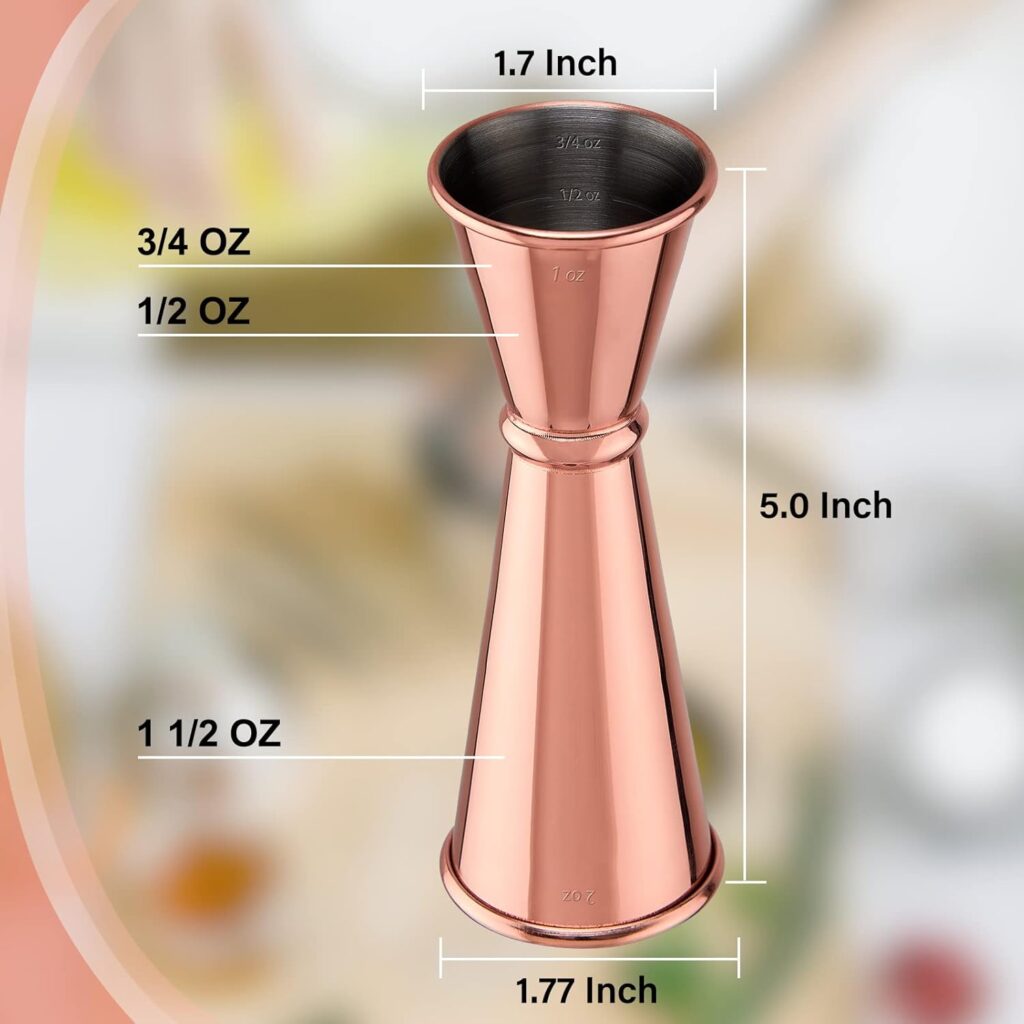
The most common style is the double-sided jigger, typically offering two measurements—often one ounce on one side and two ounces on the other, with additional internal markings for smaller quantities. Its symmetrical design makes it quick to use and easy to incorporate into your workflow. A well-designed jigger should feel balanced in the hand, pour cleanly, and have clearly visible measurement lines. Over time, even if you rely less on it, it remains a valuable reference point for dialing in proportions and maintaining consistency.
After a drink is shaken or stirred, a strainer controls what makes it into the glass. This step is essential for maintaining texture, preventing unwanted ice shards or solids from diluting the drink further, and ensuring a clean final presentation.
The Hawthorne strainer is the standard for use with a Boston shaker and French shaker. Its coiled spring fits snugly against the inside of the tin, allowing it to catch ice and other ingredients while still letting liquid flow smoothly. It provides control over the pour and adapts easily to different shaker sizes. This is the most versatile and widely used strainer, making it the default choice for most setups.
A fine mesh strainer is often used alongside a Hawthorne strainer for double straining. This additional layer removes smaller ice fragments, pulp, and fine particles that would otherwise affect the texture of the drink.While not necessary for every cocktail, it becomes especially valuable when working with citrus, herbs, or egg whites, where clarity and smoothness are more noticeable.
Bar Spoon
A bar spoon is designed specifically for stirring cocktails, particularly those that are spirit-forward and do not require shaking. Its long handle allows it to reach the bottom of a mixing glass, while its twisted shaft helps guide smooth, controlled movement through the liquid.
Stirring is about precision rather than force. The goal is to chill and dilute the drink evenly without introducing unnecessary agitation. A proper bar spoon makes this process feel fluid and controlled, whereas a standard spoon often feels clumsy by comparison.
Fresh citrus is one of the most impactful ingredients in a cocktail, and how you extract it matters. Bottled juice lacks the brightness and complexity of fresh citrus, often resulting in drinks that taste muted or unbalanced.
A citrus press allows you to extract juice efficiently while keeping seeds and excess pulp out of the mix. It simplifies the process, improves yield, and ensures consistency from one drink to the next. For any cocktail that relies on citrus, it’s an essential tool that delivers immediate results.
Once the foundational tools are in place, the next layer of barware is less about making a drink possible and more about making it better. These are the tools that refine technique, improve texture, and elevate presentation. You can absolutely make great cocktails without them, but once you start using them, the difference becomes difficult to ignore.
A mixing glass becomes essential the moment you begin working with spirit-forward cocktails. Drinks like an Old Fashioned, Manhattan, or Negroni are not meant to be shaken, as shaking introduces aeration that disrupts their texture. Instead, they rely on controlled stirring to chill and dilute while maintaining clarity and weight.
While you can technically stir in a shaker tin or even a standard glass, a proper mixing glass provides both space and stability. Its wider base allows for smoother, more controlled movement of the bar spoon, which results in more even dilution. Over time, this translates into drinks that feel more cohesive, with a cleaner finish and a more intentional texture.
A julep strainer is traditionally used with a mixing glass, offering an alternative to the Hawthorne strainer when working with stirred drinks. Its bowl-shaped design fits neatly inside the mixing glass, allowing you to control the pour while keeping ice back.
Functionally, it achieves the same goal as a Hawthorne strainer, but the experience is different. The julep strainer feels more streamlined in this context, particularly when working exclusively with stirred cocktails. It’s less about necessity and more about preference, but for those who enjoy the process as much as the result, it adds a level of refinement that feels intentional rather than improvised.
A muddler becomes important when working with fresh ingredients such as herbs, fruit, or sugar cubes. The goal is not to crush aggressively, but to gently press and release essential oils and juices without breaking down the ingredients too far.
This distinction matters more than most people realize. Over-muddling, especially with herbs, can introduce bitterness that throws off the balance of the drink. A proper muddler gives you control over that pressure, allowing you to extract flavor cleanly while maintaining the integrity of the ingredients. It’s a simple tool, but one that rewards restraint and technique.
Garnish is often treated as an afterthought, but it plays a critical role in how a drink is experienced. Aroma is a major component of flavor, and citrus oils—expressed over a drink or incorporated as a garnish—can completely change how it presents.
A peeler, channel knife, or zester allows you to work with citrus in a more controlled and intentional way. Whether you’re creating a wide peel to express oils over an Old Fashioned or a finer zest to layer subtle aroma into a drink, these tools give you the ability to shape that final detail. It’s not just about appearance—it’s about enhancing the drink before the first sip.
Ice is one of the most overlooked components of a cocktail, yet it has a direct impact on both dilution and presentation. Standard ice cubes melt quickly and inconsistently, which can dilute a drink faster than intended and alter its balance as it sits.
Large-format ice—whether in the form of spheres or oversized cubes—melts more slowly and evenly. This gives you greater control over how the drink evolves over time, particularly in spirit-forward cocktails like an Old Fashioned. The slower melt preserves structure, while the visual impact adds a level of polish that elevates the entire experience.
Final Thoughts
Barware is not about collecting tools for the sake of it, but about removing variables that stand between you and a well-made drink. Each piece has a purpose, and when that purpose is understood, the process becomes more intuitive and the results more consistent.
As you begin to build your bar, the difference becomes immediately noticeable. Balance is easier to achieve, dilution becomes controlled rather than accidental, and the overall experience feels more deliberate. The goal is not to replicate a professional bar, but to understand the mechanics behind what makes a drink work—and to give yourself the tools to execute it well.
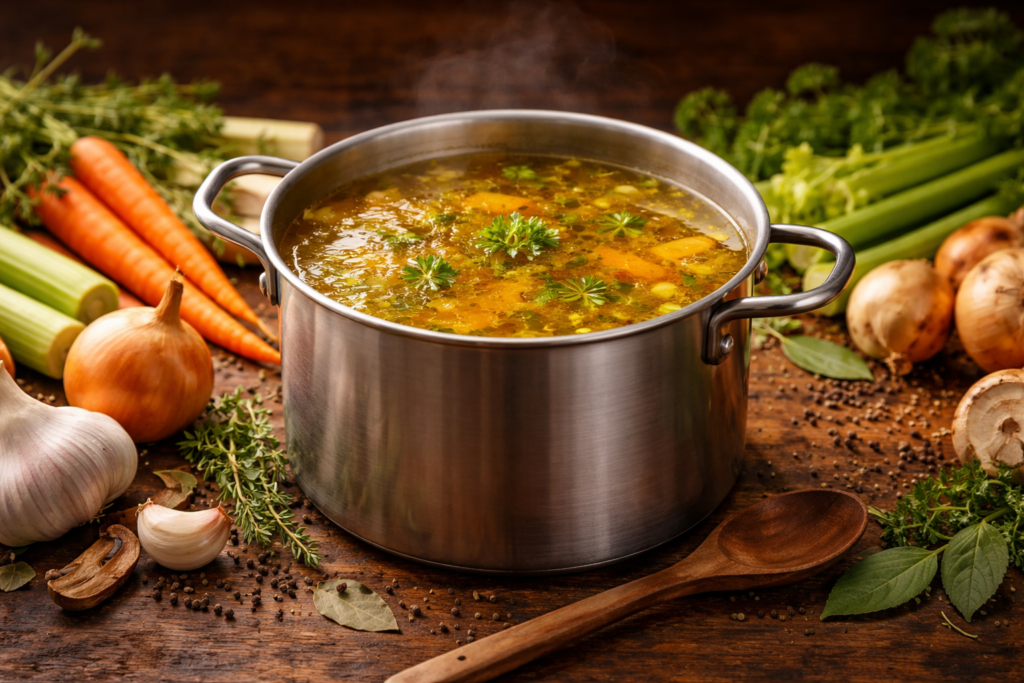
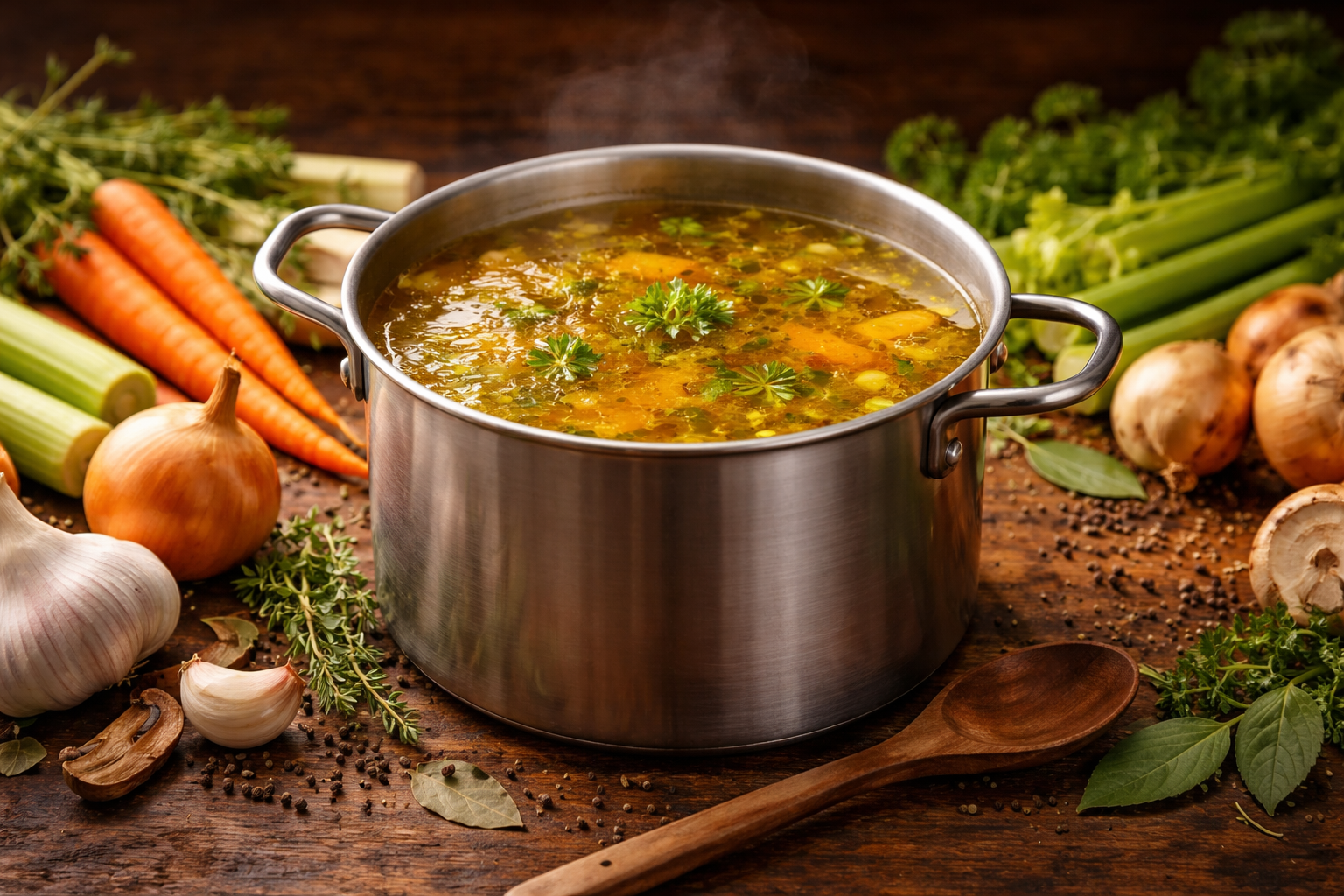
Vegetable broth is a study in extraction and balance—built not on bones or fat, but on the precise layering of aromatics, water content, and time. At its best, it delivers a clean, structured flavor profile with natural sweetness, vegetal depth, and a subtle umami backbone.
Vegetable broth is a study in extraction and balance—built not on bones or fat, but on the precise layering of aromatics, water content, and time. At its best, it delivers a clean, structured flavor profile: natural sweetness from alliums and carrots, vegetal depth from celery and leeks, and a subtle umami backbone often coaxed from mushrooms, tomato, or seaweed. The goal isn’t intensity for its own sake, but clarity—each component contributing without muddying the whole.
Technique matters. A gentle, controlled simmer preserves brightness and prevents bitterness, while careful ingredient selection avoids overly sulfuric or tannic notes (looking at you, overcooked brassicas). Properly made vegetable broth should taste full yet transparent, with a light body that supports rather than dominates.
Building flavor before the simmer
Building flavor starts before the water ever hits the pot. Taking the time to sweat or lightly roast your mirepoix—onions, carrots, celery—coaxes out their natural sugars and deepens the overall profile of the broth. Sautéing keeps things clean and controlled, enhancing sweetness without introducing bitterness, while roasting adds a more caramelized, slightly darker complexity. Neither is required, but both shift the final result from simply “vegetal” to intentionally layered.
The freezer scrap advantage
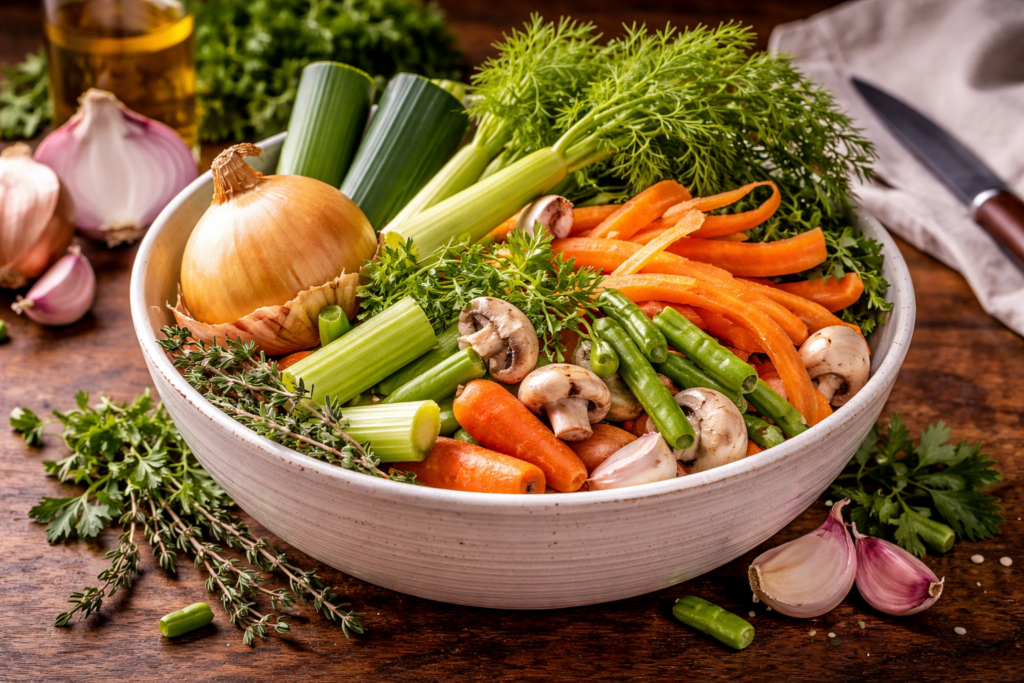
Vegetable broth is as much about resourcefulness as it is technique. A well-managed freezer scrap bag can produce a broth just as nuanced as one made from pristine ingredients. Onion skins, carrot peels, celery ends and interior leaves, leek or fennel tops, mushroom stems, herb stems—these aren’t scraps, they’re concentrated flavor.
Not all scraps are equal—and that’s where the nuance comes in. Onion skins deepen color and add subtle sweetness. Mushroom stems bring body and umami. Leek tops contribute a softer, greener allium note, while carrot peels reinforce sweetness. Even small additions can shift the profile. The goal isn’t to throw everything in—it’s to build something intentional from what you already have. The key is curation. Avoid anything overly bitter or sulfuric: brassicas like broccoli, cauliflower, and cabbage can quickly dominate; starchy vegetables like potatoes will cloud both texture and flavor; and overly sweet scraps, like large amounts of bell pepper, can throw off balance.
TIP: If it’s going into your scrap bag, it needs to be properly washed—no exceptions. Dirt and grit don’t cook out; they settle in. I thoroughly wash and dry all of my fruits and vegetables, typically when I bring them home from the grocery store. Taking the time to rinse and dry vegetables before trimming ensures that what you’re saving is flavor, not contamination.
Timing is key
When ingredients go into the pot matters just as much as what goes in. Hardy aromatics—onions, carrots, celery—can simmer from the start, building the foundation. More delicate elements should be added later to preserve their integrity.
Fresh herbs and tender scraps like parsley stems or thyme are best added in the last 5-10 minutes or steeped in the broth as it cools. The same goes for umami boosters like nori or kombu: powerful in small amounts, but easily overwhelming if left too long. Think of them as accents, not the base.
Straining
Once your broth has finished simmering, the final step is refinement. Remove it from heat and use a spider strainer ladle (or slotted spoon) to lift out the larger solids, allowing the liquid to settle for at least 10 minutes before straining. This initial rest helps separate suspended particles and makes for a cleaner pass through your strainer.
Set a mesh strainer over a clean stockpot and pour the broth through, discarding what’s filtered out. Set filtered broth aside and wash both the mesh strainer and the stockpot you initially used for simmering the broth. Line the clean strainer with dampened cheesecloth and strain broth again into clean stockpot. Wetting the cloth beforehand is key—it prevents absorption and preserves your yield. This second pass isn’t always necessary, but it’s the difference between a good broth and one with professional-level clarity.
Storage
From there, cooling becomes just as important as cooking. Let the broth cool slightly at room temperature, then transfer to the refrigerator to chill completely. This not only preserves freshness but also stabilizes the flavor.
In the refrigerator, vegetable broth will keep for about 4–5 days. For longer storage, freezing is the better option—and where a little foresight pays off. Portioning matters. Silicone freezer trays (like Souper Cubes) allow you to freeze broth in consistent, usable amounts. Always chill the broth fully before portioning, then freeze until solid and transfer the cubes to airtight freezer bags. This frees up your trays and gives you a ready supply of broth that can be used exactly as needed—whether that’s a full quart for soup or a small cube to build a pan sauce. Well-stored, frozen broth will hold its integrity for 3–5 months without sacrificing clarity or balance.
Recipes that use this broth
Homemade Vegetable Broth
Vegetable broth is a study in extraction and balance—built not on bones or fat, but on the precise layering of aromatics, water content, and time. At its best, it delivers a clean, structured flavor profile with natural sweetness, vegetal depth, and a subtle umami backbone.
Add 2 medium onions, 3 large carrots, 4 stalks celery, 2 tops leek (or fennel), and 5 cloves garlic to stockpot and lightly sauté.
TIP: You can substitute the onion, carrots, and celery for 4 cups of my Mirepoix recipe.
Once ingredient are slightly tender, add seasonings (bay leaves, salt, and peppercorns) and 12 cups of filtered cold water and slowly bring to a boil over medium-high heat.
Reduce heat to low and simmer gently, covered, for 1 hour.
Remove from heat and add fresh herbs (parsley & thyme) to stockpot.
Let the herbs steep while the broth cools for at least 10 minutes, then use a spider strainer ladle (or slotted spoon) to remove the larger solids to a mixing bowl.
Place a mesh strainer over an empty stock pot (large enough to hold the quantity of broth being poured in) and strain and discard what is filtered by the strainer.
TIP: If the mesh strainer let through small particles, clean the original (now empty) stockpot and mesh strainer; place clean mesh strainer over the clean stockpot and line with 2-4 layers of dampened cheese cloth (wetting it first will prevent the cloth from absorbing the broth); run the broth through the cheesecloth layers for an additional filtering.
Broth will keep in refrigerator for 4-5 days, or you can freeze the broth and store in the freezer for 3-5 months.
SEE NOTES SECTION FOR FREEZER STORAGE TIPS
Notes
NUTRITION NOTE: The nutritional values are for the fresh recipe ingredients listed on the card, but if you are like me, I make my vegetable broth using vegetable scraps I keep in the freezer. Six to seven (6-7) loosely-packed cups of scraps will do the trick, so long as the scraps contain the bulk of ingredients listed on the recipe card.FREEZER STORAGE NOTE: The best way to freeze broth is by utilizing silicone freezer trays, such as Souper Cubes. Make sure broth is completely chilled in the refrigerator before pouring into trays. Freeze broth cubes completely then transfer to airtight freezer bags so that you can free up and reuse the trays for other things.
Vegetable broth isn’t about throwing everything into a pot and hoping for the best—it’s about understanding how vegetables behave over time, heat, and extraction. Some build clean, layered flavor. Others muddy it, overpower it, or break it entirely.
Building the Perfect Vegetable Broth
The Foundation: What Always Works
At the core of a well-balanced vegetable broth is a familiar structure—aromatics that build sweetness, depth, and body without overwhelming the final result. Onions, carrots, and celery form the backbone for a reason. They create balance: sweetness, earthiness, and a subtle bitterness that keeps everything in check. Leeks, shallots, and garlic expand on that foundation, adding softer, more nuanced allium notes.
From there, mushrooms introduce umami and body, while tomatoes (used with restraint) can add brightness and depth. These are your anchors—the ingredients that define the broth without competing for attention.
The Supporting Cast: Use with Intention
Some vegetables work—but only when used in moderation. Leafy greens, herbs, and softer vegetables should be treated as accents, not structure. Spinach, parsley stems, zucchini, green beans—these can round out the broth, adding subtle vegetal notes and a bit of freshness, but they lack the backbone needed to carry a stock on their own. Left unchecked, they begin to collapse into the background, creating a flavor that feels less defined—more “green” than structured.
Bell peppers are a perfect example of this balance. In small amounts, they contribute a gentle sweetness and a hint of brightness. But their flavor is distinct and persistent, and once it takes hold, it doesn’t let go. The result is a broth that tastes less like a foundation and more like a finished dish—something that limits its versatility rather than enhancing it.
Herbs follow the same logic. Parsley stems, thyme, and even softer herb scraps can bring lift and aromatic clarity, especially when added toward the end of cooking. But they’re not meant to steep indefinitely. Given too much time or quantity, they shift from enhancing to defining, and once herbs start leading the profile, everything else becomes secondary.
Even vegetables with higher water content—like zucchini or certain squash—can dilute more than they contribute if overused, softening the overall impact of the broth rather than building it. They have a place, but it’s a supporting one. This is where restraint becomes a technique. The goal isn’t to eliminate these ingredients—it’s to understand their role. Used thoughtfully, they add dimension and nuance. Used excessively, they blur the lines you’ve worked to build.
The Problem Vegetables: What to Avoid
Not everything belongs in a stockpot—and most mistakes come from ignoring that. It comes down to behavior in the pot. Some vegetables break down too aggressively, some release off-notes, others overwhelm. A good broth relies on control—steady extraction, clean flavor, and restraint. Then there are ingredients that push too hard. Turnips, strong bitter greens, excessive peppers—these don’t sit in the background, they take over the front. A broth should stay neutral and flexible; once a single ingredient dominates, its usefulness narrows fast.
Cruciferous vegetables—broccoli, cabbage, cauliflower, Brussels sprouts—don’t hold up to a long extraction. Given time and heat, they release sulfur compounds that turn harsh, bitter, and slightly metallic. What works in a quick cook becomes aggressive in a simmer, and once that edge shows up, it only intensifies. Starchy vegetables like potatoes and large amounts of squash create a different problem. They absorb flavor while releasing starch into the liquid, leaving the broth cloudy and dulled. Instead of building structure, they soften it—flattening the profile and muddying the finish.
The Scrap Bag: What Earns Its Place
Scraps are where vegetable broth becomes both practical and personal—but not all scraps are equal. The ones worth saving are the ones that still carry structure and flavor. What you’re collecting isn’t waste—it’s concentration. These are the parts that often hold just as much flavor as what made it onto the plate, sometimes more. Over time, a well-managed scrap bag becomes layered by default, giving you a broader, more developed base without having to reach for fresh ingredients every time.
That said, intention still applies. A scrap bag isn’t a catch-all—it’s a curated extension of your kitchen. The same rules still matter: balance, proportion, and restraint. Too many sweet scraps will flatten the broth. Too many green elements will muddy it. What goes in should still reflect the kind of broth you want to end up with. Onion skins bring color and a subtle depth that reads more complex than their simplicity suggests. Carrot peels and ends reinforce sweetness without overpowering. Celery leaves and root ends maintain that familiar aromatic backbone, while mushroom stems contribute body and umami that help round everything out. Leek tops offer a softer, greener allium note—less sharp than onion, but just as important in building balance.
And above all, it has to be clean. Scraps should come from vegetables that were properly washed before trimming—no dirt, no grit, no exceptions. That isn’t something you can fix later. Whatever goes into the bag is exactly what ends up in the pot, and from there, into everything you build from it. If you don’t want the flavor in your broth, leave it out of the bag.
Ingredient Check
Curious about how an ingredient would impact the flavor profile of a broth? Select from the list below to see my notes on each.
A problem was detected in the following Form. Submitting it could result in errors. Please contact the site administrator.
Conclusion
A good vegetable broth isn’t built on variety—it’s built on restraint. The goal isn’t to load the pot with everything available, but to build something clear, balanced, and intentional. Complexity doesn’t come from quantity; it comes from how well each ingredient is chosen and how it behaves over time. Every ingredient should earn its place. If it doesn’t contribute structure, depth, or clarity, it doesn’t belong in the pot. That mindset shifts broth from something passive into something deliberate—less about using what you have, and more about deciding what actually serves the end result.
It helps to think of vegetable broth less like a fixed recipe and more like a framework you refine over time. You start with a foundation, build with intention, and adjust as needed. That might mean pulling back on certain elements, holding others until later, or leaving something out entirely. Balance is what defines the final result. Too many sweet vegetables and the broth turns flat, almost syrupy in character. Too many greens and it leans muddy, losing definition. Too many strong or assertive elements and the entire profile tips into bitterness or imbalance. None of these happen all at once—they creep in gradually, which is why control matters from the start.
In the end, the difference between a broth that supports a dish and one that competes with it comes down to editing. Not what you add—but what you choose to leave out.
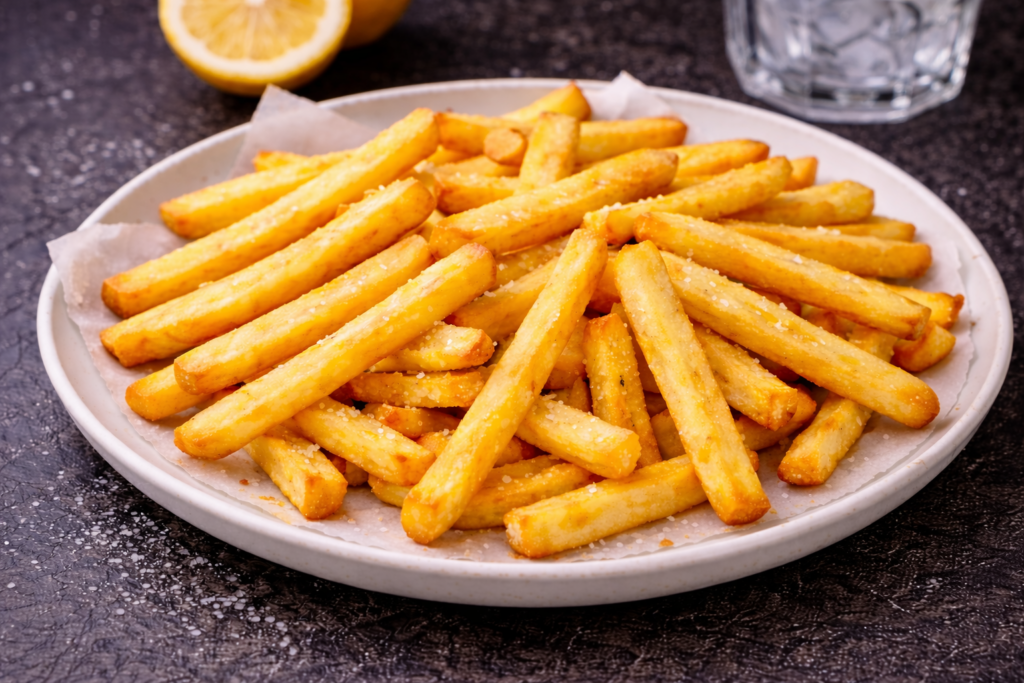
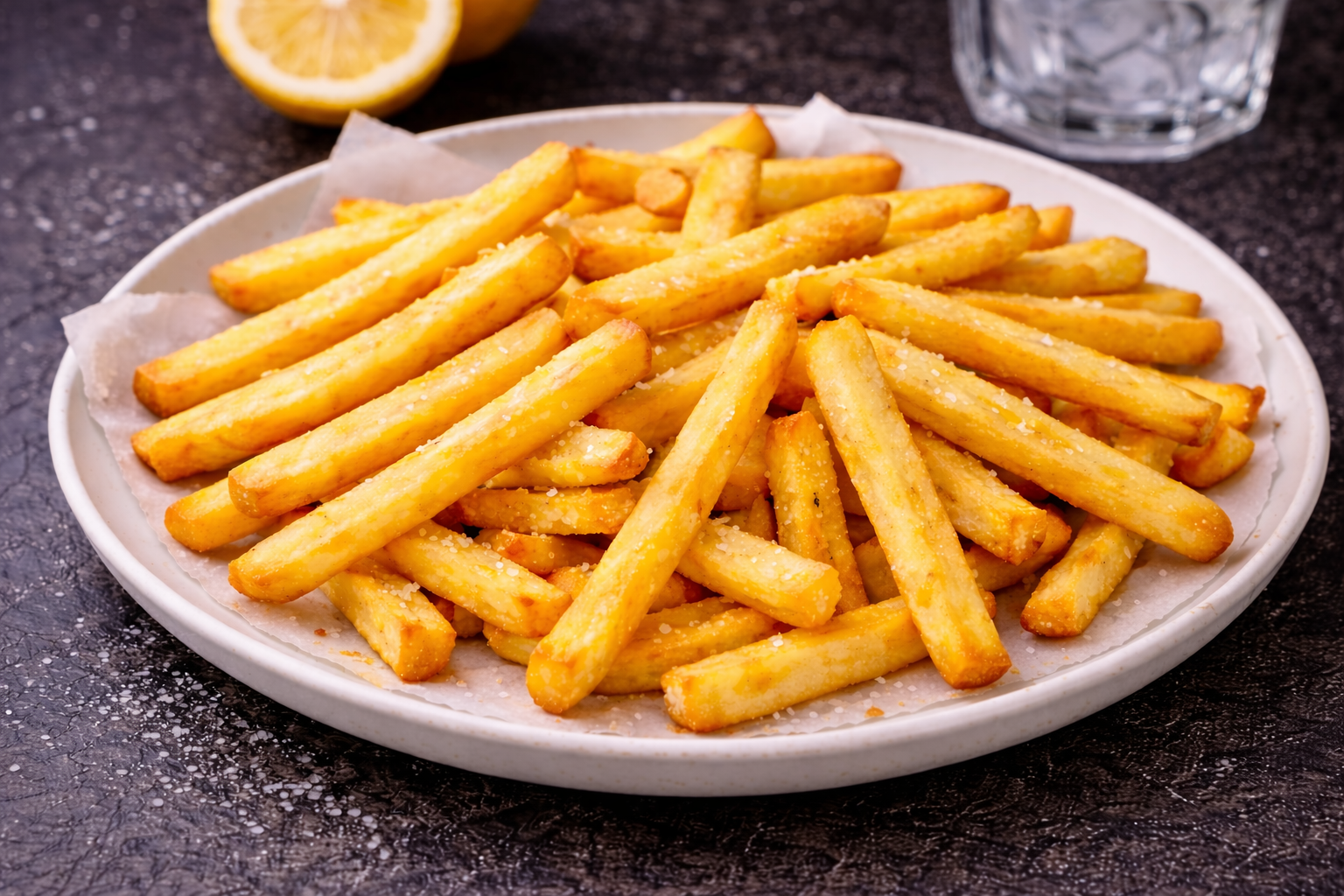
Classic hand-cut pommes frites made using the traditional double-fry method with a twist: a gentle vinegar blanch at a low temperature, an initial fry, a rest in the refrigerator, and a final fry. The technique produces fries that are beautifully crisp on the outside and a soft, fluffy inside.
Despite the name, French fries don’t originate in France. They trace back to Belgium, where potatoes were fried in fat as early as the late 1600s. The name likely came later, popularized by English speakers who associated the technique with French culinary terminology.
Whatever you call them, great fries aren’t accidental. The difference between limp and exceptional comes down to technique—how the potatoes are cut, treated, and cooked from start to finish. This method leans into those details to create fries that are crisp on the outside and soft, almost pillowy, on the inside.
Why the potato matters.
Not all potatoes behave the same when fried. For fries, a high-starch potato is the goal. Starchier varieties break down just enough during cooking to create that fluffy interior, while also allowing the exterior to crisp properly in hot oil.
Lower-starch potatoes tend to hold their structure too well, resulting in a firmer, less airy center and a less defined crust. Starting with the right potato sets the foundation for everything that follows.
The importance of blanching.
Handled carefully, this step sets up both the texture and the finish. Just like the Golden Girls wouldn’t have worked without Blanche, your fries won’t be as golden without this step. Instead of relying on a long soak alone, the potatoes are blanched in water with a small amount of vinegar. This step does more than just par-cook the fries—it actively improves their structure and color.
The vinegar introduces a gentle acidity that helps the exterior of the potatoes hold together, preventing them from breaking down or turning mushy during frying. At the same time, the hot water draws out excess surface sugars, which reduces premature browning in the oil and allows the fries to develop a more even, golden color later on.
Drying and the first fry.
After blanching, the potatoes are dried thoroughly before hitting the oil. Removing surface moisture is critical—any remaining water interferes with frying and prevents the exterior from setting properly.
The first fry is quick and intentional. It cooks the potatoes through without adding color, creating the soft interior that defines a great fry. At this stage, the fries are pale and delicate, but structurally prepared for what comes next.
Why the chill and second fry matter.
Once the first fry is complete, the fries are chilled before going back into the oil. This pause allows the interior to firm up slightly and the exterior to dry out further, which is essential for achieving that final crisp texture.
The second fry is where everything comes together. The hotter oil finishes the exterior, creating a golden, crisp shell while the inside remains tender. This two-step frying method is standard in professional kitchens for a reason—it consistently delivers fries with contrast, structure, and balance.
Salt is added only after this final fry, ensuring it adheres to the surface without interfering with the oil during cooking.
Simple, but not careless.
Hand-cut fries are a perfect example of how a simple dish can benefit from precision. Each step—cutting, blanching, drying, frying, and resting—builds toward a final result that feels intentional rather than incidental.
You’ll find the full method outlined below, from cutting the batons to the double fry that brings everything together. The process takes a little time, but most of it is hands-off, and the payoff is fries that are crisp, golden, and built the way they’re meant to be.
Hand Cut Pommes Frites
Classic hand-cut pommes frites made using the traditional double-fry method with a twist: a gentle vinegar blanch at a low temperature, an initial fry, a rest in the refrigerator, and a final fry. The technique produces fries that are beautifully crisp on the outside and a soft, fluffy inside.
Wash and peel potatoes, making sure to re-rinse each potato after peeling, drying each with a paper towel, and setting aside on butcher block for next step.
Cut
Using your chef's knife, cut potatoes into ¼"(6mm) batons.
Place cut batons into a bowl of lightly-salted water to prevent browning as you cut all the potatoes. Though the cut batons soak here, I veer from the traditional longer soak method and opt for blanching (see below).
Rinse
Carefully transfer cut batons into a strainer or colander and rinse thoroughly under running water for about 30 seconds.
Vinegar Blanch
Carefully transfer rinsed batons into a 6-quart stockpot and add 1 tbsp salt, 2 quarts water, and 2 tbsp white vinegar to the pot. Bring pot to a boil over high heat, immediately reducing heat to low once it reaches a boil. Cook for 10 minutes, then carefully transfer batons back into colander using a spider strainer or slotted spoon.
TIP: DO NOTdump stock pot into colander! Blanching has softened the batons and they will break.
Sheet-Pan Dry
Line two baking sheets with paper towels.
Carefully spread the batons evenly on lined baking sheets and leave to dry for at least 5 minutes.
Carefully lift paper towel with dried batons from baking sheet and place onn counter.
Re-line baking sheets with fresh paper towels.
Frying - Round One
Heat 1 quart canola (or peanut) oil to 400℉ in wok (or fry pan) over medium-high heat.
TIP: After 2-3 minutes of burner being on, place a toothpick in the oil. You know the oil is ready (hot enough) when bubbles form around the toothpick.
Using a spiderweb or slotted spoon, lower potato batons in small batches and cook for 1 minute, moving them around once or twice while they cook. Remove from oil and place cooked fries onto freshly-lined baking sheet.
TIP: DO NOT salt the fries when they come out of the oil during the first round of frying. Salt breaks down the fat in the oil and also reduces the smoking point, so if you salt them during this round, you will be adding tons of salt to the oil during round two of frying and your fries will not cook properly.
Repeat with small batches until all fries are cooked.
Chill
Place fries to chill in refrigerator to chill for a minimum of 30 minute
TIP: If you have to prep other parts of your meal, this is the perfect time to do it. Save Round Two of frying for the final step in your meal prep so your fries are piping hot when served.
Frying - Round Two
Line a large bowl with paper towels.
Reheat the canola (or peanut) oil to 400℉ in wok (or fry pan) over medium-high heat.
Fry half the fries for 4 minutes, moving them around once or twice, until golden and crispy, transferring cooked fried to the lined bowl.
Repeat with second half, then sprinkle with salt (or preferred seasoning). Gently toss to coat the fries with seasoning and serve!
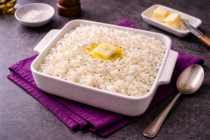
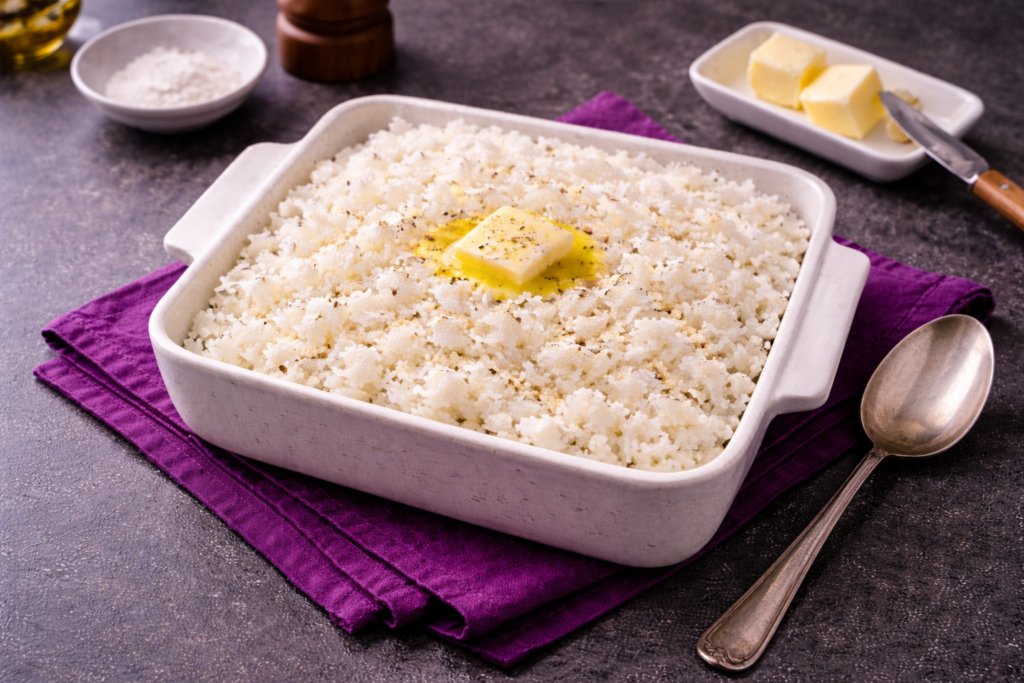
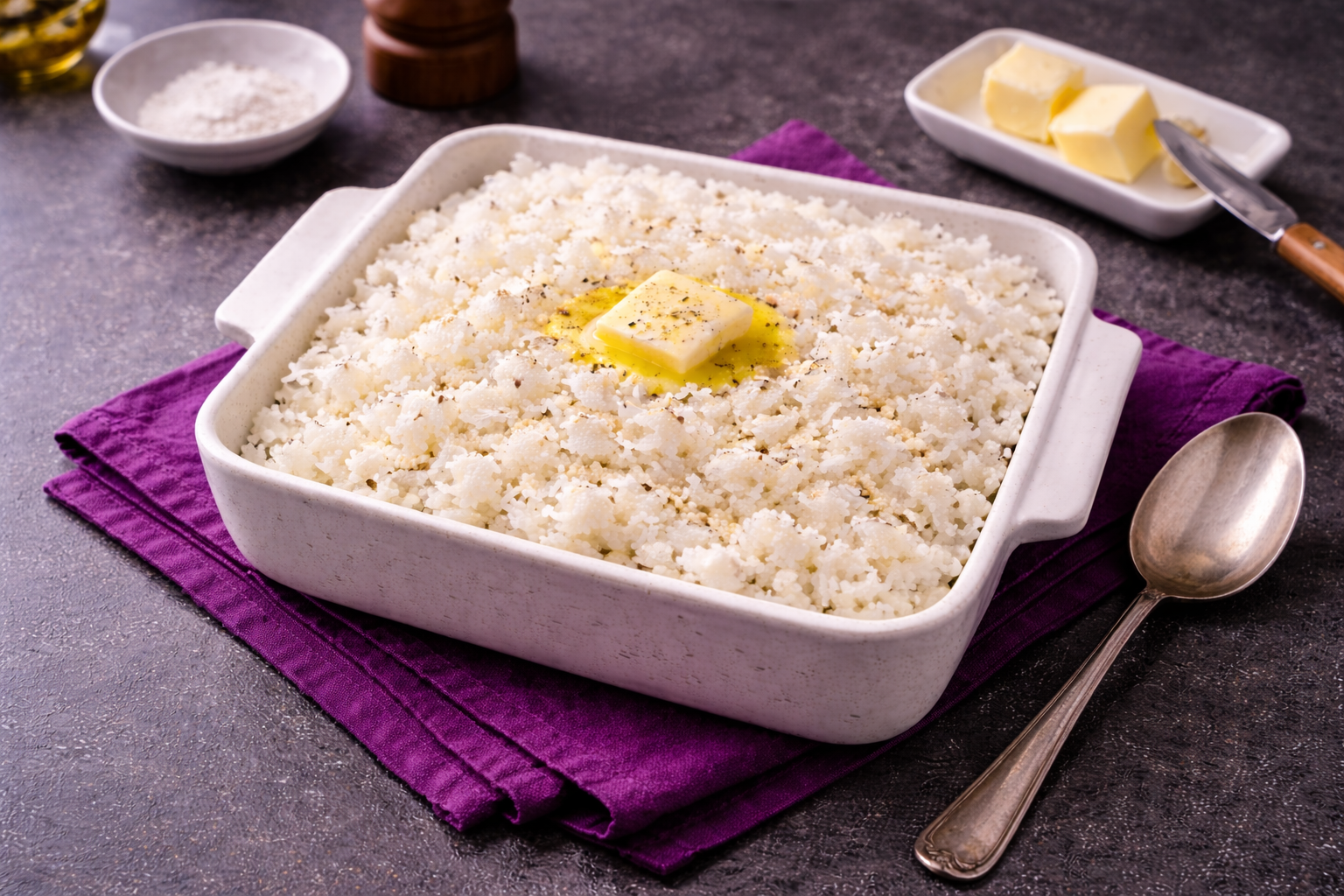
Light, fluffy white rice baked gently in the oven for perfectly cooked grains every time. This simple, reliable method removes the guesswork of stovetop rice and delivers consistent results with almost no effort.
White rice might be one of the most widely served side dishes in the world. It appears alongside countless meals across cultures—not as the centerpiece of the plate, but as the quiet foundation that lets everything else shine.
When it’s cooked well, rice should be light, fluffy, and perfectly separated, ready to soak up sauces, gravies, and pan juices without turning heavy or sticky. Achieving that texture consistently doesn’t require complicated technique, but it does benefit from a few deliberate steps that focus on controlling starch, temperature, and even cooking.
Why rinsing the rice matters.
Long grain white rice naturally carries a layer of starch that coats the grains. That starch is what causes rice to clump together during cooking, which is ideal for certain dishes but not for a clean, fluffy side. Rinsing the rice until the water runs nearly clear removes that excess starch before cooking begins, allowing the grains to remain distinct rather than sticking together as they cook. Taking the extra minute to rinse the rice dramatically improves the finished texture and keeps the dish light instead of dense or gummy.
Starting with warm liquid.
Before the rice goes into the oven, the cooking liquid is warmed first. Bringing the water, butter, salt, and pepper to a gentle simmer melts the butter and ensures the seasoning dissolves evenly throughout the liquid. Starting with warm liquid also allows the rice to begin cooking immediately once it enters the oven, rather than forcing the oven to spend time bringing cold liquid up to temperature. This small adjustment helps the rice cook more evenly and consistently from the start.
Why the oven works so well.
Cooking rice in the oven creates steady, even heat around the pan, allowing the grains to absorb liquid gradually without scorching the bottom or cooking unevenly. Once the dish is covered and placed in the oven, the process becomes almost entirely hands-off.
After baking, the rice rests undisturbed before the foil is removed, allowing the remaining steam to gently finish cooking the grains. This short rest helps the rice settle into its final texture so it fluffs easily and remains tender without becoming sticky.
A side that adapts to almost anything.
One of the strengths of plain white rice is its flexibility. The base recipe is intentionally simple, allowing it to complement a wide range of cuisines and flavor profiles. The cooking liquid can be swapped for broth, spices can be added to match the dish it’s served with, and herbs or vegetables can be folded in at the end. Instead of competing with the main course, the rice acts as a balanced foundation that supports the rest of the meal and brings the plate together.
You’ll find the full method outlined below, from rinsing the rice to warming the cooking liquid and letting the oven handle the rest. The process is simple and largely hands-off—once everything is combined in the pan, steady heat and a short rest do most of the work. If you make it, let me know how it turns out—and what you decided to serve with it.
Perfect Oven-Baked White Rice
Light, fluffy white rice baked gently in the oven for perfectly cooked grains every time. This simple, reliable method removes the guesswork of stovetop rice and delivers consistent results with almost no effort.
Using a 4-in-1 strainer, rinse 2 cups long grain white rice until nearly clear. This step removes excess starch that typically coats the grains, which would make the rice on the sticky/clumpy side when cooked.
Preparing Rice
Let the rice drain for 5 minutes while you move onto the next step.
Preheat oven to 375℉.
While the rice is straining and the oven is preheating, add 3 cups water (or substitute with chicken or vegetable broth for a more flavorful rice), 2 tbsp butter, 1 tsp salt, and ½ tsp ground black pepper to a sauce pan and bring to a simmer, stirring to make sure the butter is melted and salt is dissolved.
OPTIONAL SPICE & FLAVOR ADDITIONS: Because this is a pretty flavorless side, this recipe goes well with a diverse variety of cuisines and can also be tailored to fit the cuisine you are planning to pair with it by adding additional spices—from garlic, onion powder, cumin, turmeric, sazon, cardamon, cilantro, tarragon, etc—or other ingredients. Spices can be added into the broth mixture at this step; if you are adding solid ingredients like vegetables, I recommend adding them as the last step.
Pour drained rice into an 8" square baking dish and add warmed liquid mixture over the top, using a wooden spoon or spatula for a quick mix, and cover with foil.
Cooking Rice
Place pan in 375 ℉ preheated oven and cook undisturbed for 40 minutes.
Rest Time
After 40 minutes, remove from oven and let rest on trivet on counter for an additional 15 minutes undisturbed. DO NOT lift foil until the 15-minute rest time has passed.
Remove foil and fluff rice with wooden spoon or spatula.
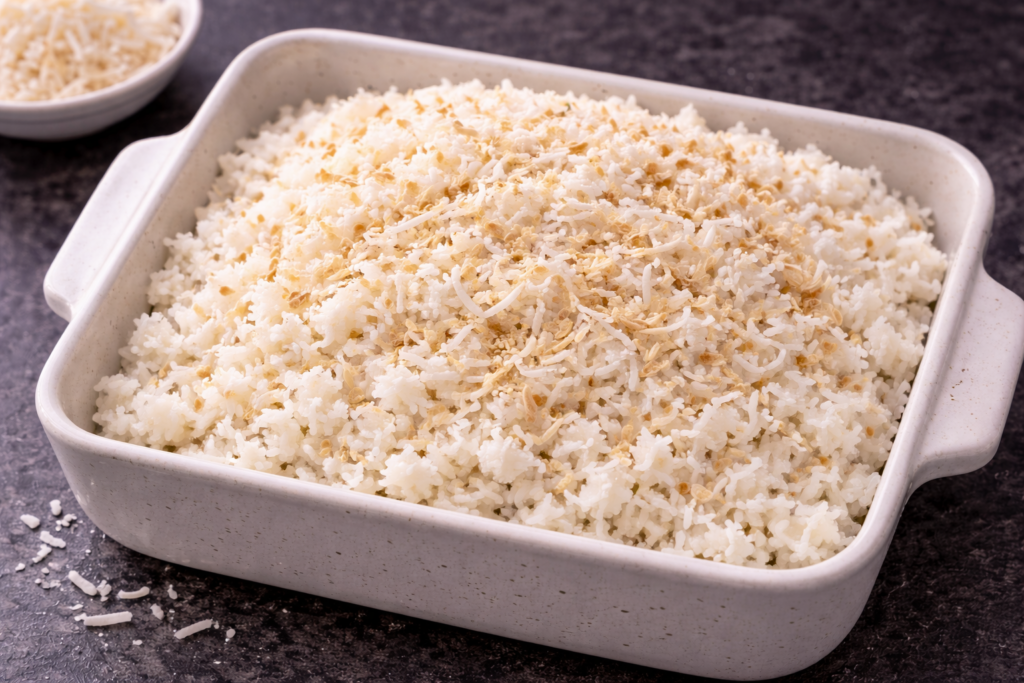
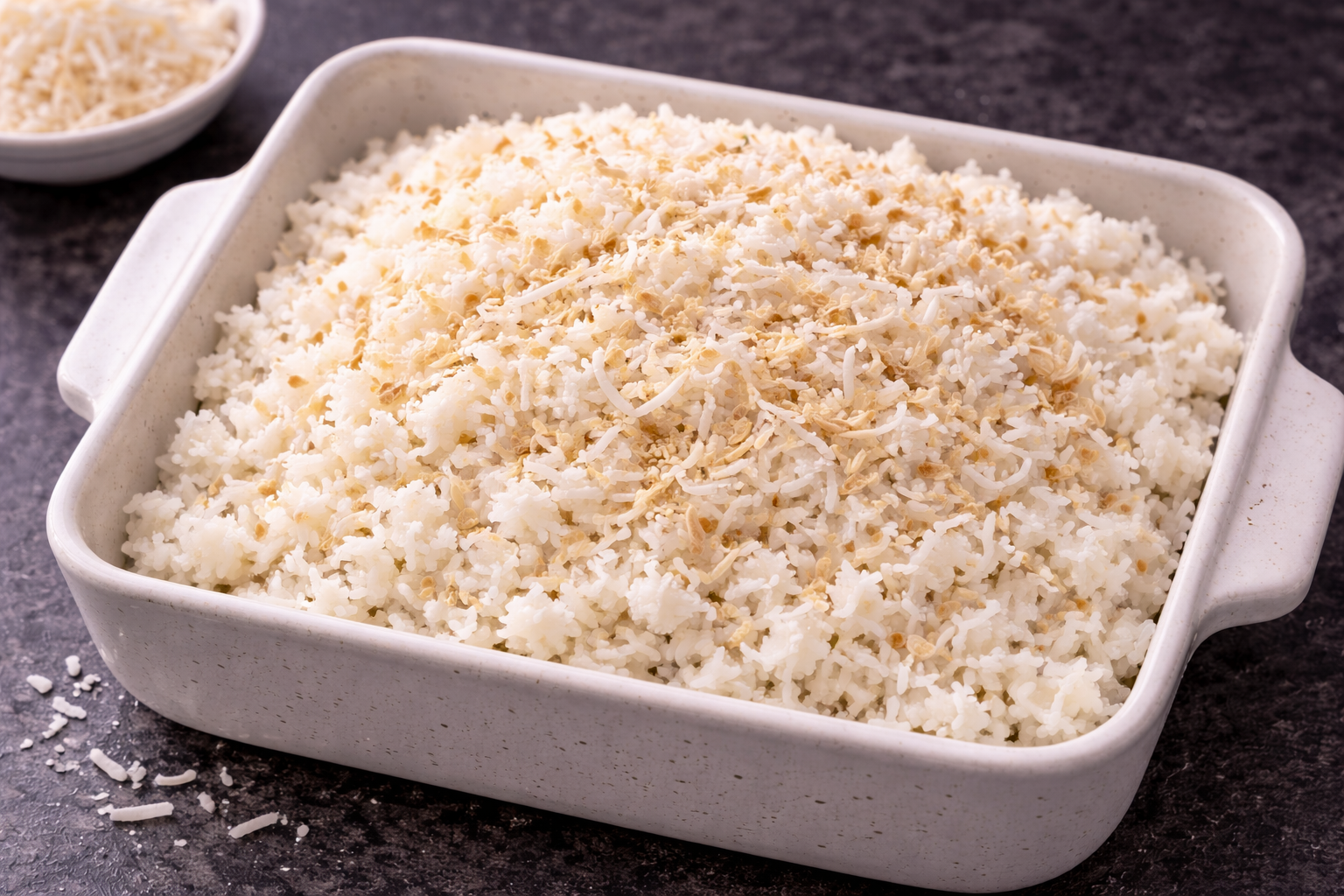
Tender jasmine rice baked in coconut milk until perfectly fluffy and fragrant. This simple oven method creates consistently perfect coconut rice without the need to babysit a pot on the stove.
Coconut rice is one of those deceptively simple dishes that can quietly make an entire meal better. When it’s done right, the grains are tender and fragrant, lightly sweet from the coconut milk, and fluffy enough to soak up whatever flavors surround it.
Most recipes cook coconut rice on the stovetop like traditional rice, but I’ve found that baking it produces a more reliable and consistent result. The oven provides steady, even heat, allowing the rice to absorb the coconut milk and water gradually without scorching the bottom or creating pockets of uneven texture. The result is rice that cooks gently and evenly—soft, aromatic, and perfectly separated.
Why rinsing and soaking matters.
Jasmine rice naturally carries a layer of starch that clings to the grains. That starch is what gives some rice dishes their stickiness, but with coconut rice it can quickly turn the dish heavy or clumpy. Rinsing the rice until the water runs nearly clear removes that excess starch and keeps the finished rice light and fluffy. I also like to soak the rice for about an hour before baking. That extra step allows the grains to hydrate evenly before they ever hit the heat, which helps them cook more uniformly in the oven. It’s a small bit of patience that pays off in texture.
Infusing the coconut flavor.
Rather than pouring the coconut milk mixrture over the rice cold, the liquid is warmed first. Bringing the coconut milk, water, and coconut palm sugar together in a saucepan allows the sugar to dissolve completely and ensures the flavor distributes evenly before it ever reaches the rice. Starting with warm liquid also helps the rice begin cooking immediately once it goes into the oven, rather than forcing the oven to spend extra time bringing the liquid up to temperature.
The coconut palm sugar adds just a hint of sweetness—enough to highlight the coconut without pushing the dish into dessert territory. Paired with a touch of salt, it creates the gentle balance coconut rice is known for: lightly sweet, lightly savory, and deeply aromatic. From there, the rice simply absorbs everything as it bakes.
A rice that adapts.
One of the things I love most about coconut rice is how easily it adapts to different cuisines. The base recipe stays beautifully simple, but it welcomes additional flavors depending on what you’re serving alongside it. Sometimes that means lime and cilantro for a brighter finish. Other times it might be ginger, lemongrass, pandan, or kaffir lime leaves to lean into Southeast Asian flavors. The coconut base is flexible enough to support all of those directions without losing its character. At its core, though, the goal is always the same: fluffy jasmine rice infused with coconut, balanced with just enough sweetness and salt to make every bite feel intentional.
You’ll find the full method outlined below, from rinsing and soaking the rice to warming the coconut base and letting the oven do the rest. The process is simple and largely hands-off—precision and patience matter more than complexity. If you make it, let me know how it turns out—and what you decided to pair it with.
Perfect Oven-Baked Coconut Rice
Tender jasmine rice baked in coconut milk until perfectly fluffy and fragrant. This simple oven method creates consistently perfect coconut rice without the need to babysit a pot on the stove.
Using a 4-in-1 strainer, rinse 2 cups jasmine rice until nearly clear. This step removes excess starch that typically coats the grains, which would make the rice on the sticky/clumpy side when cooked with the coconut milk.
Once rinsed, soak rice for 1 hour.
Preparing Rice
Once the rice has soaked for an hour, strain; let continue to drain for 5 minutes while you move onto the next step.
Preheat oven to 400℉.
While the rice is straining and the oven is preheating, add 14 oz coconut milk, 8 oz water, and 4 tsp coconut sugar to a sauce pan and bring to a simmer, stirring to make sure the coconut sugar is dissolved.
OPTIONAL SPICE & FLAVOR ADDITIONS: This coconut rice recipe goes well with a diverse variety of cuisines and can also be tailored to fit the cuisine you are planning to pair with it by adding additional spices or ingredients—from ginger, garlic, cumin, curry, lemongrass, cilantro, pandam, or kaffir lime leaves. Some variations have you add ingredients in this step, while others have you add them at the end. See Recipe Notes below.
Pour drained rice into an 8" square baking dish and add warmed liquid mixture over the top, using a wooden spoon or spatula for a quick mix, and cover with foil.
Cooking Rice
Place pan in 400 ℉ preheated oven and cook undisturbed for 40 minutes.
Rest Time
After 40 minutes, remove from oven and let rest on trivet on counter for an additional 15 minutes undisturbed. DO NOT lift foil until the 15-minute rest time has passed.
Remove foil and fluff rice with wooden spoon or spatula.
OPTIONAL SPICE & FLAVOR ADDITIONS: Some variations in the Recipe Notes below have you add additional ingredients here.
Serve and enjoy.
Notes
Coconut Lime Rice: stir in the juice and zest of one lime once rice is fully cooked and fluffed. Pairs well with the following cuisines:
Southeast Asian (Thai, Malaysian)
Polynesian (Hawai'ian)
Carribbean (Jamaican Jerk)
Mexican
Cilantro Lime Coconut Rice: stir in the juice and zest of one lime and ½ cup loosely-packed cilantro once rice is fully cooked and fluffed. Pairs well with the following cuisines:
Thai
Carribbean (Jamaican Jerk)
Mexican
Thai Coconut Rice: season the coconut milk mixture with ⅛ tsp turmeric, ½ tsp garlic powder, ½ tsp onion powder, 1 tsp ground ginger. Before covering with foil, add two Pandam leaves (tied in a knot) -OR- 2-3 kaffir lime leaves submerged in the liquid. I've also substituted the Pandam or kaffir leaves with 1 tbsp of lemongrass paste because I had it on hand, and it worked beautifully. Pairs well with the following cuisines:
Southeast Asian (Thai, Malaysian, Indian)
North Asian (Korean)
Carribbean
Coconut Ginger Rice: season the coconut milk mixture with 2 tsp ground ginger (or ginger paste). Pairs well with the following cuisines:
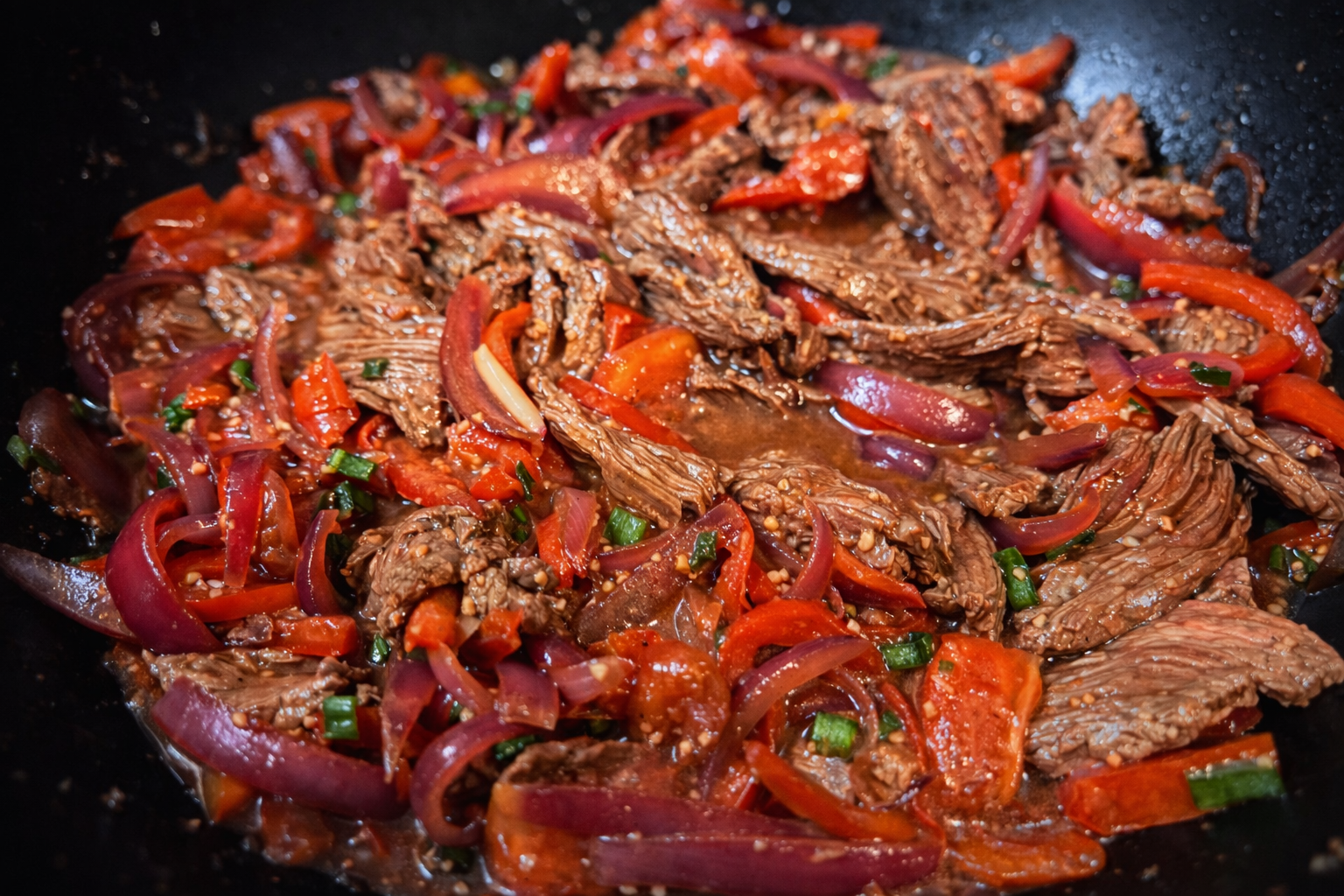
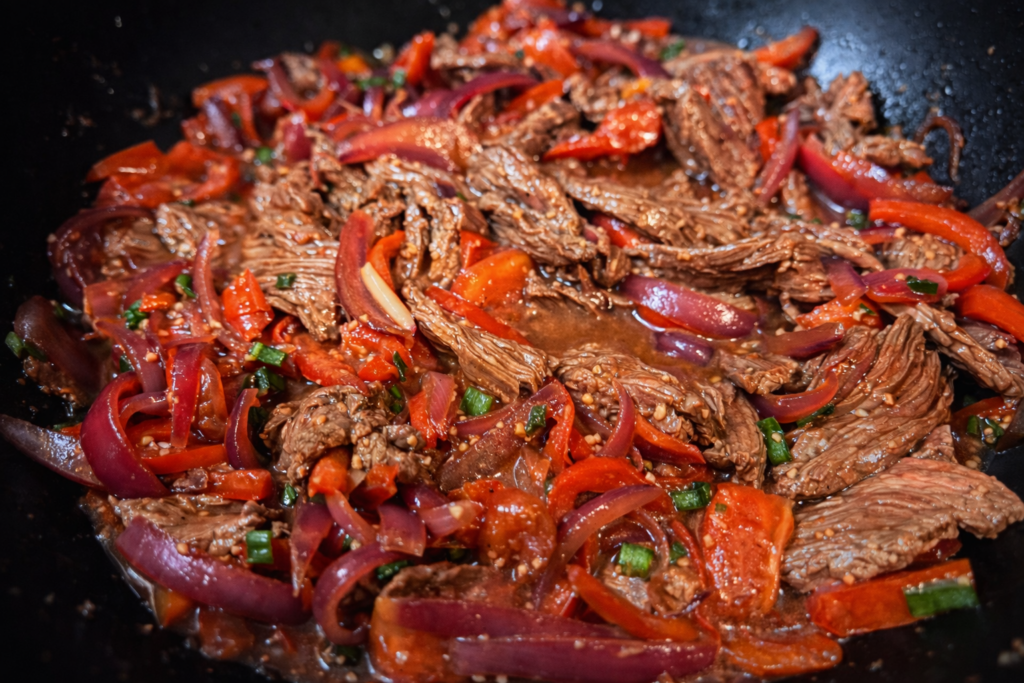
Flash-seared beef meets blistered vegetables, ají amarillo, and a ginger-laced soy reduction in this bold Peruvian staple. Served with crisp fries and rice, it’s a study in contrast—smoky wok heat, bright spice, and layered savory flavor.
Lomo Saltado is one of those dishes that perfectly captures what makes Peruvian cuisine so exciting. It’s bold, fast, and deeply satisfying—tender strips of beef seared over high heat and tossed with onions, tomatoes, and a savory sauce that comes together in minutes.
At its heart, the dish reflects the Chinese influence on Peruvian cooking—what’s known as Chifa—where wok techniques meet local ingredients and flavors. This version stays true to that spirit while leaning a little more intentionally into the aromatics and balance that make the stir-fry so vibrant.
Honoring the Chifa roots.
What makes Lomo Saltado unique isn’t just the ingredients—it’s the technique. The dish emerged from Chinese immigrant communities in Peru who adapted familiar stir-fry methods to the ingredients available to them, creating something entirely new in the process. Soy sauce, garlic, and high-heat cooking bring unmistakable Chinese influence, while tomatoes and aji peppers ground the dish firmly in Peru. That fusion is the entire identity of Lomo Saltado. It isn’t meant to feel purely one thing or the other—it’s meant to live comfortably in the middle.
For me, the goal is to preserve that balance while sharpening the flavors just enough to let each component stand on its own.
Building flavor inside the pan.
Because this dish cooks quickly, every ingredient needs to pull its weight. Instead of relying only on soy sauce and vinegar to carry the flavor, I like to build a little more depth into the stir-fry itself. That starts with a few small additions:
aji amarillo paste
a touch of freshly grated ginger
red wine vinegar or rice wine vinegar
Fresh aji amarillo peppers can be difficult to find where I live, so I typically use yellow bell peppers for their color and gentle sweetness, then bring the true Peruvian flavor back into the dish with aji amarillo paste. The paste adds that distinctive fruity heat without overwhelming the stir-fry.
The grated ginger gives the dish a subtle aromatic lift that nods to its chifa roots, while the vinegar adds brightness and keeps the sauce from feeling too heavy. I usually reach for red wine vinegar or rice wine vinegar, both of which complement the soy sauce beautifully and help round out the pan. None of it overwhelms the dish. It simply builds layers.
The magic of the stir-fry.
Lomo Saltado works because of contrast—high heat against fresh ingredients, savory depth balanced by brightness. The beef caramelizes quickly, the onions soften while still keeping their bite, and the tomatoes release just enough juice to bring everything together in a glossy, flavorful sauce.
When it’s done right, the dish feels vibrant and alive—rich without being heavy, bold without being complicated. It’s the kind of stir-fry that proves how powerful a handful of well-chosen ingredients can be when they meet a hot pan and a little intention.
What I typically serve with it.
Traditionally, Lomo Saltado is served with BOTH white rice and fries (some recipes even suggest stirring the fries into the sauce before serving, but I am personally not a fan of this method). I still have the fries part of the traditional recipe linked below, but I have a coconut recipe linked, which is the side I now typically pair with it (versus the white rice). The sweetness of the coconut balances the saltiness of the fries and the tangy-umami flavors of the sauce. I also add a bit of ginger into my coconut rice to complement the flavor of the beef stir-fry nicely.
Want a more in-depth glance at the full meal preparation of Lomo Saltado with both sides? Check out my post below, which leads you step-by-step through my prep and cooking process so that everything is timed perfectly:
You’ll find the full method outlined below, from searing the beef to bringing the stir-fry together in the pan. The process moves quickly—high heat and timing matter more than complexity. If you make it, let me know how it turns out—and what you paired it with.
Lomo Saltado
Flash-seared beef meets blistered vegetables, ají amarillo, and a ginger-laced soy reduction in this bold Peruvian staple. Served with crisp fries and rice, it’s a study in contrast—smoky wok heat, bright spice, and layered savory flavor.
SUBSTITUTION: Fresh Ají amarillo peppers aren't easy to find, so if you can't find one in your area, feel free to substitute a small yellow or orange bell pepper.
5stalksgreen onions(ends trimmed, cut into 1" pieces)
Using a butcher's block and a Santoku knife, slice your meat into medium thin slices—thin enough that they won't take a long time to cook, but thick enough so they won't overcook when seared.
TIP: As with any meat, it slices better when a bit firmer. I place my steak in the freezer for about 12-15 minutes before slicing.PRO TIP: While the meat is chilling in the freezer, move to next steps and prepare the marinade and sauce.
TIP: If you selected a tougher cut of meat, add ¼ tsp baking soda to your marinade. Baking soda will help loosen the protein fibers, making it easier to chew. You can also use meat tenderizer.
Pour prepared marinade over sliced meat in a marinade dish and marinate in refrigerator at least 10 minutes.
TIP: If you used baking soda in your marinade due to a tougher cut of meat, increase your marinating time to 1 hour.
Sauce
In a 2-cup measuring glass (spouted), combine 3 tbsp soy sauce, 1 tbsp oyster sauce, 1 tbsp red wine (or rice wine) vinegar, 1 tbsp Ají amarillo paste, 1 tsp ginger paste, and 1 tsp cornstarch.
Blend with whisk and set aside.
Vegetable Prep
Wash all vegetables before cutting.
If you've already sliced your meat, wash your butcher's block (or cutting board) before prepping your vegetables.
You'll be using your Chef's knife to prep the vegetables.
Slice red onion into ½" wedges and set aside in a ramekin (or small bowl).
Cut top (stem side) off roma tomatoes and slice into ½" wedges. If your tomatoes are particularly seed-heavy, remove them an add them into your sauce mixture. Set tomato wedges aside in ramekin (or small bowl).
Slice Ají amarillo pepper (or bell pepper, if substituting) and set aside in ramekin.
Trim white ends off 7 stalks of green onions.Slice 5 stalks into 1" pieces, setting aside in ramekin.Take remaining 2 stalks and coarsely chop, setting aside in separate ramekin for garnish later.
PRO TIP: If you leave at least 1½-2" of green stalk above the white root end, you can wrap a rubber band loosely around the bunch to hold together and add to a shallow dish of water. The onion stalks will regenerate after a few days and you can plant in a small pot to put in a windowsill to always have fresh green onions on hand.
Remove cilantro leaves from stems (discard the stems) and coarsely chop leaves, setting aside about ¼ cup in one ramekin and about 2 tbsp in an additional ramekin for garnish later.
Cooking the Stir Fry
Remove marinated sliced beef from fridge and strain marinade from meat; this will prevent excessive splatter while searing
Add about 1 tbsp of vegetable (or canola) oil to wok over high heat until it starts to shimmer.
Sear the meat in batches for about 2 minutes, flipping as needed to ensure an even cook. Remove from heat and add to mixing bowl or plate (I opt for a bowl because adding the meat in batches means the top layer will hold the heat in for the layers below it.
TIP: I leave my meat pretty pink in the middle for two reasons: 1) The meat will continue to cook a bit more as it rests in the bowl or plate; 2) The meat is added back to the wok in the final steps, and adding it to a bubbling sauce will cook it slightly more. You don't want to overcook your meat and make it tough.
Once all meat is seared, drain excess oil and juices from wok. Add 1 tbsp of fresh oil to wok and bring back to med-high heat until it starts to shimmer.
Add the ramekin of onions and sauté for 1 minute.
Add in 4 tsp minced garlic and sauté for another minute.
Add in ramekins of tomatoes, cilantro, and green onions and cook for another 2 minutes or until tomatoes are slightly tender but still have their shape.
Add sauce to pan and bring to a low simmer to thicken the sauce.
Turn off heat and add meat back into wok, mixing and thoroughly incorporating with other ingredients until sauce coats the meat.
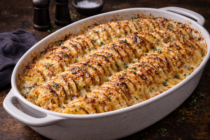
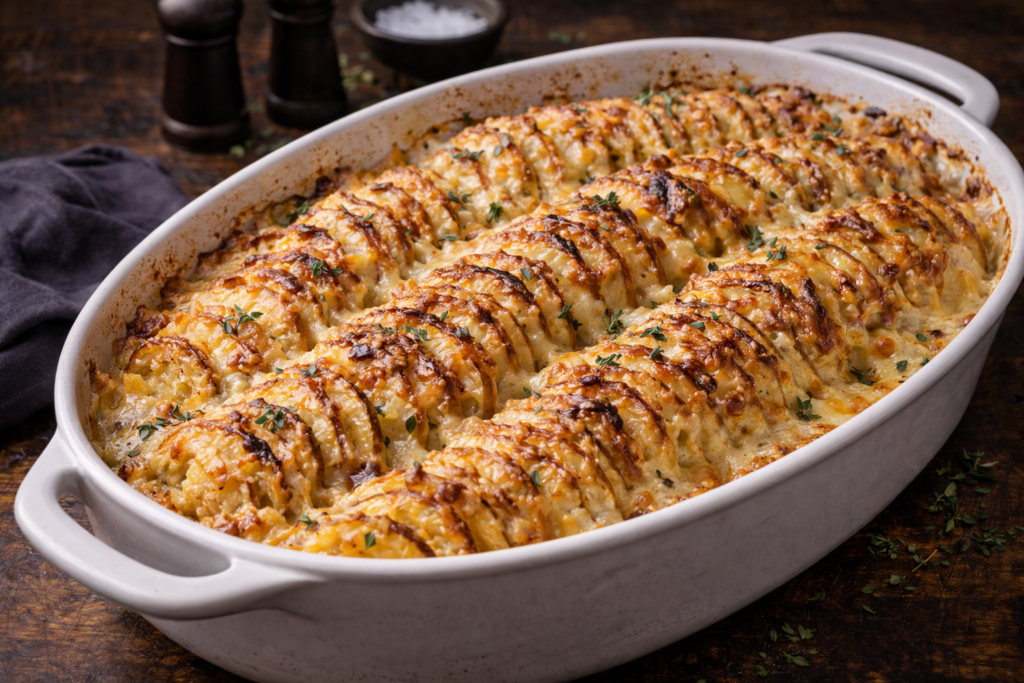
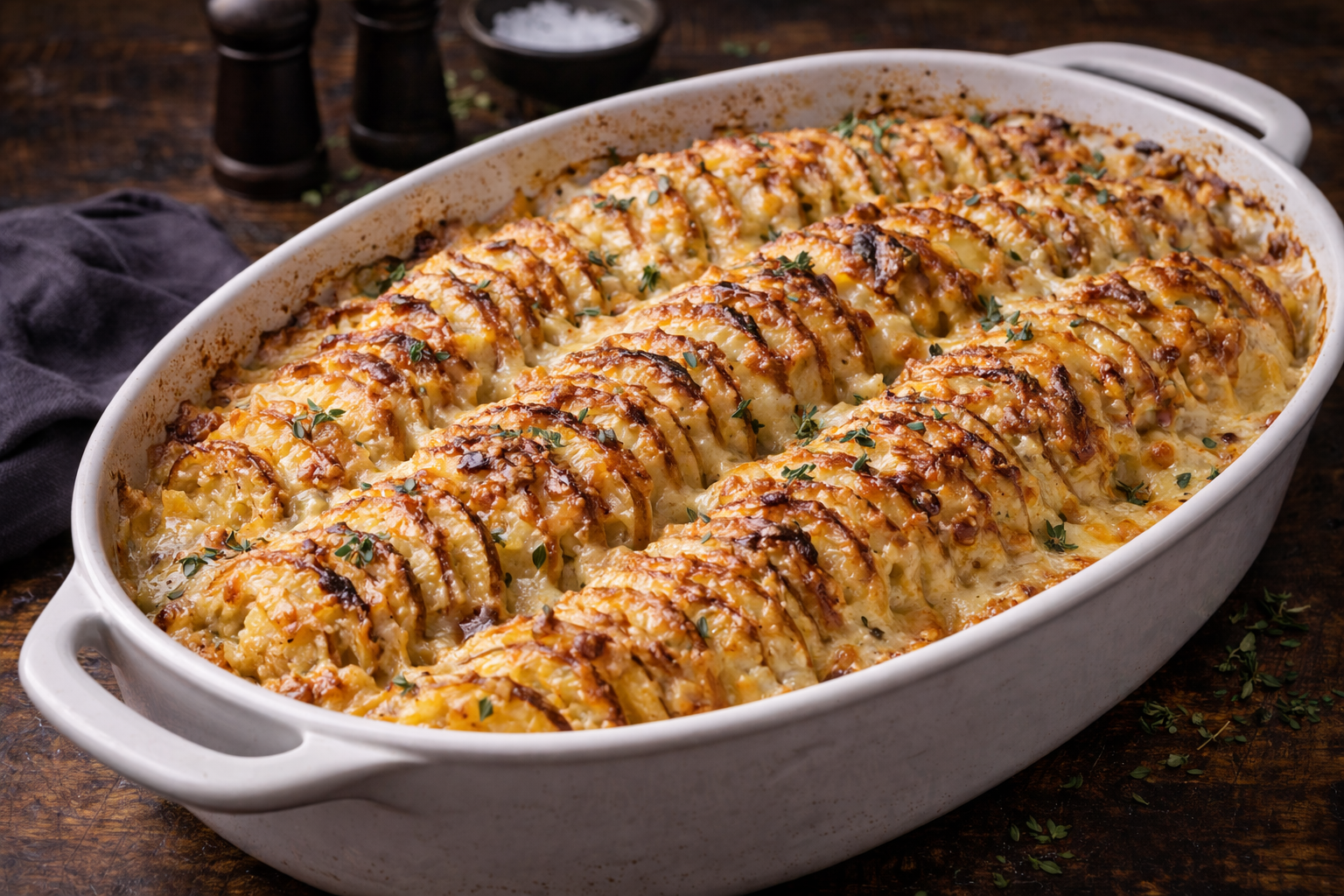
Thinly sliced potatoes layered vertically and baked in a rich cream infusion with nutty Gruyère until bubbling and golden. Crisp edges, tender centers, and a deeply savory finish make this French-inspired classic equal parts elegant and indulgent. Structured in presentation, layered in flavor, and unapologetically rich.
There’s something about Potatoes Au Gratin that feels timeless. It isn’t flashy. It isn’t complicated. But when done correctly, it commands the table.
This version leans into technique and presentation just as much as flavor. Thinly sliced potatoes are arranged vertically—like a ratatouille—allowing the sauce and Gruyère to weave through every layer. The result isn’t just creamy; it’s structured, defined, and intentional.
Why Gruyère matters.
If you’re making a true gratin, the cheese shouldn’t just melt—it should contribute character.
Gruyère is nutty, slightly sweet, and complex without overpowering the dish. It melts seamlessly into the sauce while still browning beautifully on top. Those caramelized ridges are where the depth lives—and Gruyère delivers that every time, especially coupled with Parmesan, like this recipe calls for in addition.
All about the Roux.
This gratin begins with butter and seasoned flour cooked briefly before being whisked with milk or half-and-half. Milk keeps it classic. Half-and-half leans more indulgent. Either way, the roux is what makes the texture intentional.
Starting with a roux gives the sauce body from the beginning. It creates a creamier, thicker consistency that coats each slice evenly and bakes into something structured rather than loose. The result is a gratin that slices cleanly and holds its shape without sacrificing silkiness.
Mandoline or Knife? Both Work.
I recommend using a mandoline because it allows you to set a consistent thickness—and consistency matters in a dish like this. Even slices cook evenly. They absorb the sauce at the same rate. They soften without turning mushy.
But if you’re confident with a chef’s knife, use it. A steady hand and a sharp blade will give you just as beautiful a result. The key is thin, uniform slices—not the tool itself. Technique matters more than equipment.
The Finish.
As it bakes, the sauce tightens and the Gruyère bubbles into golden ridges across the surface. The top should be deeply caramelized— not pale, not scorched—just structured and bubbling. Let it rest before serving. The layers settle. That’s when you know the technique worked.
You’ll find the full method outlined below, from preparing the roux to arranging the potatoes for that vertical finish. The process is straightforward—precision matters more than complexity. If you make it, let me know how it holds its structure—and what you paired it with.
Gruyère Pommes de Terre Au Gratin
Thinly sliced potatoes layered vertically and baked in a rich cream infusion with nutty Gruyère until bubbling and golden. Crisp edges, tender centers, and a deeply savory finish make this French-inspired classic equal parts elegant and indulgent. Structured in presentation, layered in flavor, and unapologetically rich.
Wash and peel potatoes, making sure to re-rinse each potato after peeling, drying each with a paper towel.
Pre-heat oven to 400℉
Using a kitchen mandoline, slice each potato into ⅛" or 3mm slices. Once all the potatoes are sliced, use paper towel to soak up excess water from slices, and place in a mixing bowl.
Sprinkle 1 tsp salt, ½ tsp pepper, 1 tsp onion powder, ½ tsp thyme onto potato slices and mix in bowl until all the slices are coated with the seasoning blend.
Sauce
In a medium sauce pan, melt 4 tbsp butter on medium heat.
Once butter is melted, add 4 tbsp flour, ½ tsp garlic powder, ½ tsp paprika and whisk until combined; heat until mixture has a nice golden color.
Add 2 cups milk (or half and half) and whisk until the milk, butter, and flour are nice and creamy smooth (no clumps); bring the sauce to a simmer.
Constantly stirring, continue to cook for about 10 minutes or until sauce thickens and coats the whisk; remove from heat.
Add 1½ cups of the grated Gruyère and ¼ cup of the grated Parmesan, folding it into the sauce until melted and thoroughly incorporated.
Assembly
Grease casserole dish and load in potato slices standing vertically in about three rows (much how you would arrange the veggies in a ratatouille); be sure not to pack the slices too tightly, as you want the sauce to be able to work its way between the slices as it cooks.
Pour half the sauce over the potatoes, taking a fork to ensure the sauce works its way between the slices; top with remaining sauce, spreading evenly and making sure the potatoes are completely covered.
Top with remaining ½ cup Gruyère and ¼ cup Parmesan cheeses, spreading evenly.
Cover with lid (or foil if dish doesn't have a lid) and bake for 45 minutes.
Uncover and continue baking for another 35 minutes or until the potatoes are tender (when fork is inserted) and the cheese has a golden brown color.
Remove from oven and let rest on the counter for about 10 minutes before serving. This gives the sauce time to cool and bind.
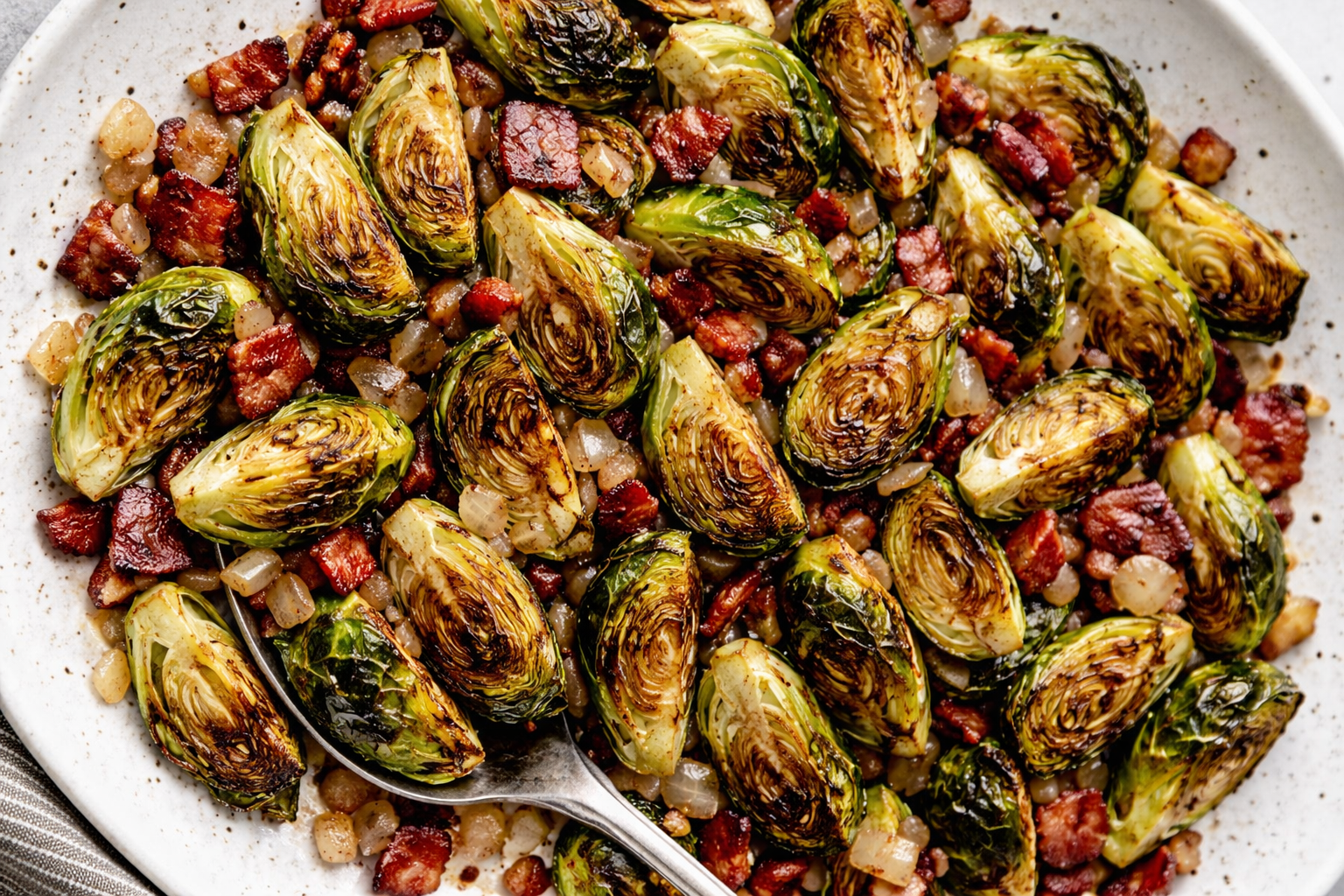
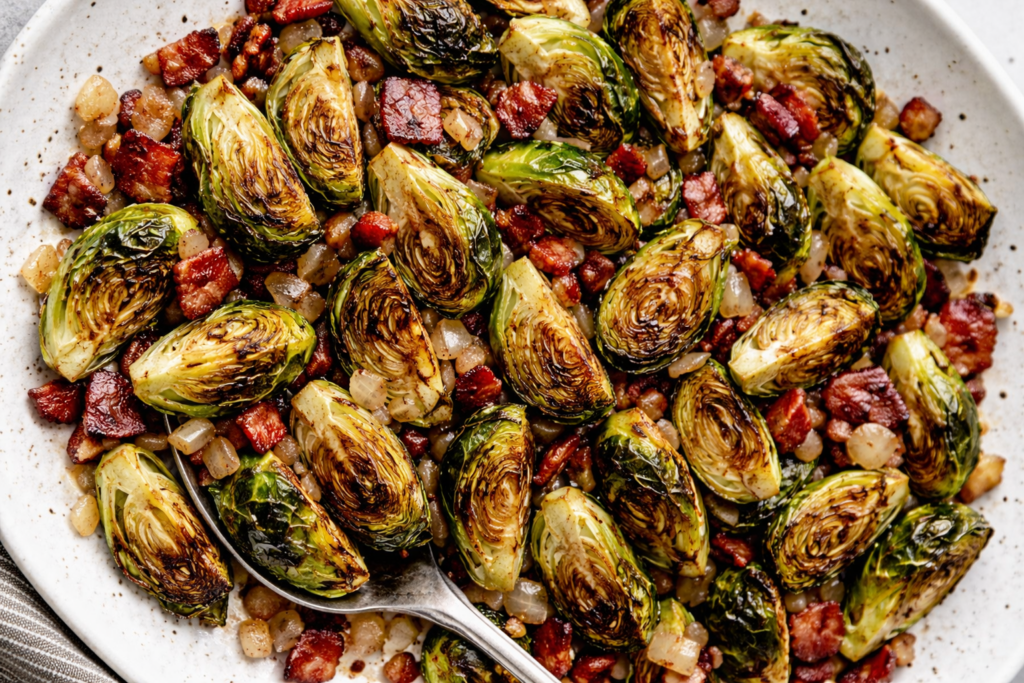
Roasted Brussels sprouts tossed with crisp bacon and reduced balsamic until caramelized and glossy. The balance of smoky, tangy, and sweet makes this a bold, flavor-packed addition to any feast.
Brussels sprouts have earned a bad reputation over the years—but only because they’ve been handled poorly. When roasted correctly, they’re crisp at the edges, tender at the center, and deeply nutty in a way that feels far more intentional than their boiled predecessors.
This version keeps things simple—but deliberate. The sprouts roast on their own sheet pan, seasoned and coated, spaced out and left undisturbed long enough to develop real color. High heat allows the outer leaves to blister and crisp while the interior softens without turning mushy.
Baking the bacon.
I always bake my bacon in the oven versus frying. Not only does it prevent nuisance bacon splatter, but baking it ensures it turns properly crisp instead of soft or chewy or overdone and burnt—and it also leaves behind rendered bacon grease that doesn’t go to waste in this recipe.
Typically, depending on the cut and the brand, bacon is baked in the oven at 400°F for 15-20 minutes, but we take advantage of the oven already being hot and bake it alongside the sprouts, checking it at 15 minutes, and then every so often following, until it reaches your personal desired crispiness.
Layers of flavor.
Once the bacon comes out of the oven, I reserve a bit of that rendered fat and use some of it to sauté the minced shallot and red bell pepper. These two ingredients are optional, but i think they compliment this dish perfectly, absorbing the smokiness of the bacon while adding subtle sweetness and depth. Everything comes together only at the end. The roasted sprouts, crisped bacon, and sautéed aromatics are tossed lightly in a balsamic glaze that clings to the edges without masking the caramelization or overpowering.
The sprouts remain the star. The bacon and aromatics add savory depth. The glaze ties it all together with balance and brightness. It’s structured. Intentional. And bold enough to hold its own beside a rich main course. My husband—who abhors most vegetables—is even in love with this dish. Done properly, Brussels sprouts don’t need a lot of disguising. They just need heat—and a little respect.
The recipe card below breaks it down step by step, but the goal is simple: crisp edges, properly rendered bacon, softened shallots and peppers, and a balsamic glaze that clings without drowning the pan. Nothing should feel heavy or sticky. Roast the sprouts with confidence. Let them darken. Let the bacon crisp fully before it’s chopped and folded back in. Build the flavor in layers, then toss everything together at the end so each component keeps its integrity. And above all, let the sprouts lead.
Bacon & Balsamic Roasted Brussels Sprouts
Roasted Brussels sprouts tossed with crisp bacon and reduced balsamic until caramelized and glossy. The balance of smoky, tangy, and sweet makes this a bold, flavor-packed addition to any feast.
Remove and discard any damaged or discolored leaves from Brussels sprouts; wash Brussels sprouts thoroughly with cold water.
On a butcher's block (or cutting board), trim and discard stem ends from each Brussels sprout with a Chef's knife.
TIP: Save any leaves that come loose from the trimming process. These add a lovely crunch to the final dish when roasted.
Cut each Brussels sprout into quarters and toss into a mixing bowl with the loose leaves.
Toss Brussels sprouts with olive oil (enough to lightly coat, about 2 tbsp), 2 tsp salt, 1 tsp pepper, 1 tsp onion powder, and 1 tbsp garlic until they are evenly coated with oil and seasonings.
TIP: If you'd like to add a bit more depth of flavor, you can add 1-2 tsp balsamic glaze at this stage, before roasting, but be sure the glaze evenly coats with the oil and seasonings.
Pour Brussels sprouts onto a parchment-lined baking sheet and spread evenly into a single layer.
Bacon Prep
On second parchment-lined baking sheet, place 4-6 slices of bacon (see NOTE), spacing them evenly.
NOTE: The amount of slices can be adjusted to your taste, but I say 4-6 slices, depending on the thickness/cut of the bacon you buy. I typically go with 4 slices of a thicker cut, hickory or applewood smoked bacon.
Roasting
Place Brussels sprouts on top rack and bacon on middle rack of pre-heated oven.
Roast the Brussels sprouts and baconfor 15 minutes.
TIP: If you'd like to include one or both of the optional ingredients listed, prep them during this 15 minutes.
Pull Brussels sprouts out of oven and stir; replace to top rack and cook for another 15 minutes.
The bacon will only take about 15-20 minutes to cook, depending on thickness and desired crispiness, so check on it when stirring the Brussels sprouts; if it's not cooked to your desired crispiness, leave in and check at about 1-minute intervals until you're happy with it.
Optional Ingredients (choose none, one, or both)
On a butcher's block (or cutting board), mince shallot and/or red bell pepper with a Chef's knife; set aside.
Combining Ingredients
Once you remove the bacon from the oven, move cooked bacon to paper towel to remove excess grease and help it crisp a bit more.
Retain about 3 tbsp of bacon grease and discard the rest with the parchment paper.
Transfer bacon from paper towel to butcher block and chop into ¼" pieces with Chef's knife.
OPTIONAL: If you opted to include one or both of the optional ingredients listed, heat 2 tbsp of bacon grease in large skillet and sauté shallot and/or bell pepper until nice and tender.
Once Brussels sprouts are finished, remove from oven, transfer to mixing bowl, and add bacon.
OPTIONAL: If you opted to include one or both of the optional ingredients listed, add them to the mixing bowl with the Brussels sprouts and bacon here.
Drizzle balsamic glaze over ingredient mixture, enough to lightly coat when mixed. The amount of balsamic glaze is dependent on your taste preferences, so adjust accordingly.
OPTIONAL: If you would like to add a bit more bacon flavor, add 1 tbsp of the reserved bacon grease to the mixing bowl.
Mix ingredients thoroughly and transfer to oven safe serving dish; it's ready to serve, or you can set aside and reheat in oven when ready to serve.
TIP: Because of the temperature of the oven needing to be higher than most recipes, I cook this side ahead of my main course and put it in an oven-safe dish so that I can return it to the oven for the last 15 minutes of cook time of my main course. It especially works well if your main course also gets cooked in the oven.